Author: admin

  • Strategies for Telcos to drive the digital economy Part 1

    Strategies for Telcos to drive the digital economy Part 1

    In an ever-changing state of communication, innovation has become quintessential force that is driving the digital economy. Looking at the current trends, every organization wants to go digital. Being digital holds different meaning for different organizations based on the nature of their business.

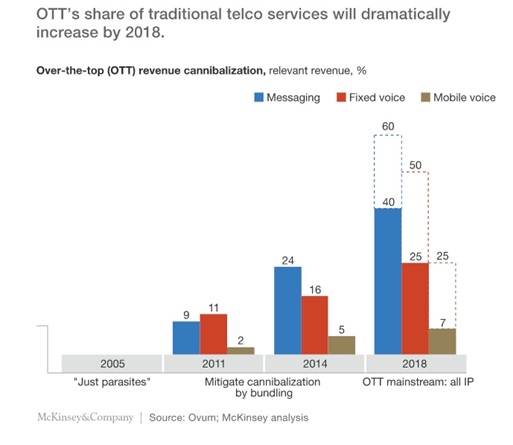
    But when it comes to the telecom world, going digital is more of a catchup rather than a race to be a pioneer. A lot of non-telco players are already digitalized from day one, and that too by using CSP’s platform and customer base. Rise of OTT players and other disruptors have done a significant damage to the traditional voice and text business as well. The consulting leaders such as Ovum and McKinsey predict the success of OTT players in capturing a significant share of telco services.


    OTT's share


    As the number of years ascends, the revenue graph takes an inverse fall and this analysis makes it important for CSPs, who have the best of world resources in the form of capital, customer base, infrastructure and brand name, to start doing things differently by shifting their focal point from just a traditional to a mix of traditional and digital services. Now is the time for the CSPs to take the process of metamorphosis seriously.

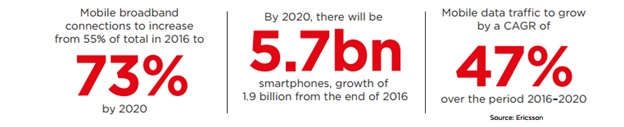
    (Based on GSMA figures,) The period starting from 2016 to 2020 will witness substantial ballooning of the data and connectivity indicating clearly that digitalization is going to play a pivotal role in service providers growth and thus will help in balancing the loss incurred due to reducing revenues from traditional services.


    mobile-broadband-connection


    The transition from communications service provider (CSP) to Digital Service Provider (DSP) cannot be a quarantined approach. It requires partnership with innovators/disruptors to bring in new services and experiences. Confederation of progressive vendors with digitalized vision is indispensable in providing solutions that can support this transition. CSP to DSP transformation approach cannot be concentrated around only new revenue streams. Industry experts have defined DSP as a service provider whose, not only services, but also operations are under the single umbrella of digitalization. One who provides services as well as operations, both digitalized.

    We have a strong view that there are lot other areas which are still left untapped.

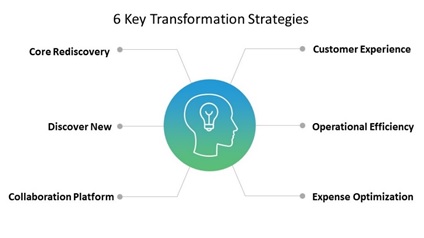
    Looking at the current scenarios, there are 6 key strategies that are listed based on the idea of helping CSPs in increasing their revenues by bringing innovation and creativity in their existing services, acceptance of new technologies, sustaining demanding customer base and reducing operational & transformation expenses. Below is the list of our 6 key digitalization strategies that are recommended for a progressive CSP during its transformation.

    In my next blog I will elaborate on these strategies in detail and discuss how it will help CSPs to transform themselves into DSPs and thus help them to drive the digital economy. Stay tuned!


    transformation-strategies


  • Device Journey Management: the next frontier for Device Assurance

    Device Journey Management: the next frontier for Device Assurance

    In recent years operators have scaled their thinking into hundreds of millions – but not in terms of data volumes, but instead in the numbers of devices now utilizing their networks.  Smart handsets have led the charge of devices, followed (and soon to be surpassed) by IoT devices, and an army of small cells that will serve to densify the upcoming 5G network rollouts around the world.

    Why are these devices capturing more and more operator attention?  With over 1.5 billion smart phones shipped from manufacturers in 2017, the amount of investment by telecom operators just in this device category alone amounts to approximately 20% of their overall operational budget.  However, each year tens of millions of dollars of this opex are being written off as losses by operators due to issues with logistics (forward and reverse), fraud, and process misalignments; device journey oversight doesn’t exist as a discipline today.

    Subex has invested almost two years researching this domain, including talking with operators of all sizes around the world.  What we have found is an expanding set of exploitable gaps that current systems and practices are incapable of closing.  Points of risk exist across internal processes, channel partners, distribution and supply chain, and various other areas leading to (and sometimes even originating from) the end consumers.  These risk points accumulate losses for operators that range between $500K USD to over $10M USD per month, per operator, depending on size of the operator.

    The device growth area today is not only in smart handsets, but also in a wide array of small cells, sensors, and various other categories.  With already significant gaps existing in oversight, this new breed of devices puts an even greater risk on operating budgets.  Under current estimates, deployed IoT devices alone in the next 5 years will exceed 200 billion units, dwarfing the handset counts worldwide.  Can losses be sustained, or even ignored, at these levels?

    Subex will be speaking about a comprehensive strategy and methodology for Device Journey Management during a presentation at the CFCA Winter Conference in Las Vegas on February 6th, 2018.  We will also be at the Mobile World Congress in Barcelona later in February where we look forward to speaking with operators encountering the same problems.

  • Assurance by any other name… reflections on RAG Sydney

    Assurance by any other name… reflections on RAG Sydney

    In my role leading business solution consulting for Subex Network Analytics, I traverse a lot of time zones.  People assume I have sage advice and perhaps an elixir to cure jet lag.  Sadly, I slog through the transitions like everyone else, employing a variety of coping strategies.   I just read about an intriguing approach that some members of the US ski jumping team will use at the Winter Olympics.  They are embracing jet lag, purposefully showing up just days prior to competitions.  Why?  For them, it is best not to think too much as they soar into the abyss.  Being in a foggy state may be an asset for some, but the rest of us still need to find ways to stay on our game as we trot the globe!

    Fortunately, I managed to keep my edge for the Risk and Assurance Group (RAG) conference in Sydney, after traveling 18-time zones to get there.   It was a very worthwhile event, held on the Optus campus, with a good mix of operators and vendor partners.   Anamitra Mukherjee (Optus) delivered the keynote and provided material examples of how his team is challenging the traditional boundaries of RA, branching into areas such as handset assurance and network assurance.  Members of his team, Sujith Dissanayake and Gihan Samarawickrama, provided more insights on handset assurance during their talk later in the conference.   Anamitra explained that Network Assurance enables operators to determine whether they are spending the “right dollars” on the network.  Are there opportunities for cost savings such as harvesting unused assets and redeploying them?   He went on to describe the benefits of reconciling the fixed asset register against the physical network.  Payoffs include better asset visibility, more accurate depreciation schedules and efficient tax strategies.  Calculating the profitability of cell sites is another area his team is exploring.

    From Anamitra’s talk one got the sense that it is time for operators to ask: “Is there more to assurance than RA?”  The consensus at the event was a resounding “yes”.   This was a major topic of discussion.  Eric Priezkalns, one of the event organizers, expands nicely on this theme in his blog post about the event.   Jayne Hunter of Vodafone Hutchison Australia explained that her role has migrated from RA to Margin Assurance.   Darren Rinaldi of Foxtel described how his team performs “entitlement reconciliation” within the broader context of process assurance.   Geoff Ibbett from RRM Solutions chimed in with the importance of contract assurance during a panel discussion.  I could go on but you get the idea…

    To the list of assurances, I joined the party and added device assurance.  Subex is observing that usage-based frauds have been in decline (although IRSF continues to be popular) and there has been a sharp uptick in device and equipment issues.  Device/equipment frauds, thefts, reverse logistics breakdowns, etc. are becoming endemic.   During my talk, I pointed out that such issues are not limited to mobile handsets.  CPEs, set top boxes and even small cells can be considered devices and all have their own risks to mitigate.  To this mix you can add vCPEs and the need to control for excess license costs.

    There certainly is a new world of assurances to contemplate.  In my book, there is only one missing.  Any takers for jet lag assurance?

  • Smart NetEx decisions for improved Capital Efficiency and Customer Experience – Subex Limited

    Smart NetEx decisions for improved Capital Efficiency and Customer Experience – Subex Limited

    There’s an interesting story playing out between U.S. state governments and city municipalities over the expansion of small cells. There is a significant push from the US government to expand small cells installation base and thereby increase the investments in this space. Many operators in the US are more than ever focused on getting the small cells deployment strategy correct as well as get it rapidly implemented.

    Small cells are nothing new. We have been hearing for more than 7 years now, on the potential benefits of microcells – small cells, femtocells, picocells and how they can alleviate the capacity/coverage problems. Only in the last 2 – 3 years, small cells trend has picked up, with the uptick in mobile broadband and massive video consumption.

    Market Reality

    As the need for network capacity is constantly increasing, Telcos cannot afford to wait for long, till new technology standards are completely finalized and hence, it has prompted many prominent big names to announce 5G fixed wireless offering and 5G trails with vendors. In what looks like proactive initiative or in some cases the must-have network features, many Telcos have started to take incremental advantages and gains from 4G LTE-A/LAA with advanced features like Massive MIMO, 256QAM, Carrier aggregation etc. Despite all these, the coverage and capacity problems plague in extremely dense urban settings. Festive events or public aggregation pose challenging problems, especially when the traffic demand becomes quite unpredictable, forcing Telcos to deploy super buffered capacities. For example, look at some few stats related to last year’s Super Bowl at NRG Stadium, Houston. It probably created history of sorts on data transfer –

    • Verizon’s network transmitted 11 terabytes up 57% from the last year
    • AT&T data transmission is 9.8 terabytes, nearly double from the last year
    • Sprint’s network carried 5 TB data transfer
    • Super Bowl Live at Discovery Green the week prior to the Super Bowl, there were 59.9 TB of data, or 171 million social media posts with photos, used on the AT&T network in Houston

    High voltage events like these, are becoming of strategic importance for the operators to keep the network up and for keeping the customer experience top-notch for obvious reasons. Customer perception – the potential brand establishment, is highest during these events. Telcos don’t want to take any sort of chance in such events and thus opt to deploy microcells with high-speed backhaul to support such events.

    There’s another easily relatable trend – the indoor consumption of data is significantly high compared to mobile users, in the ratio of 80:20. This is especially true in urban areas, at homes and offices. Not only capacity is a concern, even coverage becomes challenging in high rise concrete zones. Small cells perfectly fit in this category to improve coverage & capacity to keep up the customer satisfaction. On the contrary, few Telcos operating in the densest telecom market in terms of user density, like in India, where the hotspots, coverage holes become the key decision points for capacity enhancements and optimization, do install new macro cells. In such cases macro cells are cost effective and addresses the issues effectively.

    With 5G, we will see an increasing number of HetNets – small cells operating in tandem with macro cells thus handling offloading, higher throughput, greater coverage and in the process enables superior customer experience. Next evolution of investment planning is moving in the direction to cater to network densification trend.

    Network Investment planning

    Network capacity expansion cycle has shrunk, given the fact that the rate at which the traffic growth forecast exercises are done at every few months. This cycle is going to shrink further, due to dynamics of the data demand on the network, new business models, and technology changes. Network Planners and Capital allocators at CSPs, now require greater insights to address the high impact zones where Capex investment or capacity expansion provides maximum business outcomes.

    Unfortunately, the processes for network investments still carry age old practices in this new paradigm! For instance, in one of our discussions with Telcos in India, we understood the yearly network Capex budget is decided based on competition strength or weakness in various circles (sub-regions) and based on simple extrapolation of traffic forecasts. Once these projections are agreed upon by various internal teams, network planning team go through series of technical negotiations with vendors and orders are placed. Of course, this is high level description of the entire laborious and time-consuming process. But you get the drift – there’s no rigor in understanding the insights that Telco’s own data can throw upon, for better network investments decisions.

    Capital Allocation

    For capital allocators inside Telcos, aka CFO vertical, it is important to understand the optimal use of capital on network investment. Investment in network capacity expansion can be done intelligently, keeping in view of key business metrics like maximizing ARPU, targeting high revenue sites, tackling competition presense etc, which ultimately helps in achieving business goals – maximize revenue, efficient usage of resources (cost center), optimize opex, learn lessons for next capex cycle etc. A data analytics approach reinforces and propagates this methodology of crunching data from various sources, understand the different moving parts and provides decision models and corresponding outcome scores for capital allocators to make appropriate network investment decisions, backed up by data.

    Customer Experience

    In the other end of the spectrum, the network planners and network managers are really focused on customer experience around the existing sites and at times around newly commissioned sites (new investments), to understand the factors impacting the quality of user experience. Some of these factors could be – no services due to coverage holes, poor connections due to capacity hotspots etc. These factors are crucial, as they provide clues about the network coverage or capacity bottlenecks that need to be fine-tuned through further investments or capacity augments.

    Ultimate goals for network teams is to reduce customer churn, keep up customer experience and reduce network downtimes. With advent of newer technologies like 5G, these goals will be stretched due to increased complexity of the networks and super high load demand expected. Network planners are looking for advanced yet locally adpatable solutions to address network investment strategies to meet increasing expectations on great customer experience.

    Conclusion

    Therefore, it has become more important than ever that Telcos need to take a holistic perspective about many factors like the network capacity elasticities, everchanging user demand dynamics, quality of experience, financially lucrative regions, subscriber demographic profiles, marketing expansions, competitive presence and accordingly influence the network investment decisions to maximize both customer delight and achieve business objectives.

    References:

    1. https://www.techrepublic.com/article/super-bowl-51-makes-digital-history-with-record-breaking-data-usage/
    2. https://blog.mobile-network-testing.com/capacity-enhancements/hetnets-small-cells-indoor-deployments/
    3. https://www.telecompetitor.com/indoor-mobile-forecast-six-fold-increase-by-2020/
  • The holistic approach to securing IoT Ecosystems

    The holistic approach to securing IoT Ecosystems

    With the convergence of the physical and digital world, IoT ecosystem is becoming more pervasive and smart. With its “connected” nature, the concept of securing the IoT ecosystem has taken precedence and has today become a necessity. It is no longer a question of “IF” IoT networks will get hacked, It’s “WHEN.”  Organizations should be concerned about what should be done “WHEN” the ecosystem is compromised.

    The blog discusses the various risks the IoT boom poses, and the approached organizations need to adopt to safeguard themselves.

    Read More

    Note: Published with permission from Liveworx

    As a digital service provider, your adoption of Internet of Things (IoT) services presents opportunities as well as challenges. The upside: IoT opens new revenue streams by providing always-connected services to digital subscribers. The downside: IoT exposes subscribers to identity theft and security breaches. Subex provides holistic cyber security to ensure that enterprises are safe from unauthorized access and intrusion across their network.Subex Secure offers comprehensive IoT security coverage from real-time discovery and monitoring to response and recovery. Our solution leverages a one-of-its-kind honeypot network that combines physical devices and device emulations to generate IoT / ICS signatures. Our system evaluates global identity and device breaches and updates the Subex Secure signature repository to safeguard your enterprise from new and emerging IoT threats.

  • Does a Digital Lifestyle offer Operators opportunities, or is the path more ominous?

    Does a Digital Lifestyle offer Operators opportunities, or is the path more ominous?

    It stands to reason that the Digital lifestyle of consumers will dramatically impact how operators generate revenues over the next 10-15 years. Transformations are taking place that will move activities, entertainment, commerce, healthcare, transportation, and most other aspects of our lives into Digital modalities. This has invited thousands of micro-providers of applications and networks into the mix, quickly marginalizing the value of the operator to merely an “enabling pipe.” This puts the operator into a competitive situation, ultimately impacting margins. But that’s only on the revenue side of the equation… the story could become far more complex.

    For an operator, the days of 25%-40% EBIDTA are waning, if not almost gone (in many regions). Pressures on pricing remain downward, with new product offers being the primary method to sustain acceptable revenues and margins. This has opened the door for some impressive creativity by many operators, especially in developing markets. In many cases no market appears off limits, as seen by the offerings by progressive organizations like MTN in Africa: Who would have anticipated an operator would offer personal transportation services rivaling Uber?

    These seemingly odd moves are, in fact, brilliant moves by operators to seek new sources of revenues as their businesses are being redefined by the digital services we are quickly becoming reliant on. The impacts on revenue models due to this change in the business are stunning: Traditional billed services like voice, and even data, are fading in importance. Revenue models are instead focusing more on casual services, pay-per-use services, marketplace services, etc. Put more simply, the “pipe” is no longer where the earning potential lies for the operator.

    So now a previously non-agile, large operator business is finding itself competing with, and in many cases partnering with, literally thousands of aggressive, hungry micro-entities that provide products and services accessed by the networks. There is less reliance on monthly guaranteed revenue; the battle for revenue very often resides in millions of micro-transactions.

    All of the discussion cannot focus entirely on revenues, however. Margins are also sustained by costs. Agility, therefore, must exist on the cost side of the operator business. In the old world of monthly recurring and predictable revenues, costs could be managed and allocated more confidently. Opex and Capex planning and forecasting practices were based on budgeting with a high degree of certainty. But as revenues models are changing, so must cost models. Where possible, operators will need to employ similar creativity to curbing costs, as they are with earning revenues.

    How can operators, therefore, modify cost models in the business to be as aggressive and variable as the revenue models they rely upon? This is where the opportunities for SDN/NFV networks can shave significant costs, while changing operator cost models in ways that were not previously achievable.

    Software-Defined Networks (SDN) and Network Function Virtualization (NFV) will allow operators to provide Network-on-Demand and Service-on-Demand models to consumers, while effectively minimizing, if not eliminating the need for human intervention. The costs associated with truck rolls, call centers, and expensive specialized network equipment will be dramatically reduced, resulting in decreased Opex and Capex burdens on the business. The savings need to expand further, however.

    In current cost models, operators must deploy and maintain network services around the clock, which consumes significant and ongoing expenses. However, if a network is based on SDN/NFV architectures, the deployed services are no longer in a fixed position in the network, simply because they are now software-defined and/or virtualized. This means an intelligent network can move assets where needed, and when needed. These assets are capitalized as licensed instances; so now an operator can have a pool of 1,000 licenses for a virtual service, and deploy them only as necessary.

    This type of dynamic deployment model should allow operators to negotiate dynamic cost models as well; imagine only paying for a license when you have it deployed (and it is generating revenue). While this idea may seem far-fetched, consider that now the network functions we are discussing are no longer controlled by a few network equipment and function providers; micro-entities (application developers) can now produce those functions, often at far less expensive price points.

    The business transformations taking place in operators globally are forcing entirely new ways of addressing margin pressures, as the revenue and cost variables operators have historically used are no longer the same. Looking beyond margins in consumer-facing products and services, new network cost models must be explored, especially since those models were based on what is now an outdated means to earn revenues.

  • The Steady Decline in Operating Cash Flow for Telcos

    The Steady Decline in Operating Cash Flow for Telcos

    How does one gauge the financial performance of a telco?   Earnings growth, commonly measured using EBITDA, is favored by many analysts.  But how much of the story does this metric tell?   For a telco, OIBDA (Operating Income Before Depreciation and Amortization) may be a bit more insightful given that it generally excludes income and financial events outside of the core business.   Of course, there are many secondary metrics that often get attention during earnings calls and we know them well: ARPU, postpaid vs. prepaid mix, subscriber growth & churn, etc.   I’m going to make my case in this space for another metric that should be top-of-mind for executives, corporate boards and analysts: Operating Cash Flow or OCF.

    Let’s start with a key component of OCF which is Capex Intensity.  This is simply the ratio of Capex to Revenue.   Ideally, it should be normalized to exclude one-time significant events like investments in spectrum.   Subex conducted a study of financial results for 44 large tier operators between 2011-2015*.   One of the interesting, if unsurprising, findings is that Capex Intensity has been rising steadily.  Consider the following chart.  In 2011, the average Capex Intensity was 15.9% for the operators in our study.   In 2015 it was 18.9%.   We also have data going back to 2008 which shows an industry average of 13.3%!

    The chart shows Capex Intensity for Americas and Europe are slowly tracking upward.   In 2015, there was a huge spike for the big groups while there was a dip for APAC.  This is largely explained by inclusion of the big Chinese operators (China Mobile, China Telecom and China Unicom) in the “Groups” category provided by Gartner due to their scale.  Capex Intensity for these three was over 38% in 2015 as China scrambles to build out LTE infrastructure for all those folks using WeChat and shopping on Alibaba!

    Now consider the five-year trend for OIBDA.

    Between 2011 and 2015, for the operators in the study, OIBDA margin declined an average of 2.2%

    This brings me back to Operating Cash Flow (OCF).   Anyone who runs a business will tell you that free cash from operations is their most watched number.   I ran a commercial kitchen with 5 employees for several years and, believe me, I lost many nights sleep over our cash position.  Then I got back into telecom.  What was I thinking?  But I digress…

    My argument is that the influence of Capex tends to get buried in financial statements.   Certainly telcos have to invest in networks to fuel subscriber growth and deliver a rich customer experience.  But the trends in Capex Intensity (up) and OIBDA margins (down) are unmistakable and they compound each other.  Take a look at the next chart.

    OCF = (OIBDA – Capex)/Revenue, or equivalently, OIBDA Margin – Capex Intensity.    So it is a fairly complete measure of the operational health of an operator because it considers Revenue, Opex and Capex.  Anything left over can be used for debt service, taxes and dividends.   Between 2011 and 2015, OCF among operators globally fell 5.3%.   This is a significant observation.

    What can reverse the trend?  In the long term, business models that better compete with OTT players is certainly a hot topic of discussion.  Perhaps SDN and NFV will tilt network economics back in the telcos’ favor.   In the near term, it is clear that better Capex governance and controls can at least slow the trend.  Keep in mind that 100% of Capex savings flows to the bottom line, while an incremental dollar of revenue only contributes the margin amount.

    I see these industry numbers as a call to action—managing and reducing Capex should be an imperative at the corporate board level for every telco.   Capex governance includes:

    • Giving commercials and finance teams some of the same visibility to asset utilization as the network teams.
    • Aggressively exploiting cases where assets can be reused before purchasing new
    • Proactively selling off excess assets while they still have value to other telcos
    • Keeping financial and technical records of assets fully aligned
    • Placing better controls on high-risk assets at the edges of the network such as CPE, set top boxes, access points, small cells and handsets

    I’ll close with this observation— while SDN and NFV bring the promise of reducing Capex via virtualization and commoditization, the economics are not yet proven and the transition will take years.  Early adopters of NFV have found, for example, that it may take multiple Virtual Network Functions (VNFs) to replace the same function performed by one instance of legacy software on dedicated hardware.  This erodes Capex savings from virtualization.  The lesson is that exploiting approaches to reduce Capex in the existing network should not get lost when chasing the promise of virtualization.

    If you would like more background on the methodology used for our analysis, and the operators we included, please write to me.

    *Raw financial data supplied by Gartner.  Analysis by Subex.

  • IoT Settlements – Leverage the world of opportunity

    IoT Settlements – Leverage the world of opportunity

    The Scenario

    Of late IoT has gained a lot of attention and every operator is at least thinking of leveraging this latest platform to offer innovative products, but the big question is how?

    Many operators are relying on their vendors to come up with IoT use cases, the challenge here is that even the Vendors are still in process of deep diving as IoT is still a niche market.

    One of the major factor that makes IoT an unknown area is the lack of visible use cases to be seen in our day to day life, though the developed counties have made significant progress, developing world is yet to embrace the “Smart” systems. With lot of emphasis on Smart cities, IoT business is here to stay.

    When it comes to IoT Settlements, both Telcos and Vendors should start thinking out of the traditional wholesale approach. Telcos are looking for vendors who can support them with their traditional as well as new business areas with the centralized solution.

    The Concept

    Understanding “Internet of Things” concept is very simple, it is a network of “Things”. Things are physical objects that can be added to a network, have sensors and can be controlled using software. These things can be as common as day to day devices like a Fridge, a Car, a thermostat and so on. The purpose of connecting ‘things’ is to have a centralized access to their features and to control enormous data they are capable of producing.

    One very obvious fact that can be identified from IoT is to have a medium for keeping things connected. This creates an immense opportunity for telecom operators to provide medium for supporting the connected items. According to Gartner by 2020, the Internet of Things will grow to 26 billion units installed which excludes connected PCs and smartphones. This will add $1.9 trillion to the global economy. Intel estimates 31 billion devices to be connected by 2020. According to Cisco by 2020, 50 billion devices will be connected, whereas Morgan Stanley feels that the number is much higher and it can go up to 75 billion.  The good news is, there is a substantial growth opportunity for everyone, right from smart device manufacturers to the smart service providers everyone can get their share of business from IoT.

    The Process

    Let us consider an example of a smart home. There are multiple interconnected devices which are installed for security, entertainment, utility etc. These are all connected to a centralized hub, which in turn is connected to the IoT platform. IoT platform consumes the data generated by these smart devices for insights and to make sense of this huge data.

    To establish this network of devices connected to hub and IoT Platform, internet is needed. This gap is filled by the Telcos. So bringing in smartness requires lot of partners to work together. Let us enrich above example to get more clear understanding of the multi partner involvement.

    A  leading furniture retailer has introduced a new Smart Home Solution, where consumer can install smart devices such as TV, Fridge, Air conditioner, Washing Machine, Radio, lighting solution, thermostat and security solution. Finally these devices are connected to hub to have a centralized control of the devices.

    A smart Hub ensures all smart devices speak the same language, this enables user to remotely control the devices even if the user is far away from the home. To bring in more intelligence the data gets transmitted from smart devices to the IoT Platform. The IoT platform analyzes the data, apply rules and makes devices more smart based on the usage patterns.

    Finally the most important piece of this setup is facilitated by a Telecom operator to ensure internet connectivity for all the devices to communicate. Telecom operators can also bundle voice and SMS services along with data to take actions based on the defined rules. E.g. in case there is a security breach, device can initiate a call & SMS to the owner and insurance company to inform this breach.

    So in this particular eco system, we have seen multiple partners working together to establish a Smart Home solution.  Similarly there are multi partner IoT use cases for Smart Car Fleet, Smart Healthcare, Smart Grids, etc. In all the IoT use cases irrespective of the catered domain, Telecom Operators and IoT platform vendors will always play a significant role, directly or indirectly they will contribute to billions of dollars in the IoT economy.

    For a Telco, providing backbone is not the only important thing in IoT space. With the complex partnership models, Partner Management, Billing and Settlements are other crucial activities that will result in the Cost and Revenue identification.

    The Solution – Partner Management, Billing & Settlement

    With the cut throat competition and reducing margins in the traditional Wholesale business, operators are adding new dimensions to their business with immense revenue generation capabilities of Internet of Things.

    A new age partner Settlement solution cannot limit its functionalities to just traditional business models. There is a requirement for settlement solutions to be more agile in accepting and delivering new business requirements with short time to market. If we talk about IoT for a Telco, now partners are not limited to Voice or Content providers, rather the list is getting much diversified with partners coming in from various domains like health care, agriculture, utility, etc.

    For a smart home solution, a telecom operator can provide IoT backbone to a furniture retailer , where the Telco will ensure internet connectivity and will enable IoT platform in collaboration with a cloud computing platform. Here the furniture retailer becomes the Telecom operator’s customer and the cloud platform provider is Telco’s vendor.

    Partner Management & Settlement solution deployed at Telco should take care of partner (Customer & Vendor) lifecycle management, easy on-boarding, business transparency along with IoT billing & settlements. Partner Settlement solution should also be capable of managing plethora of Meta data that will be provided by the IoT Platform for billing and Partner analysis. The volume of IoT data can be much more compared to traditional usage data.

    The system should also be capable of providing innovative products and should do billing accordingly. Key point here is to have personalized plans created based on the business need. Some of the products that can be offered as a part of IoT platform are:

    1. Flat Rating – Flat rates for data, call and SMS for each units.
    2. Fixed Charges – Fixed product price for unlimited data, voice & SMS
    3. One time & Recurring Charges – Product to support one time and recurring charge capabilities
    4. Device Based – Charge based on number of devices connected
    5. Slab & Tired based – Data, Voice and SMS to be defined, rates varies based on the slabs & Tiers
    6. Pay-as-you-go – Charge only based on the usage, deduction from Prepaid Balance
    7. Cross Domain Products – IoT clubbed with content or other interactive services

    IoT billing & settlement is not just limited to the Telco and their direct partners, it has to be extended to the associated MVNOs in from of Billing as a service. There can be a multi-level partner involvement as well, say based on the movie genre analysis information available in meta data generated by a Smart TV, a latest movie can be suggested for subscription through an entertainment company , and hence the entertainment company can become 2nd level Advert/Content partner.

    IoT is still evolving, there can be many aspect that are yet to be explored. This is the right time for Telcos, platform and equipment vendors to start investing in IoT to stay ahead of the competition.

    Infographic :

    partner-settlement-solution

  • The Evolution of Internet Protocol

    The Evolution of Internet Protocol

    In traditional interconnect, every telecom operator has domestic and international partners to terminate traffic, or use hub operators to route the traffic to specific destinations using Time-division multiplexing (TDM) circuits. But with full service IP networks coming into the arena, telecommunication operators can provide video, data and voice using the same backbone network structure. Over the next few years the traditional TDM/PSTN and IP would probably continue to coexist. Interconnection in effect also undergoes a transformation here. Interconnection creates end to end service connectivity and interoperability across providers.

    As the industry is transiting into a hybrid model where IP coexists with TDM, the physical infrastructure for call transfer and exchange is undergoing a technological transformation. All new networks are using the IP backbone and this has lesser points of interconnection as compared with the TDM/PSTN network. The need for more bandwidth and to keep up with network trends now, focusing on accurately transport newer types of data, IP is definitely the most cost effective and sustainable solution.

    The current subscriber needs and demands are seamless, ubiquitous connectivity of mobile services everywhere, giving them access to information and social data. And while today the focus is on voice and video, voice is rapidly becoming a part of other bundled packages and offerings.

    The focus of past bilateral agreements between telecom providers were typically based on commercials and volumes with penalty, shortfall or send/pay clauses associated. Settlements happened at a defined frequency where invoices are exchanged, compared and reconciled in cases of disputes. Quality metrics in the traditional interconnect model were parameters like ASR, NER, etc., which sampled/monitored data to derive the call quality and checked periodically for SLA violations and route failures. At this stage, the IP layer was merely handling transport, while the actual services (be it voice, content, OTT, or web based) would be delivered in any combination. With IP related services becoming a predominant offering, it means the understanding of quality, routing and agreements would change dynamically over the next few years and lead to the need of a ‘new’ interconnection model that would be able to handle these level of agreements, charging and settlement. Quality of service for IP now needs to prioritize data security, encryption and protection of information.

    The target being constant connectivity, another challenge in terms of both technology and business is roaming agreements. Initially GPRS roaming required complex agreements between every individual operators and each operator had to maintain dedicated links. GSMA had launched GRX (GPRS Roaming eXchange) technology a few years ago to handle mobile packet delivery and exchange. This started off supporting 2.5G technology and eventually 3G as well. The idea behind this was to ease roaming agreements between GPRS vendors. GRX is typically based on a public IP backbone and used GTP (GPRS Tunneling Protocol) and enabled the GRX operator to act as a hub for the interconnect partners without having direct or dedicated links between them. GRX is making way for IPX (Internet Protocol eXchange) which addresses some of the drawbacks of GRX. Primarily MNOs could leverage the benefits of GRX and this was a model based on best effort, hence QoS, security, acknowledgement were not guaranteed in this method.

    IPX on the other hand, has clear quality parameters like Service Availability, Jitter, Packet Loss and Delay. It also has defined traffic classes: Conversational, Streaming, Interactive and Background Class, so any kind of application has to be clearly mapped to a potential QoS class name, for example: Instant Messaging is Interactive, Video is Streaming while File Transfer is Background. Telecommunication operators with backbone network would look at offering an IPX solution to mobile operators, content providers and aggregators by supporting multiple data, video and voice services. Mobile operators earlier had to rely on multiple platforms for voice and data and can now look at a unified synergy. The target market would look at not only MNOs (Mobile Network Operators), but also MVNOs (Mobile Virtual Network Operators), Content Providers, App Providers, Fixed Line Providers.

    With IPX built on a secure IPVPN network, a lot of the parameters around security and protection would be eliminated, while all kinds of data can traverse through a standard backbone network. Operators need to focus on sustainable revenue models. A strong settlement and assurance system would be critical in this play to understand the packetized data structure and price based on the CoS (Class of Service).

  • Should you still be “keeping your eye on the ball”?

    Should you still be “keeping your eye on the ball”?

    In almost every major sports analogy where a ball is used, the coach is always telling players to “keep their eye on the ball.” In baseball this is obviously critical. Certainly the same holds true in cricket. Other sports rely on this fundamental as well; the ball is the player’s universe. Without keeping your eye on that ball scoring doesn’t happen, and victories escape our favorite teams.
    In the world of Revenue Management the same analogy has been applied to those charged with protecting revenues. “Keep your eye on the money.” We’ve all received our marching orders to monitor and protect the revenue process, from where value is generated, billed, and ultimately collected.
    What has inevitably happened, however, is an ever-growing expansion of what was originally a relatively simple carrier business model. Consider this maturing timeline for most operators over the years:

    • Risk Management (“ERM”) became an embedded factor in enterprises as they grew larger
    • Revenue Management soon grew on its own within Risk Management, eventually dominating the ERM program with both Fraud and Revenue teams operating (mostly) autonomously
    • Operator business models have since evolved well beyond the classic voice services that ERM was chartered to monitor, further stressing an already crowded ERM oversight domain

    Suddenly (actually, over the last 20 years), Risk Management programs are finding that there is no longer a single ball to keep their eye on; in fact, there are many. Revenue is now generated from many streams (e.g., product lines), all using different business models. But what makes this even more difficult is the relationships and interdependencies these product lines have with each other – these also need to be monitored for risks and failures. Now ERM can’t simply deploy independent, autonomous teams to track individual streams – the collaboration and sharing of consistent data and resources is now a critical requirement.
    Putting this into context, let’s talk about fictitious Carrier “A” … we’ll call them Rio Hondo Telecom:
    Rio Hondo offers 3G and 4G mobile services. They also operate as an ILEC (Independent Local Exchange Carrier), so they have invested in a great deal in underground plant, in the form of both copper and cable, to serve the majority of their 1 million customers. Through that plant they offer fixed line telephony, broadband, and video broadcast services to consumers, and high-speed business service packages to enterprises. Unfortunately, they have no last mile access to 15% of their enterprise customers, and 10% of their standard consumer customer base is too far away to receive broadband and broadcast services. Therefore, Rio Hondo has formed several partnerships with other operators to round out their service offering to those outlying customers. They started carrying services 65 years ago…and their ERM teams formed in the early 1980’s. They have limited Fraud and Revenue controls in place, yet their business models have grown well beyond what they can easily monitor for risks. Where should their ERM teams be focusing their resources? Candidates must include both revenue generation and revenue support functions, among others.

    1. Revenue generations functions:
      a. Event creation, mediation, and billing
      b. Recurring charge integrity
      c. Retail sales of equipment and services
    2. Revenue support functions:
      a. Retail and call center provisioning operations, and change requests
      b. Order integrity and fall-out management – critical for bundled service delivery
      c. Capturing of traded/returned equipment, including tracking to warehouse receipt
      d. Chargeback management, merchant charging integrity
    3. Cost and other support functions:
      a. Service call management and charging
      b. CPE and inventory assurance
      c. Commissioning integrity
      d. Partner services delivered as ordered, billed appropriately

    This operator example is not uncommon, and certainly something that we have successfully worked with operators to manage for much of the last 16 years. What has been learned over this time that ERM can’t just keep their eyes on the “business model complexity” ball; now ERM must also keep their eyes on every ball that deals with product, service, and support inter-dependencies that now dominate the carrier business landscape.
    This is the foundation that drove the birth of the ROC from Subex. First envisioned over a decade ago, the latest generation of ROC3 products fully support the monitoring and instrumentation of every facet of Revenue, Cost, Fraud, and Network Asset protection within the operator’s business…all from a single, integrated architecture. With ROC3, operators can not only keep their eyes on as many balls as their business can throw at them, they can easily manage which ones to catch, and which ones to hit “out of the park!”