Author: admin

  • The legacy network is dead, long live the legacy network!

    The legacy network is dead, long live the legacy network!

    I was recently asked by a Tier 1 client in North America if Subex can use our network discovery technology to retrieve information from D4 channel banks.  I honestly had not crossed paths with these relics of the voice network since my days doing central office engineering in the late 80’s.  So you may be wondering, in a day-and-age when the buzz is about SDN/NFV, IoT and everything in the “Cloud”, why is someone worried about the humble channel bank?

    As it turns out, there’s plenty to worry about.  End-of-life technology can be a significant Opex drain.  Operators incur costs for energy (power, HVAC), maintenance and real estate to keep such equipment in place.  Compounding the problem is that much of this old equipment typically sits racked, stacked and powered… and idle (no traffic).   Channel banks are just one example.  Arguably, the entire fixed-line TDM network is retirement-age (I’m talking about SONET/SDH DACs and ADMs, voice switches, local loop equipment, etc.) and needs to yield to IP/MPLS and VoIP.

    In a previous blog post, I wrote about what operators need to consider when planning a transformation from legacy technologies to future state.   For this post, I will stay grounded in the present and focus on this question: What strategies can operators employ to reduce their Opex and Capex burdens when operating a legacy network?   For starters:

    • Use network discovery techniques to determine the operational status of your actively deployed network assets.
    • For all unutilized assets, apply a deliberate strategy to disposition everything.  Too often, because operators don’t have adequate visibility to operational status and utilization of assets in the legacy network, they default to what I call a “rust-in-place” strategy.  Since they lack the visibility, they ignore the problem.  Equipment sits idle or underutilized and costs add up.  My suggestion is to proceed with purpose—if an asset is carrying adequate revenue-producing traffic, fine.  If not, do something about it!

    For assets with reuse potential, then the options include:

    • Harvest and reuse elsewhere in the network.  Benefit: Avoid Capex for new purchases.
    • Perform grooms to more densely pack some assets and free up others for reuse or end-of-life monetization.
    • Allocate as spare.  Benefits: Reduced maintenance costs when spares are optimized in terms of count and location.   Customer experience is improved and exposure to SLA penalties is reduced when spares are well managed.

    If there is no reuse potential, then consider:

    • Reselling on the secondary market if there is still industry demand for the asset.
    • If not, then recover and sell for salvage value.
    • In both cases, remember that the NPV of averted monthly energy and real estate costs may actually exceed any direct cash received when the asset is sold or salvaged.
    • Don’t overlook other possible financial benefits from disposing unneeded assets such as tax write-offs and reduced insurance premiums.

    Most importantly, seek an asset management and logistics partner who can help you squeeze the most value from legacy assets.  Elements of a legacy network cost reduction program include:

    • Automated audits via network discovery
    • Asset evaluation and disposition recommendations
    • Capacity utilization trending and related analytics
    • Asset tracking
    • Turnkey asset recovery services
    • Resale valuation and brokerage services
    • Eco-friendly recycling
    • Analytics for sparing level optimization
    • Spares management
    • Warehousing and related logistics services
    • Warranty and annual maintenance contract management
    • Test, repair and engineering services

    Subex provides industry-leading asset management solutions and services.  With our forward and reverse logistics partners around the globe, we can help you to establish a turnkey and highly effective legacy network cost reduction program.

  • Making history in Prague

    Making history in Prague

    One of the most commonly used greeting, Dobrý den, means “Good Day” in Czech. Coincidentally, we at Subex believe this to be an apt indicator of things to come at the 12th Subex Annual User conference, happening in the magical city of Prague. In a city famous for its spectacular architecture and scenic beauty, we at Subex feel excited about the ground-breaking sessions planned for our esteemed guests.

    In the past year we, both operators and partners, have seen the rise of new threats and hidden opportunities. We have seen margins getting further squeezed by the nimble tactics of OTT players, and conversely we have also seen some operators take bold new steps to capitalize new technologies. We have seen the magic of LTE establish the foundation of our collective next steps in the telecommunications industry, both in terms of defining the new business ecosystems which would evolve, as well as how and what services we would deliver. In a way, we are going back to basics – observe, study, understand and compete.

    Following up on the success of the 2014 User conference, this year Subex is pulling out all the stops in terms of pushing the boundaries of innovation in business optimization. This time around, it’s going to be about looking to the future and preparing for agile transformation today. The day and age of “built to last” solutions might be seeing it’s official sunset. A new era is upon is – The era of “built to change” solutions. When operators are grappling with the vast product possibilities now open to them, it becomes of paramount importance that associated risks can be handled at the pace of business. To help us gaze into the crystal ball, we’ve reached out to industry stalwarts like

    Simon Torrance – Futurist & Senior Advisor on Digital Innovation, Analysys Mason
    Mark Zmigrodski – Manager Fraud Investigations at AT&T & Director – CFCA
    Mike Willet – Executive Director at Ernst & Young
    Paul Fedarb – Head of GTM UK Billing & Collection at BT Group

    My good friend Eric Priezkalns, Co-founder at Commsrisk returns this year as the event’s chairman . Last year his ability to bring the speaker and the audience closer together in meaningful discussion (and debate) ensured that all of us took away the best from all the sessions. Beyond the speaking participants, we have a full roster of industry leaders and active voices in the risk & assurance community like Amit Agrawal (Group Director, RAFM at Etisalat), Edward Granillo (Director, TeliaSonera Group-wide RAFM), Pedro Bravo (Revenue Assurance and Credit Scoring Manager at NOS), Ahmed Saleh Benatif (Director of RA at STC) and the list just goes on. In such a rich gathering of domain experts, I for one would expect something fantastic to emerge from the planned sessions. The sessions themselves are keyed towards focused discussions around emerging technologies, evolving risk frameworks and a little bit of magic (by yours truly).

    In keeping with the theme of Prague, Subex also plans to spring a few pleasant surprises for our esteemed customers. Rest assured, we are confident that this would be a User Conference that won’t be soon forgotten. We are looking forward to breaking new ground, and jointly going where no risk management expert has gone before!

  • The Case for Monetizing the Internet of Things

    The Case for Monetizing the Internet of Things

    The Internet of Things. While the discussions around IoT are interesting, in reality what are these “things”? More importantly, why should operators care? On the surface the answer is simple: The IoT world is all about Monitoring, and Machine to Machine explosive use of networks. It’s all about how to plan for the capacity – where to invest, when, and how much is needed to meet the IoT demand? This is the realm where Subex Asset Assurance and Network Analytics platforms help operators plan, procure, and place assets to quickly and effectively meet that challenge.

    The Internet of Things, however, goes much deeper than a network optimization discussion. The IoT is ultimately about data. Data about our lives, our spending, our health, the “things” that support us (power, roads, air quality, resource availability, etc.). The value in the IoT is in the collecting and monetizing of that data.

    Imagine the scope of that data, by walking through a day in a life where IoT is engaged. Waking up is now more about an alarm clock. It’s now about a smart home knowing what day of the week it is, and therefore what time you’ll be wanting to wake. It’s about the home knowing what temperature the water heater needs to maintain to support the amount of water you typically need to shower; it’s about knowing which rooms in your home you’ll be using today, and controlling the environment in those rooms at the right time. It’s about anticipating your food consumption…and warning you when those supplies are low. An even smarter home will seek marketing promotions from local grocers, to give you best options for pricing to replace those depleting supplies.

    In this whitepaper we’ll explore the value of IoT data in more depth, as we continue through a day in an IoT engaged life. This data has the ability to steer spend habits, and thus help retailers secure share of wallet. Analytics and Data Sciences are a crucial component in the successful harvesting of IoT data, and any latency in understanding the data will absolutely make the difference in determining who wins the wallet-share competition.

  • Getting Closer to a Reliable FAR

    Getting Closer to a Reliable FAR

    OK finance teams, time to come out of the shadows.  At most operators with whom I have worked, the focus of enterprise data quality efforts has been on optimizing network operations.  Misalignment between the network and data in systems that support planning, provisioning, activation and service assurance adds friction and cost to essential telco processes.  No new insight here.

    Lately I’ve been spending more time with the finance guys.   Despite stereotypes to the contrary, they’re not just number crunchers.  They care about what’s in the network- where it is, how old it is, the condition it’s in, where it’s been, where it’s going and what happens at end of life.  Complicating their lives, the financial database of record for network assets, the Fixed Asset Register (FAR), typically suffers from the same data issues confounding the Ops teams—if not worse.

    Sounds bad, but Finance doesn’t have to worry about delivering or supporting new services.  So what’s the harm?   Based on the earful I’ve received from finance organizations, including a Tier 1 CFO—plenty.  This diagram provides a sampling of corporate functions dependent upon accurate asset records in the FAR:

    Mission Critical Role of the FAR

    Among the potential costs of inaccurate fixed asset records are:

    • Improper calculation of depreciation
    • Failure to identify impaired assets and candidates for accelerated write-downs
    • Overpayment of property taxes
    • Overpayment of insurance premiums
    • Restatement of past financial results
    • Risk of regulatory penalties
    • Exposure to fraud, theft and asset mismanagement cases

    Such issues get corporate board-level attention.  I am aware of several recent cases of poor FAR audit results prompting an operator to launch a FAR cleanup effort or even a full asset management program.

    To their credit, financial reporting analysts I have spoken with are not blind to their data woes—just typically dependent upon compromises and work-arounds.  They often manage as best they can by mining numerous B/OSS’s to cobble together a view of assets across all network layers and asset classes.  Gaps and inaccuracies in this view abound.

    Among the most common methods finance organizations employ to address the situation are manual audits performed on sample sites once or twice a year.   This mostly provides insights on how far off the FAR is from reality.  Generally, such spot audits are too limited and expensive to support systemic and continuous correction of the errant data.

    So how do we achieve a reliable FAR (before the Board takes it up as a crusade)?

    It starts with determining the impact of inaccurate asset records on financial reporting and planning, corporate governance, taxation and regulatory compliance.  Is the exposure minimal and bounded, or are the risks unacceptable?  Assuming the latter, a FAR get-well plan should include:

    • Data acquisition methods for both active and passive network assets that use the network itself as a source versus other systems
    • Comparison of this data to the FAR and reconciliation of errors
    • A permanent mechanism to keep the FAR aligned with the changing network so the data stays clean
    • Commensurate process enhancements and guardrails to reinforce automated approaches—which can never guarantee 100% accuracy on their own

    When tightly aligned with the network, the FAR becomes more than a reporting tool, it can become a strategic enabler for Capex optimization.

  • Big Data and the Zettabyte

    Big Data and the Zettabyte

    The industry buzzwords and focus around Big Data Management are starting to wane in the media, but should it?

    Consider this: In 2015, the internet is expected to carry over a Zettabyte of data for the first time ever. Even more interesting…and alarming…is that by 2020, forecasts are calling for upwards of 35 Zettabytes, per year (!), to be carried. If Big Data were a round of golf, and we as an industry thought we were somewhere around the 2nd or 3rd hole, in reality, we haven’t even purchased our clubs yet.

    For those of you not familiar with a Zettabyte, here is the breakdown:
    1000 Terabytes = Petabyte
    1000 Petabytes = Exabyte
    1000 Exabytes = Zettabyte

    Mobile video data alone has increased over 3500% since 2010; statistics abound for data growth – and they all point to explosive growth continuing. With the advent of 4G, raising data speeds and volumes by an order of magnitude, we now see 5G appearing by 2017 in some markets – again raising the volumes and speeds by yet another order of magnitude. Everything in our lives is being connected. Cars, appliances, our bodies (and embedded equipment to run them, e.g., pacemakers), every shop and street corner (video), and even the air, the water currents, and the space surrounding our immediate planet, are all feeding data in increasing volumes and depths into our collective networks. What does this mean?

    It means, quite simply, that we haven’t even begun to understand what Big Data is and how it will impact us. It also means that the communications industry, and the backbone it supports, has a long way to go (as the default host for much of this data) to be prepared.

  • Capex Optimization:  A strategy for growth, or defense?

    Capex Optimization: A strategy for growth, or defense?

    The battle is heating up and speeding up in virtually every market. Customers want the newest, latest, greatest handsets, products, and services.  But how long has this battle been heating up, really?  The answer is simple:  Since the 1980’s.  All that has continued to change are the tools used by the operators in the battle.  Let’s examine the latest tools being used in the Americas and understand how that impacts Capex.  The results may be surprising:

    In what is arguably the start of the latest rounds of “artillery”, T-Mobile launched free roaming to over 100 countries in 2013, and started attracting customers by the millions away from the likes of AT&T and Verizon.  After the immediate dust settled and the program was seen to actually be viable, AT&T responded with paying the early termination fees for converting subscribers from T-Mobile.  In the process, flat rate plans with expanded data benefited all of us, as T-Mobile and AT&T both offered non-contract based data allotment increases, for no cost (and in many cases, lower costs) to existing subscribers, to shore up their retention numbers.

    Verizon has taken a more conservative approach, saying they have the largest 4G network, which has caused AT&T to counter with having the fastest 4G network.  Not to be left behind, T-Mobile responded with offering to roll over unused data, and to unleash attractive unlimited plans via their recently acquired MetroPCS brand.

    All the while, Sprint, the last major national carrier in the mix, has been losing market share while “sprinting” to greatly expand their 4G network.  In the recent weeks they have jumped into the market with a very viable message, aimed directly at AT&T and Verizon, to cut subscriber bills in half…literally.  They even took out an ad in the most expensive slot in the world:  The American Super Bowl.  This ad was designed to “apologize” to AT&T and Verizon.

    And now the latest, and perhaps most interesting move, has been the international expansion of some operators into Latin American markets.  The model is simple:  Buy a Latin operator network.  Re-brand it to your internationally known name.  Offer local services that extend all the way into North America.  No roaming or interconnect, and all local calling.  This is a major threat to long-time incumbents in the Latin market, and it’s already happening. Three years ago I was asked what I thought the impact of 4G/LTE would be to the markets.  I made a quite possibly crazy prediction that 4G was going to upset the way we understand roaming and interconnect, simply due to the fact that data, VoIP, and the new products that were going to ride on femtocells and wifi / wimax were going to totally change the playing field.  Could it be that something similar is gathering momentum today?

    What is the common thread in all of these battles in the Americas market(s)?  Quite simply, the operator revenues are not growing, or are not growing at the pace to keep up with Capex spend.  Networks are being extended and evolved not to add revenue, but instead to sustain revenue.  Here’s an example:  In the last 24 months I have moved my entire family to 4G.  My bill decreased.  More data was added to my plan.  My bill again decreased.  I then expanded my home DSL to a 30x increase in speed.  My bill stayed flat.  All of this involved more network capacity and expansion in products and services.  But I was not further monetized…I was just retained.

    Capex optimization, if pursued for growth, could be considered a great goal and something to strive toward.  However, if Capex optimization is pursued to simply maintain your revenues (and market share), this should no longer be considered a goal, but instead a critical strategy for longer term survival.

    So ultimately, how do operators monetize networks?  Perhaps the question needs to be focused on monetizing customers – by turning attention toward strategies that get more share of wallet.  Operators should invest Capex into supporting behavioural shifts in their customers.   Mobile wallet, xBanking, xCommerce, etc, need to be provided as revenue-generating services by the operators, for those customers.  It’s no longer about getting money for network services…it’s now about getting money from supporting a behaviour facilitated by those network services.

  • Using the ROC to re-shape industry big-data usefulness

    Recently I have watched several vendors in our markets talk about Big Data, and the technologies they are supporting to manage that data. What I’m trying to understand in all these announcements, however, is “what does that mean for me, the user?” … or put more directly, “so what?”
    There are great numbers out there. With all the buzz about Exadata and Hadoop being made in the market, operators have reason to take notice of what’s being achieved: 1 billion loaded records per hour; 10x-13x storage savings; 70% decreases in DB license costs… Subex is also seeing similar fantastic numbers, and in many cases we are now benchmarking 40x faster performance that these other vendors’ results. Subex has supported Exadata for some time, is seeing significantly stronger results using Vertica, and will be supporting Hadoop in the coming months (including the Hadoop + Vertica hybrid, which is proving to be the best performing architecture anywhere in the industry). But still the question remains: So what?
    Vendors in our market have continued to allude to the ability to process data faster and save costs. But what else can this increased data power do for you? That should be the question being asked and answered. For this, Subex has strategically employed these new data processing advantages right in the heart of the ROC suite – which now enables our operator customers to not only see those “default” benefits of faster processing (decreased hardware, decreased costs, etc.), but to also extend their business intelligence into other critical business areas (in many cases, real time), including:
    – Customer Experience and propensities to Churn
    – Enterprise Margin analytics
    – Aggressive network and service Time to Exhaustion analytics
    – Service impact “what if” propensities and analysis
    – Distributed fraud support in wholesale parent/child enterprise relationships
    – Deep packet inspection and response for IP fraud detection and cost management
    – Immediate wholesale cost/benefit analysis with carrier trading
    – Analytics insights into root causes underlying specific issues in costs and revenues
    – Preventative security insights to plug loss exposure before it happens
    – Predictive product analytics to understand the internal impact of a product offer
    – Etc.
    These are but some of the areas operators should be looking for answers from within that new data processing capability…not just faster dashboard updates for current processing. Big Data remains useless if you can’t process new insights and intelligence from within its unstructured foundation. By positioning all relevant new performance technology advances into the heart of the ROC suite, every Subex application will benefit from the improved performance, while be positioned to share that data across other ROC solutions in the suite. This strategic approach will ultimately enable operators to model and extract far more critical intelligence for all the questions above, and more!

  • The Capex Snorkel Effect

    The Capex Snorkel Effect

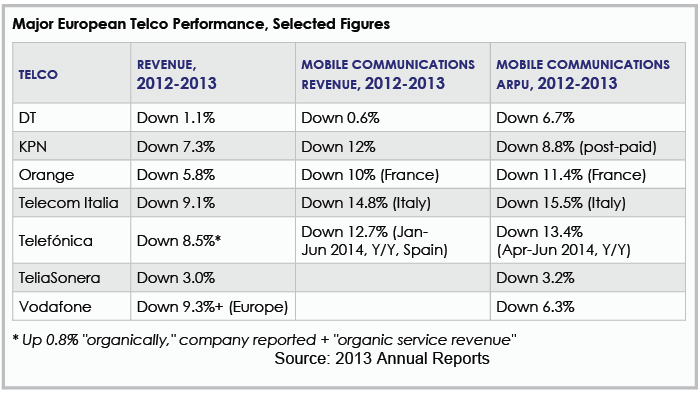
    I just read through an interesting, somewhat validating article from Alex Leslie of Billing Views, talking about operator revenues and margins.  In a nutshell, revenue and ARPU are down across virtually every major operator in Europe, according to their own annual reports, and almost all were down by double digits!

    I can’t help but believe that this is true in other regions as well, and the problem continues to be growing year on year.  Are we surprised?  When I moved my family to a new mobile operator, leaving another after 9 years, we leapt into the 4G world with all new handsets, 10x the speed, 10x the data, unlimited everything else, and our price went down.  Only 6 months later they lowered my plan price yet again, as part of a national retention promotion.  So why should dropping revenues and shrinking margins surprise anyone?

    The fact is they don’t surprise anyone, but they do worry CFOs and Boards, as shrinking (and in some cases, negative) margins are the final result of the trend.

    The trend has to stop at some point…through mergers, spectrum purchases, policy controls, or even government intervention…it has to stop.  But how far will it go beforehand, and how does an operator stay strong in the face of an industry trend that seems (for the moment) unstoppable?

    The answer may be more straight-forward then you think:  Focus on Capex maximization.  Period.  However this doesn’t mean slash budgets – although that is the current tactic in play across the industry.  What it does mean, however, is sweat the maximum efficiency out of your purchases that you can.  Why can programs like Subex Asset Assurance find tens, and now hundreds of millions of dollars in asset recapture opportunities across an operator’s business?  While there are many answers to that question, the fact remains that we are finding massive sums of Capex that operators can recycle right back to the top line.

    Therefore the formula remains, quite possibly, this simple:  Maximizing Capex allows operators to build and transform their networks more completely, quickly, and efficiently, which puts them in a market strength position.  Think of it as having a longer snorkel than your competitors as financial crisis waters are rising…

  • Network Transformations – From Survive to Thrive

    Network Transformations – From Survive to Thrive

    Riding my bicycle near Boulder, Colorado where I live can be a humbling experience.  Not only are there steep climbs and high altitude (over 1600m) to contend with but these are the proving grounds of pro-cyclists and world-class triathletes.  I often feel as though I’m riding a stationary bicycle in a gym as another flash of brightly colored spandex goes whizzing by.  So I decided that it was time to “transform” my ride, and now have a new carbon-fiber bike.  Will this make me faster and more efficient?  Perhaps psychologically!  It’s fitting that transformation has been on my mind in other ways recently.

    Transformation has always been part of the telecom experience.  What is interesting to me now is not simply the pace of change, but the fact that it is occurring on so many fronts concurrently.  For starters, operators are transforming their core networks and related transport services.  Legacy TDM technologies such as PDH and SDH/SONET are being replaced by next generation optical.  To get there, many operators are planning to retire “old iron” ADMs and DACs, reaping not only network efficiencies but tremendous cost savings in real estate exits and lower energy consumption.  In mobility, the transformation experience is not only about the 2G-3G-4G upgrade path but about phasing out the traditional separation of voice and data services.  And of course, the compelling economics of commoditization and virtualization are moving to the network and network functions in the form of SDN and NFV.

    Regardless of the technologies involved, transformation is almost always a messy endeavor.  Among the questions operators need to ask themselves when planning or executing a network transformation are:

    • Do we know enough about how existing services are routed through the network to confidently move them to the new network?
      • Even one customer outage can be costly
    • How do we best realize value from assets we fork-lifted out of the network?
      • What can be redeployed?
      • What can be sold for reuse or scrap?
      • Can we account for every asset that is decommissioned?
    • How do we assure the significant levels of new Capex investment are generating a suitable ROI?
    • What are the unique Opex and Capex risks when operating a “hybrid” network that is in a transition state?
    • What are the plans for legacy B/OSS?  Will they complement and enable the network transformation or serve as a hindrance?

    Riding a bike is certainly easier than transforming a network, so I know my metaphor only goes so far.  However, having worked for many years at operators and experienced such transformations first hand, I know at least one aspect of the metaphor holds.  Falling off a bike and missing business targets for a delayed or failed transformation both hurt!  Fortunately, the Subex Network Analytics portfolio of products is engineered to answer the above questions—and many others—to help ensure a better transformation experience.

  • “A cup of coffee commits one to 40 years of friendship” – Turkish Proverb

    “A cup of coffee commits one to 40 years of friendship” – Turkish Proverb

    Istanbul is a city of seeming contradictions, a confluence of the old and the new.  Scratch slightly beyond the surface and one would be awed by the profound depth of culture and the warmth and hospitality of the Turkish people.  Istanbul has been described as a magical bridge between the east and the west and we can see the diversity to this day in this beautiful city. This is a city which has ingrained the best of all, and became more prosperous for it. I cannot imagine a better place for Subex to host its annual User Conference.

    When we think of user conferences, we think of warm, open spaces. We think of sharing, collaboration and evolution. We think of inclusive growth. All of these are feelings and thoughts I associate with Istanbul. The roster of industry leaders who have so graciously decided to share their time, knowledge and wisdom with all of us is truly humbling. The number of operator registrations this year has been a record high (over 150), and in this we as Subex feel the weight of responsibility to deliver value to our customers.

    Of course, delivering value becomes a significantly easier task when you have esteemed guests like:

    Gerd Leonhard (Futurist, Author, Keynote Speaker, Think-Tank Leader & Strategist)
    Alex Leslie (Publisher & Editor – BillingViews)
    Eric Priezkalns (Co-founder – TalkRA.com)
    Michael Rimkus (Vice President, Internal Audit & Risk Management at T-Mobile US, Inc)
    Dave Huras (President – CFCA and Manager Toll Fraud and Voice Operations – MTS Allstream)

    The best part being that the above is a small part of the overall roster. I for one am very excited to hear from old friends like Amit Agrawal (Group Director – RAFM Etisalat) and Sanjay Batham (GM – Design & Implementation Reliance Jio) about highly relevant topics like the challenges around group RAFM design, advent of 4G and associated challenges, social network analytics, demystifying asset assurance and various other topics.

    It is always a wonderful thing when we get an opportunity to learn from the experiences of others. When I look at the list of topics for this event, I’m glad to note that there is a welcome balance between the lessons of the past as well as a peek into the future. Given that these views are being given by our friends and colleagues in the Telecom world, I am sure that the level of meaningful interaction would be at an all-time high as well. The number of case studies this time around tells me that our telecom friends have been busy at work innovating solutions and are eager to share practical experiences with a larger audience. Much like Istanbul itself, the overall agenda is a rich amalgamation of practical knowledge, challenges and solutions from across the world.

    So here’s to old friends, respected colleagues and industry leaders. If you’ve registered for the meet, let’s catch up for a glass of Türk kahvesi in beautiful Istanbul – and cheer to 40 more years of friendship!