Author: admin

  • Partner Management way forward for CSPs in a digital world

    Partner Management way forward for CSPs in a digital world

    The impact has been profound of the COVID-19 Pandemic on the whole world, especially for customer service providers. The impact was not felt on the revenues as predicted by some analysts; instead, the impact was how these services are provided and the interaction with customers.

    This impact has brought a paradigm shift on what the customer wants, their behavior, and their requirements. The key thing here to understand is the number of revenue streams that have opened. CSPs have started the work towards pivoting these challenging times into opportunities and opportunities into Revenue.

    CSPs are under pressure to innovate to counter the rise in competition. They are now expanding their partner ecosystem to drive cost-effective innovation to improve customer experience.

    However, from a service operations point of view, the pandemic has exposed CSPs, many of which have not invested in software and processes that enable them to change their internal structures smoothly in response to such a massive change in the Partner Ecosystem.

    Despite them understanding the importance of Partner Ecosystem, CSPs are significantly behind in implementing new business models & digital offerings. Following are the challenges which CSPs are facing in curating partner ecosystem, asking more profound questions on CSPs’ capacity to deliver the right technology, skills, and business agility:

    Ability to manage Partner Ecosystem & Relationships

    Selecting the right partners for a CSPs ecosystem by identifying and scoring them on key KPIs so that their ecosystem is profitable also enables CSPs to accelerate innovation, increase agility and lower the operating cost by offsetting pressure from traditional services.

    With the rise in complexity in the partnerships, an end-to-end partner ecosystem management system to the like of Subex’s is the need of the hour.

    Which helps to choose the right partner for a CSPs Ecosystem and end-to-end manages the relationship.

    Having the right technology in place to manage monetization & Contracts across the partner ecosystem

    A converged integrated platform that manages a CSPs B2B billing & settlement for all the LOBs at a single place manages disputes; reconciliation to have high assurance on the revenue is one of the critical requirements.

    Growing Partner Ecosystem and increasing dynamics also asks for a High-quality Contract management solution that analyses, tracks SLA, and maintain contractual integrity for all the partners is another area where CSPs need to work upon.

    The need for a Converged system that does all of this to create a seamless experience of conversation between partners & CSPs will drive the growth that CSPs are aspiring for.

    Why Subex Partner Ecosystem Management?

    Subex Partner Ecosystem Management offers capabilities to Expand business while working with traditional partners and digital disruptors to introduce new-age products and services. Partner Ecosystem Management enables collaboration between communication services providers (CSP) and their partners to manage all aspects, from partner onboarding to billing and dispute settlement, taking care of entire partner lifecycle management through a transparent process.

    Partner Management Way Forward For Csps In A Digital World

    Rise of the API Economy in Forging Dynamic Digital Partnerships

    Download the whitepaper to know more!

  • How to build an ai platform with no code

    No-code AI is a type in the AI application that aims to democratize AI. No-code AI means using a no-code development platform with a visual, code-free and often drag-and-drop interface to deploy AI and machine learning models. No code AI enables non-technical users to quickly classify, analyze data and easily build accurate models to make predictions without business analysts.

    No code AI Platform is the closest to the ideal of “any person without prior training” when it comes to data handling. The increased level of democratization of data to personalized applications has been proven time and time again, the majority of businesses struggle to implement AI to utilize its full potential and scale the use cases to all workflows of the company.

    With each model of ML built for a company, the goals of the unique model of No-code would be to conquer complexities, increase efficiency with automated machine learning, instant visualizations and Auto Feature Engineering which all provide ready results once the AI platform is up and running.

    Here is how to build an AI platform with No-code

    CONNECT :

    Building custom AI solutions requires integrating with an existing data source or uploading your data files in just a few clicks, cleaning data, categorizing, structuring data, training and debugging the model. These take even less time on No-code to enable Auto Data Preparation. Studies claim that low code/ no-code solutions have the potential to reduce the development time up by 90%, so connecting your existing business models and data with point and click interfaces will draw the most benefits once employed.

    BUILD :

    No-code AI platforms allow automation through drag and drop UI. Easy-to-use AI platforms leverage the time/value/knowledge trade-off in a genuinely attractive way and allow customers with no AI coding skills to optimize day-to-day operations and to solve business issues.

    Visual, often drag-and-drop, no-code AI tools make AI easy to operate and build a personalized platform for non-technical people or those who lack the time or resources to build such systems from the ground up. Building the No-code allows skipping training, testing and validating the models that are traditionally required by ML platforms.

    DEPLOY :

    Saving and launching takes just a few clicks and can be instantly applied on web platforms or other applications to start using on your business models.

    COLLABORATE :

    Inviting and corporating relevant data and integrating AI models help the ML make a better prediction and help with accuracy in all applications.

    Besides the ease of starting with No-code, there are some huge advantages to no-code AI:

    • Accessibility: No-code AI allows businesses to make use of AI in the first place and can act as the stepping-stone towards intensified use of data science or AI in the future. The relatively low investment paired with people building up hands-on knowledge of AI tools tackles the biggest obstacles to AI adoption at small and mid-sized companies.
    • Usability: Drag-and-Drop allows anyone in the company to find an AI solution to a problem, and more often than not, in a budget-friendly way. These tools are built primarily with non-technical users and non-developers in mind.
    • Speed: The best type of no-code AI application allow users to iterate through time and help machine code platforms to learn quickly. This allows for more rapid experimentation to see what can be done using one’s data – and getting back to business right afterwards. The simplicity of the process of No-code deployment and intuitive processes help significantly in the launching speed.
    • Quality: No-code tools useful for people who may not have a technical talent group, to begin with. This takes significant work going into the product with defaults and safety measures that need to be carefully chosen on behalf of the user. To further tackle such risks, some AI platforms have human reviews built-in and ask for input when required. This reduces human error marginally when setting up such systems in the first place and allows direct interaction with the platform during daily operations.
    • Scalability: AI itself doesn’t have any drawback to manage a task for a single or a hundred users and neither do servers that are automatically scaled up or down, depending on the load.

    How HyperSense AI Platform works?

    HyperSense AI uses automated machine learning to automate iterative tasks of machine learning model development. It allows data scientists and experts to build ML models with higher scale, productivity, and efficiency while sustaining the model quality. It accelerates the time to get production-ready models with greater ease and efficiency. It also decreases human errors mainly because of manual measures in ML models. It also makes data intelligence accessible to all, enabling both trained and non-trained resources to rapidly build accurate and robust models, thus fostering a decentralized process.

    The quality of a machine learning model is not only based on code but also on the features used for running the model. Around 80% of data scientists’ time goes into creating, training, and testing data. HyperSense AI Studio comes with features to store registered, discovered and used data as a part of an ML pipeline. It enables reusing features for different models driving AI at scale.

    HyperSense AI Studio is built with assisted analytics capabilities, provides users with the ability to build applications with suitable levels of automation and human involvement at any stage of the data science cycle based on task and business requirements. It notifies users while creating a pipeline. It reduces complexity and iterations. These workflows are not a black box, so what happens at each stage can be surfaced to the user in detail, including the results.

    Guided Analytics As many enterprises have started their AI journey and are at different stages of maturity, they require a module that can leverage their existing components in an organization while choosing a specific module suitable to their business needs.

    HyperSense AI Studio is a highly composable data science studio that allows them to integrate with the existing assets in the organization. It can be integrated using various options such as APIs, files, databases, and streaming to achieve modularity and plug-and-play capabilities for quick data collection.

    Composable Architecture Visual Analytics combined with HyperSense AI Studio’s automated ML capabilities provides users with visibility into how the AI system arrives at a decision and how the decision can be improved. Without AI Model Monitoring, sometimes the decisions made can be biased. Visual analytics can reduce these suspicions by providing a fine picture of the decision process. It improves the efficiency of the AI projects and helps to create ML pipelines quickly

    HyperSense AI Studio provides ML operation capabilities that leverage automation to monitor, deploy and govern operations to manage machine learning lifecycle to get better business results. With ML platforms, models can be easily deployed into the production environments. It provides constant monitoring and production diagnostics to improve the performance of existing models. It also shows an AI trust and testing framework that helps to maintain the governance process for AI projects across the entire organization. ML HyperSense AI Studio supports multiple deployment options based on business requirements and priorities. The deployment options are On-premises Cloud or Hybrid.

    Overall, deploying an AI Orchestration platform helps enterprises operationalize AI enabling scalability and growth. Facilitating technologies such as machine learning and AI assists with data preparation, model construction and deployment, insight generation, and insight explanation to augment how enterprises explore and analyze the data for substantial improvements.

    Eliminate AI Model bias with HyperSense AI Studio

    Try Free!

  • Simplifying Contract Management over Blockchain

    Simplifying Contract Management over Blockchain

    With the evolution of 5G, sharing of infrastructure and assets between telecom infrastructure companies and CSPs is the need of the hour. The vast operations cost involved in maintaining infrastructure and assets by CSPs is critical for optimizing and sharing infrastructures resources. CSPs need to get into an agreement with several new vendors and other CSPs as partners to meet the new business expectation. Infrastructure sharing will improve the business experience where competitors become partners to reduce their investments. Infrastructure sharing includes the mast, sites, tower, and many more. Other than this, CSPs also offer services associated with Virtual reality, IoT devices, 5G slices, etc. This requires regular onboarding of new partners to help them offer and deliver these services to the end-users.

    Once a CSPs or vendor gets into an agreement with CSPs to share their assets or provide a service, they need to maintain the contracts, which is currently a manual process or is done using a basic document management system. This data is maintained over excel or an open-source system in most places, leading to delays and errors. Currently, complexity in infrastructure sharing requires follow-up and closure of commercial agreements, which get delayed due to the complexity of negotiating the terms and conditions within timelines, which further delays the onboarding of suppliers and vendors. Due to the current situation, partners’ onboarding is a critical function at the same level as commissioning management, dealer management, tower sharing, etc.

    Due to the absence of standard policies across industries, it’s challenging to keep track of financial transactions, and hence, auditing activities are not transparent. A ready-to-use enterprise solution can be deployed for end-to-end contract management, which will simplify the process by digitally capturing the transactions and transparency in a step-by-step process.

    What is Blockchain?

    • Blockchain is a shared, immutable ledger for recording transactions, tracking assets, and building trust.
    • A decentralized, distributed ledger that stores encrypted blocks of data and chains them together to form a chronological single-source-of-truth for the data

    How can a Blockchain-based end-to-end solution help resolve the above challenges?

    Blockchain is a technology capable of hosting smart contracts that comprise the application logic of the system. Smart contracts can ensure the standardization of templates for contracts and agreements where rich queries reside over an immutable distributed ledger. Moreover, smart contracts will ensure the least manual intervention in contract life cycle processes. These processes include:

    • Template authorization
    • Contract creation & review
    • Contract negotiation
    • Contract approval
    • Contract execution
    • Contract renewal
    • Contract expiry

    How can a decentralized enterprise solution help?

    A decentralized enterprise solution can help to:

    • Productivity
      • Reduce the lead time in contract negotiation and quick onboarding process
      • Digitization and automation lead to a reduction in human resources efforts
    • Efficiency
      • Closure of agreement as per the contractual timelines and real-time tracking of status
      • Capture contract workflow with immutable timestamps, which can be quickly backtracked
      • Implement standard template for contracts via smart contracts
    • Trust
      • Agreement negotiation and T&C get captured digitally
      • Payment, penalty terms, and settlement are captured as per the contract
    • Transparency
      • Any deviation in SLA will be penalized as per the agreed contract automatically
      • Provide real-time reports and dashboard views for operators
      • CSPs, Partners, and regulatory bodies ensure that infrastructure will be shared transparently

    A permissioned blockchain with a decentralized database will simplify the process, help standardize the template, and help in the smooth execution of contract life cycle management. Blockchain will ensure that the productivity, performance, and level of trust are better by making terms and conditions of the contract visible and SLA tracking transparent to all end-users at all times, leading to minimum expenses for dispute settlement. Hence, Blockchain can help overcome the challenges of managing the contract lifecycle through a secured network.

    Download the point of view on Contract Assurance for Content Billing

    Download Now!

  • What is No-Code ML and How to get started?

    What is No-Code ML and How to get started?

    Machine learning and artificial intelligence are two limbs of technology that are quickly evolving and helping businesses run. Today’s businesses rely on updated data and deep insights, which primarily depend on our ability to find and analyze them. In such a case, we need machine learning to learn from this data and give individualized assistance on a large scale to help us make better decisions. However, mastering machine learning tools and deep-diving into data science is time-consuming. This led to the development of No-Code AI!

    With the advancements in ML and AI, both no-code AI platforms and libraries have expanded quite a bit. The limits to using and applying ML models in applications have deterred greatly. Machine learning has become more accessible than ever before as the industry expands.

    In this blog, we introduce you to how No Code AI works, its benefits, and what it can deliver for businesses.

    What exactly is No-code?

    The quick definition would be that it is a bot that can deliver everything AI and ML promise without having to write any code. A no-code development platform is a graphical development interface that allows developers to create portable applications using established templates, pre-built logic models, drag-and-drop application components, links to other constituents, and so on, all without having to code.

    No-code technologies are often aimed at business users, enabling them to easily transform their corporate work-cases into personalized applications without the users having prior coding skills to create applications using no-code.

    No-Code is the future, and here’s why :

    The objective of no-code AI is to help businesses to turn data into actionable information via predictive analytics in minutes rather than weeks or months. Programs can be built from the ground up with end-to-end scalability in mind. From rapid deployment tech to plug-and-play integration, No-Code AI has it all.

    More and more businesses are shifting towards AI and ML hounding the promise of success via AI and rightfully so. By democratizing access to machine learning capabilities across any team, it is easier to optimize the businesses once the tools are properly integrated.

    There is a significant demand for skills and talents in the technology business. No-Code AI would bridge this demand and supply gap by allowing non-programmers to manage the addition of fundamental functionalities, which in turn frees up IT staff to focus their efforts on more challenging tasks or strategies with higher business value. This tradeoff also saves the company valuable time and resources in the long run.

    Managing and maintaining no-code machine learning environments can be done from a single comprehensive dashboard, which empowers IT professionals, to design every app within the boundaries of their organization.

    The Benefits of No-Code AI

    There are diverse advantages of using no-code, given that they are “effortless and suitable.” We’ll go over a bunch of them for you.

    1. Evolve into data-driven business without a data science team

    Because the speed at which an application can be developed is faster and has even become simpler, the IT or Data Science department is no longer flooded with requests. Work that once took months is now completed in hours or days, so putting forth your ideas and work program samples are easier than ever before. In return, No-code AI can deliver a data-driven application that can work for you independently to the data science team.

    2. Deploy machine learning-driven strategies and scale them

    Traditional coding has the drawback of making it difficult to update functionality, especially if the code is written in a language you are unfamiliar with. You can quickly revise the functionality with no-code in only a few hours. With the ever-evolving market, it’s never been easier to utilize No-code ML tools to leverage data directly to drive your product sales or scale your business.

    3. Improve decision-making

    Machine learning appears to most firms to be a sophisticated, pricey, and talent-intensive technology. But in reality, Machine learning platforms can be wonderful efforts without much investment and infrastructure needs, whether the goal is to construct a recommendation engine or a machine learning API to harness your real-time social informatics, ML can help you make better decisions by working faster with data but also develop a visual data information output you can understand quickly.

    4. Eliminate costs while improving profit

    The maintenance of ML and AI was scary not so long ago because of the complexity required in the pre-no-code era. But with No-code ML, even during maintenance, you don’t need a programmer which reduces the costs significantly both in terms of maintaining a data science operator and also the costs that would traditionally be levied to pay for updating the model and keeping the algorithm in check.

    How to get started with No-Code?

    If you decide to get started with machine learning and integrate it into your existing programme, Experience HyperSense No Code AI platform which provides unique combination of automation and customization of machine learning pipelines to help enterprise scale faster.

    In high-load, data-intensive situations, they are not a replacement for specialised ML models. These technologies are only liable for what they are: no-code platforms that allow non-technical users or ML newcomers to quickly adapt to the models and apps.

    It is evident now that the future with No-code Machine Learning at the core will bring great results towards businesses opting to deploy them. The sooner the deployment of ML into the system, the better will be the results from the self-taught algorithm in AI.

    Operationalize Machine Learning models with MLOps

    Learn more

  • Shaken and Stirred: How telecom industry is dealing with Robocalls

    Shaken and Stirred: How telecom industry is dealing with Robocalls

    “While there is no silver bullet in the endless fight against scammers, STIR/SHAKEN will turbo-charge many of the tools we use in our fight against robocalls: from consumer apps and network-level blocking, to enforcement investigations and shutting down the gateways used by international robocall campaigns.” Jessica Rosenworcel, acting Chairwoman, FCC (1)

    Call spoofing is a menace to phone users across the globe. The intention behind these calls varies from simply maximizing the chances that the receiver will pick up the call to being part of a grander fraud scheme to steal identities, financial details, and more.

    Fraudulent robocalls will cost customers US $40 billion in 2022, up from US $31 billion in 2021, according to a study by Juniper Research (2).

    The alarm is officially raised. In March 2020, the US-based Federal Communications Commission (FCC) directed the telecommunications industry to actively and innovatively seek ways to combat robocalling.

    One of the prominent standards to start with is STIR/SHAKEN. Short for “Secure Telephone Identity Revisited” (STIR) and “Signature-based Handling of Asserted information using toKENs” (SHAKEN), the framework provides mechanisms that avert caller ID spoofing. By verifying caller IDs, the framework helps receivers identify that a robocall is, in fact, a robocall versus a legitimate call (3). The deadline for communication service providers to fully implement STIR/SHAKEN was June 2021.

    The secret world of caller spoofing
    Curious about the acronym STIR/SHAKEN? Indeed, it is inspired by secret agent 007, James Bond, who famously prefers his Martinis shaken and not stirred. Since the STIR framework was developed earlier, SHAKEN had to be the obvious choice. Jim McEachern, a senior technology consultant with the ATIS, wittily remarks, “We tortured the English language until we came up with an acronym” (7).

    How can standards help? 

    The STIR/SHAKEN framework uses digital certificates based on common public-key cryptography techniques to ensure that the calling number of a telephone call is secure.

    Those providers that fail to implement STIR/SHAKEN and register themselves in the robocall mitigation database won’t be able to provide domestic voice traffic services (4).

    The protocols themselves reinforce the telco network’s ability to prevent caller ID spoofing. STIR is the actual technology that fights illegal spoofing using digital certificates that cross-check the accuracy and validity of a calling number. SHAKEN guides telcos on how to properly implement STIR technology within their networks.


    The STIR/SHAKEN workflow 

    • The originating telephone service provider receives a SIP INVITE.
    • The call source and the calling number are checked by the originating telephone service provider to determine how to attest to the validity of the calling number.
      • Full Attestation (A) — The service provider has authenticated the calling party, and they are authorized to use the calling number.
      • Partial Attestation (B) — The service provider has authenticated the call origination but cannot verify that the call source is authorized to use the calling number.
      • Gateway Attestation (C) — The service provider has authenticated from where it received the call but cannot authenticate the call source.
    • The originating service provider creates a ‘SIP identity header.’ This notes details like the dialer’s number, the number being dialed, timestamp, attestation type, origination identifier, etc.
    • These two information buckets or digital certificates – the SIP Invite and the SIP Identity header – are sent to the destination service provider that passes it to the verification service.
    • The digital certificates are verified against the public certificate repository through a complex process, after which successful verification deems that the dialing number is not spoofed or illegal.
    • The call is approved for the destination service provider, and the call completes its journey, reaching the final party.

    Shaking up a stir across the globe 

    STIR is a globally accepted standard that can be implemented in any country. On the other hand, SHAKEN is specific for the United States (6).

    America has been enthusiastic about its adoption of STIR/SHAKEN. Verizon, an American telco and one of the largest in the world, implemented the FCC’s industry mandate by March 2019. It has fully upgraded its wireless network to STIR/SHAKEN (5). This move has allowed Verizon to protect more than 78 million customers from over 13 billion spoofed calls!

    By 2021, many other top US mobile carriers followed suit in adopting STIR/SHAKEN, such as AT&T, T-Mobile, and US Cellular (1).

    At the heels of the US, other countries are evaluating the STIR/SHAKEN standards and their effectiveness in combating illegal call spoofing according to their unique needs.

    Take the case of Ofcom, UK’s communications regulator, which plans to fully retire copper lines and adopt VoIP from the PSTN by January 2025 as a step towards implementing STIR/SHAKEN. But since the UK does not have a national telephone number database of assigned numbers, NICC, a UK-based tech forum, has suggested a three-phased approach for transition. Other examples are Canada and France.

    Teething troubles with STIR/SHAKEN

    While STIR/SHAKEN can be lauded for its advantages, it also has shortcomings.

    This is why even though the deadline for implementing STIR/SHAKEN is behind us, completely getting rid of spoofed calls remains an uphill task.

    Here’s why:

    • No compulsion for smaller providers – Small providers having less than 100,000 subscribers are exempt from the FCC mandate; they qualify for a two-year extension. Certain other extensions have also been made for non-IP portions of provider networks, making them the preferred route for scammers now (6).
    • Copper landline wires – Landline phone networks have also not been able to deploy STIR/SHAKEN as copper landlines are unable to support this technology (1).
    • Not applicable on SMS – STIR/SHAKEN applies to only phone calls and not SMS services. Scammers can still bombard millions of unwitting users with illegally spoofed messages over SMS (9).
    • A costly avenue – Implementing STIR/SHAKEN is a costly affair.

    More to be done! 

    Telecom may be far from achieving spoof-free, networks but implementing STIR/SHAKEN standards are a step in the right direction.

    Scammers are quick to adapt to obstacles and are constantly seeking clever ways to bypass stronger security protocols. Nations and legitimate providers must work together to create interoperable standards that weed out the menace of illegal and malicious robocalling.

    Regulators like the FCC must study the effectiveness of STIR/SHAKEN standards, addresses concerns periodically, and find the right tech partners to make implementation seamless and cost-friendly.

    References

    1. https://arstechnica.com/tech-policy/2021/07/us-hits-anti-robocall-milestone-but-annoying-calls-wont-stop-any-time-soon/
    2. https://www.juniperresearch.com/press/robocall-fraud-to-cost-consumers-$40bn
    3. https://www.consumeraffairs.com/news/major-phone-carriers-confirm-theyve-met-the-fccs-mandate-on-robocall-protection-070121.html
    4. https://www.natlawreview.com/article/fcc-reminders-re-stirshaken-and-robocall-mitigation-database
    5. https://www.verizon.com/about/news/over-78-million-verizon-customers-protected-over-13-billion-unwanted-calls
    6. https://www.dwt.com/insights/2020/10/fcc-stir-shaken-robocall-mitigation-plan-deadline
    7. https://www.latimes.com/business/lazarus/la-fi-lazarus-robocalls-fcc-task-force-20170901-story.html

    Combating Robocalls with Multi-Tiered Detection and Prevention Approach

    Download the point of view

  • Top 7 AI and Data Analytics Trends to look forward in 2022

    There’s no doubt that AI and analytics are already changing how businesses operate across different industries- whether through task automation, insight generation, or other use cases. In 2022, it will continue to transform the enterprises in the way they live and work, and leaders will shift their focus to adopting AI solutions that are more sustainable and scalable.

    What 2022 is going to look like for AI and Data Analytics?

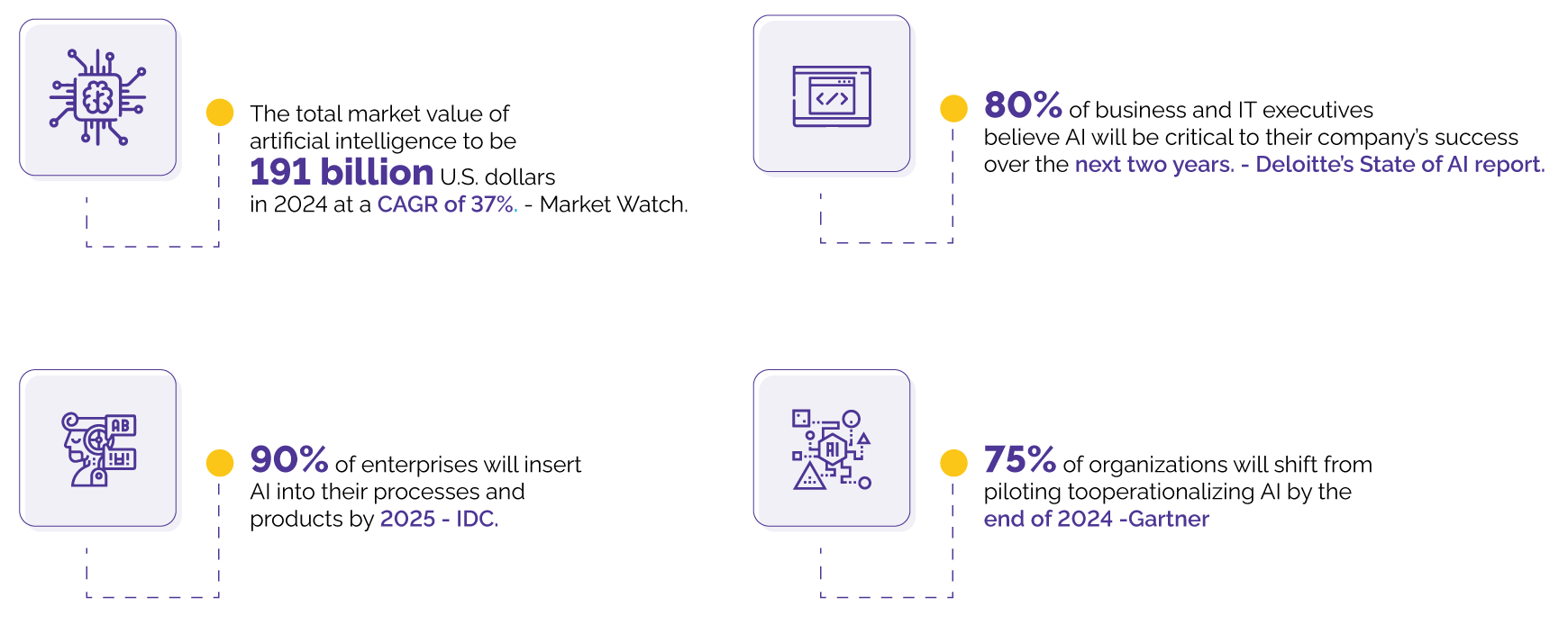
    In 2021, many enterprises saw the adoption of AI in at least one function across major industries. According to McKinsey Global Survey 2021, 57 percent of respondents report AI adoption, up from 45 percent in 2020.

    In 2022, preparation is the key to AI and Analytics success. It may be tempting to push AI into legacy environments as quickly as possible; it would be wiser to adopt a more careful and thoughtful approach. AI is only as good as the data it can access, so shoring up both infrastructure and data management and preparation processes will play a substantial role in adopting future AI-driven initiatives.

    From a technology perspective, there are many discussions around low-code/no-code AI platforms and architectural approaches to analytics, like Data Fabric, composable data, and analytics, workforce augmentation, etc. Let’s look at some interesting statistics for this year.
    Data analysis

    Top AI and Data Analytics trends to keep you on the radar

    Many new developments and breakthroughs will continue to push the boundaries of what’s possible. Here are the key areas where those breakthroughs will occur in 2022:

    #1 Data Fabric will be a key foundation for the enterprise to establish a frictionless data journey

    As the data increases in volume and becomes increasingly complex, and digital business accelerates, data fabric creates an agile and data-centric environment that responds quickly to the fast pace of change. According to Gartner, the data fabric concept enables frictionless access to and sharing data in a distributed data environment. It consists of end-to-end data integration and management solution that unlocks the potential of the data and reduces data to insights journey from any environment- cloud, on-premises, or edge. It reduces the time for integration for design by 30%, deployment by 30%, and maintenance by 70% because the technology designs draw on the ability to use/reuse and combine different data integration styles.

    #2 Composable data and analytics fosters agility

    Enterprises have more than one standard tool for analytics and BI. So, introducing new technology or tool becomes a costly affair. Composable data and analytics use/reuse components from multiple data, analytics, and AI solutions to reduce costs, boost deployment speed, and encourage collaboration. It uses AI across business intelligence, data management, and predictive analytics, evolving the analytics capabilities of an organization and enabling leaders to connect data insights to business actions.

    #3 Improved decision intelligence for enterprise-wide decision support

    Decision intelligence uses emerging technologies such as AI/ML to process large amounts of data to quickly extract meaningful insights for enterprises needed to drive actions for the business. In 2022, decision intelligence has the potential to make assessments not only better, but also faster, given that machine-generated decisions can be processed at speeds that humans cannot achieve.

    #4 Rise of Low-code and No-code technologies

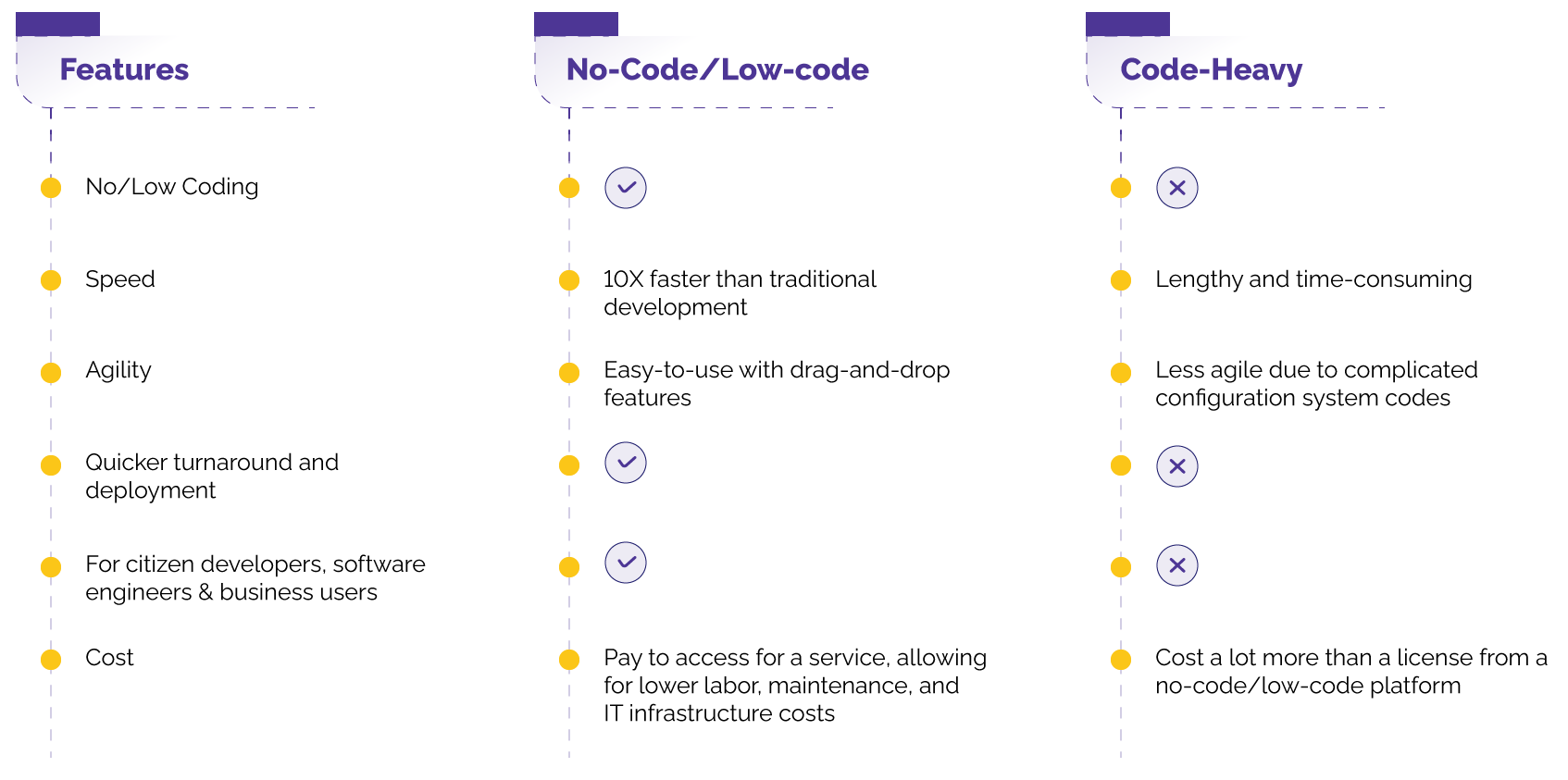
    According to Gartner, by 2023, over 50% of medium to large enterprises will have adopted low-code or no-code as one of their strategic application platforms. Also, it predicts that low-code platforms will be responsible for more than 65% of application development activity by 2024. The low-code and no-code technologies enable businesses to keep up with the rapidly changing technology landscape through innovation and by empowering business users and technical programmers to build applications with little to no coding.

    No-code/Low-code vs. Code-Heavy: What’s the difference?
    Data analysis

    #5 Ethical AI and Ethical Data Analytics become tangible

    As enterprises power AI advancements, the lack of governmental oversights has pushed the debate over the ethics of responsible AI to the fore. In 2022, we will see how ethical AI and ethical data analytics will continue to play a significant part in the simulation of innovation and economic growth, since more organizations will realize the need for responsible tech. Fairness of algorithms and data transparency are issues that will need to be addressed in the coming years as AI adoption is more widespread than ever. It will hopefully work its way towards policymakers as well.

    #6 AI will evolve more rapidly, expanding and impacting every business process

    While in 2021, most of the enterprises were still in the proof-of-concept phase of AI. 2022 will see a shift towards AI-first approaches. AI applications will be at the forefront of enterprise strategies. As AI/ML models become the norm, companies will expand AI to become every part of the department and impact every business process.

    #7 AI will become more widespread and accessible

    Previously in 2021, only big players such as Amazon, Google, Microsoft, etc., had the deep pockets to make AI/ML models a reality. In 2022, there will be more off-the-shelf technology to make AI/ML models more accessible, like readily available functionality to make applications talk, convert speech to text, and other industry-specific use cases. Also, modern workplaces are evolving with AI getting incorporated into their processes. Humans and machines will work alongside each other for quicker results. This creates a great combination of human innovation and machine intelligence.

    In 2022, AI and data analytics will not only be more prevalent but will also be more strategic. It will continue to be used to achieve productivity gains. In the coming years, AI will also be used to rethink and redesign products, services, business models, and overall strategy.

    This year, the challenges of integrating, cleaning, and processing data will continue. However, at the same time, there will be a flood of more generic AI and data-analytics platforms that will help replace manual tasks, freeing up data scientists for strategic tasks. As today’s enterprises strive to be data-driven and demand that the data be most efficient to provide a better experience, more enabling technologies will be available to ease the transition and adoption of AI across the organization.

    Do you agree with the points discussed in the article? If yes, which of the trends do you plan to adopt in your organization? Feel free to let us know your thoughts and comments in the section below if we’ve missed any important points.

    Derive Maximum Value From Your AI Investments

    Request Demo

  • An Introduction to efficient Hypermeter optimization for XGBoost model using Optuna

    An Introduction to efficient Hypermeter optimization for XGBoost model using Optuna

    Efficient Hyperparam

    Introduction :

    Hyperparameter optimization is the science of tuning or choosing the best set of hyperparameters for a learning algorithm. A set of optimal hyperparameter has a big impact on the performance of any machine learning algorithm. It is one of the most time-consuming yet a crucial step in machine learning training pipeline.

    A Machine learning model has two types of tunable parameter :

    • Model parameters
    • Model hyperparameters

    Efficient Hyperparam

    Model parameters vs Model hyperparameters (source)

    Model parameters are learned during the training phase of a model or classifier. For example :

    • coefficients in logistic regression or liner regression
    • weights in an artificial neural network

    Model Hyperparameters are set by user before the model training phase. For example :

    • ‘c’ (regularization strength), ‘penalty’ and ‘solver’ in logistic regression
    • ‘learning rate’, ‘batch size’, ‘number of hidden layers’ etc. in an artificial neural network

    The choice of Machine learning model depends on the dataset, the task in hand i.e. prediction or classification. Each model has its own unique set of hyperparameter and the task of finding the best combination of these parameter is known as hyperparameter optimization.

    For solving hyperparameter optimization problem there are various methods are available. For example :

    • Grid Search
    • Random Search
    • Optuna
    • HyperOpt

    In this post, we will focus on Optuna library which has one of the most accurate and successful hyperparameter optimization strategy.

    Optuna :

    Optuna is an open source hyperparameter optimization (HPO) framework to automate search space of hyperparameter. For finding an optimal set of hyperparameters, Optuna uses Bayesian method. It supports various types of samplers listed below :

    • GridSampler(using grid search)
    • RandomSampler(using random sampling)
    • TPESampler (using Tree-structured Parzen Estimator algorithm)
    • CmaEsSampler ( using CMA-ES algorithm)

    Use of Optuna for hyperparameter optimization is explained using Credit Card Fraud Detection dataset on Kaggle. The problem statement is to classify a credit card transaction fraudulent or genuine(binary classification). This data contains only numerical input variables which are PCA transformation of original features. Due to confidentially issues, the original features and more background information about the data are not available.

    In this case, we have used only a subset of the dataset to speed up the training time and to ensure the two different classes reach a perfectly balance. Here, the sampling method used is TPESampler . A subset of a dataset is shown in the figure below :

    Efficient Hyperparam

    A subset of Credit Card Fraud Detection dataset

    Importing required packages :

    import optuna
    from optuna import Trial, visualization
    from optuna.samplers import TPESampler
    from xgboost import XGBClassifier

    Following are the main steps involved in HPO using Optuna for XGBoost model:

    1. Define Objective Function :
      The first important step is to define an objective function. The objective should be to return a real value which has to minimize or maximize. In our case, we will be training XGBoost model and using the cross-validation score for evaluation. We will be returning this cross-validation score from an objective function which has to be maximized.
    2. Define Hyperparameter Search Space :
      Optuna supports five kind of hyperparameters distribution, which are given as follows :
    • Integer parameter: A uniform distribution on integers.
      n_estimators = trial.suggest_int(‘n_estimators’,100,500)
    • Categorical parameter: A categorical distribution.
      criterion = trial.suggest_categorical(‘criterion’ ,[‘gini’, ‘entropy’])
    • Uniform parameter: A uniform distribution in linear domain.
      subsample = trial.suggest_uniform(‘subsample’ ,0.2,0.8)
    • Discrete-uniform parameter: A discretized uniform distribution in linear domain.
      max_features = trial.suggest_discrete_uniform(‘max_features’, 0.05,1,0.05)
    • Loguniform parameter: A uniform distribution in log domain.
      learning_rate = trial.sugget_loguniform(‘learning_rate’ : 1e-6, 1e-3)

    The below figure shows the objective function and hyperparameter for our example.

    Objective Function

    1. Study Objective :
      We have to understand some important terminologies mentioned in their docs, which will make our work easier. These are given as follows :
    • Trial : A single call of the objective function
    • Study : An optimization session, which is a set of trails
    • Parameter : A variable whose value is to be optimized such as value of “n_estimators”

    The Study object is used to manage optimization process. Method create_study() returns a study object. A study object has useful properties for analyzing the optimization outcome. In method of create_study(), we have to define the direction of objective function i.e. “maximize” or “minimize” and sampler for example TPESampler(). After creating study, we can call Optimize().

    1. Best Trial and Result :
      Once the optimization process completed then we can obtain the best parameters value and the optimal value of the objective function.

    Best trial: score 0.9427118644067797,
    params {‘n_estimators’: 396, ‘max_depth’: 6, ‘reg_alpha’: 3, ‘reg_lambda’: 3, ‘min_child_weight’: 2, ‘gamma’: 0, ‘learning_rate’: 0.09041583301198859, ‘colsample_bytree’: 0.45999999999999996}

    1. Trail History :
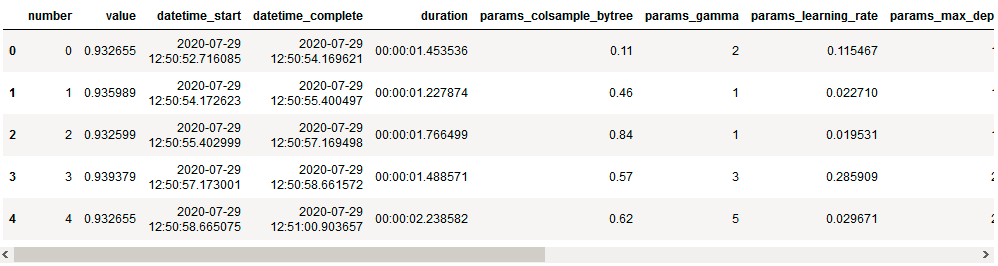
      We can get the entire history of all the trial in the form data frame by just calling study.trails_dataframe().

    Efficient Hyperparam

    1. Visualizations :

    Efficient Hyperparam

    Photo by Isaac Smith on Unsplash

    Visualizing the hyperparameter search space can be very useful. From the visualization, we can gain some useful information on the interaction between parameters and we can see where to search next. The optuna.visualization module includes a set of useful visualizations.

    i) plot_optimization_history(study): plots optimization history of all trials as well as the best score at each point.

    Efficient Hyperparam

    Optimization History Plot

    ii) plot_slice(study): plots the parameter relationship as slice also we can see which part of search space were explored more.

    Efficient Hyperparam

    Slice Plot

    iii) plot_parallel_coordinate(study) : plots the interactive visualization of the high-dimensional parameter relationship in study and scores.

    Efficient Hyperparam

    Parallel Coordinate Plot

    iv) plot_contor(study): plots parameter interactive chart from we can choose which hyperparameter space has to explore.

    Efficient Hyperparam

    Contour Plot

    Overall, Visualizations are Amazing in Optuna !!

    Want to see AI/ML models in action?

    Build your first AI model for Free with our 14-day free trial of HyperSense AI studio

    Get Free Trial

  • Evolution from Interconnect to Partner Management

    Evolution from Interconnect to Partner Management

    What is Interconnect Business?

    Interconnect is a process for telecom operators to handle calls for other operators, thus allowing people using different networks to communicate in domestic and international scenarios. Point of Interconnection connects the physical interface between two telecom operators to connect their customers. If operator A and operator B are not interconnected partners, their customers would not call each other. So, to allow ease of communication, operators get into interconnecting agreements with each other, thus allowing excellent business opportunities for them.

    What is Interconnect Billing System?

    It is a centralized, automated solution that supports multi-party agreements with multiple service providers to use the network and facilitate the traffic routing between multiple networks like circuit-switched networks (e.g., PSTN) or computer networks (e.g., Internet). The traffic flow is regulated through the rules defined by the system’s rules according to the interconnect agreement between the operators. The interconnect billing solution is near real-time processing to allow business optimization and help achieve increased operational efficiency and network profitability. As the business in most of the cases is bidirectional, billing systems perform two essential tasks-

    • Managing Deals or Bilateral Bulk Agreements
    • Partner Settlements –the incoming and outgoing invoices are taken through a net-off process where the net payable or receivables are identified

    Why is there a need for a Partner Management Solution?

    5G is beyond pure connectivity. CSPs need to work with other partners to develop compelling product bundles that provide ancillary services and processes to help enterprises achieve a significant strategic shift. CSPs should use their 5G assets to create value with their partners.

    While doing so, it is essential to acknowledge that partnerships play a critical role in the continued business success of service providers. Enhancing partner profitability is critical to retaining the right partnerships. Low partner profitability due to lack of settlement processes and systems may lead to a loss of invaluable partners, affecting service levels, revenues, and margins.

    Earlier, Voice revenues used to be the bread and butter for every Telco, but the emergence of Internet and OTT services have impacted revenues drastically. Gone are the days when operators entered into interconnecting partnerships only with other telecom operators to share and leverage each other’s network, primarily for Voice traffic and Messaging revenues. The proliferation of smart devices and high-speed internet has completely revolutionized the telecom ecosystem. A sudden rise in the plethora of partner-enabled services has led to a more significant divergence between partner management and interconnection systems. The number of interconnect partners has relatively increased. Still, the nature of partnerships has been relatively the same, which does not stand true for partner settlements where new partnerships are budding up quickly.

    Key differences between Interconnection and Partner Management Solution:

    Interconnect and Settlements

    • It mainly includes systems that record the volume and value of traffic. Primarily related to the rating for voice, data, and messaging
    • Traditional and widely deployed. Almost all mobile operators have some form of interconnection and settlement system in use
    • The revenue model is typically based on the volume of transactions
    • Settlements are mostly related to inter CSP connectivity

    Partner Management

    • It includes systems that enable third-party providers to offer their services to CSP customers and enable CSPs to charge for their service
    • Comparatively new and driven mainly by demand for partner-enabled digital economy services
    • The revenue model is mostly revenue sharing and, in some cases, is tied to product licensing
    • Support complex third-party settlements, subscription, billing, etc

    The wholesale telecom market is expanding aggressively, competition is fierce, margins have dwindled, billions of transactions/events take place which must be rated and charged, and multi-party agreements have become complex leading to a decrease in the quality of service rendered.

    There is a need for a Partner Management system that overcomes all CSP challenges for superior partner relations. This is where Subex Partner Management fits in. It is a convergent platform that offers a 360⁰ view of the evolving telecom ecosystem across Mobility, Content, and Entertainment, 5G for Business, Enterprise, and Internet of Things by providing a nuanced profile of partner agreements based on data such as revenue and margins. It helps in swift partner onboarding, partner self-care, partner assurance, end-to-end revenue visibility, and accessible communication between Telco and its partners. It is designed to co-exist with your legacy systems and manage diverse revenue streams while helping you launch high-value, high-margin services in collaboration with partners.

    From Effective to Cutting-edge: Next Generation Partner Lifecycle Management

    Download the point of view

  • Land record-keeping over blockchain

    Land record-keeping over blockchain

    Being a second populous country and seventh-largest nation globally, Land Record keeping in India is a vast transactional activity where most processes are manual and non-digital. Digital access of records, simplification of the process to bring transparency for buyer-to-seller to-authority, and a tamper-proof ledger are extremely necessary to deal with the increasing numbers of litigation cases.

    The current set-up of land records transactions involves multiple departments like land, revenue, forest, banks, and others as key stakeholders. These numerous stakeholders are involved in the transactions, so keeping track of deadlines and SLAs is difficult and complex, leading to delay in assigning ownership or transfer of ownership, etc. Any errors in the ledger can affect ownership rights. These manual ledgers and paperwork can be easily forged, affecting the ownership and leading to boundary or land litigation disputes.

    In the absence of a will, the partition of property among successors of the deceased owner is again a complex process. Even the validation and verification of forged documents during the process is not an easy task, and it leads to delay due to complexity even it’s not accurate.

    A blockchain-based next-generation end-to-end solution is required to overcome all these issues, ensuring privacy, security, and a tamper-proof platform.

    How can a decentralized blockchain-based solution help overcome the above challenges?

    1. Multiple vital stakeholders can be onboarded on the chain to share the data through smart contracts over the private channel as and when required quickly.
    2. SLA of each stakeholder or department can be tracked easily and made available in a real-time dashboard.
    3. A golden record or ownership database can be maintained, accessible to authorized users over the chain to validate the transactions and records.
    4. This mechanism can identify fake documents by verifying them against the golden database.
    5. Dynamic parameters like ownership, mortgage information, litigation status, property tax details, etc., can be easily derived from a tamper-proof master source.
    6. Any land dispute associated with boundaries can be immediately flagged in real-time.
    7. The sanction of loans against land or property can be facilitated easily and quickly.
    8. The allocation process of new lands or property will be more transparent.
    9. Transfer of ownership can be done over an immutable platform that can quickly be backtracked and remain tamper-proof.
    10. Once land allocation or transfer of ownership is confirmed, it can be approved on distributed ledger where each transaction is signed off with a digital signature, timestamp, and digital key of the user.

    A next-generation E2E solution over blockchain would be digital, decentralized, transparent, and immutable. It could help simplify the land record-keeping process where multiple departments are involved by bringing transparency across the chain by utilizing blockchain’s key features. A tamper-proof distributed ledger among the stakeholders will increase efficiency by improving response time, real-time analysis, and data availability.

    Streamlining partnership through decentralized technology

    Schedule Demo