Author: Payal Paranjape

  • 5 Ways MLOps can Save Your Company Money

    MLOps is a technique that makes use of automated model training techniques across the machine learning pipeline. MLOps is helpful in making the shift from manually running a few ML models to rapidly scaling ML models throughout the whole business process. In this post, we’ll go over some of the major ideas behind how MLOps may improve business workflow and increase revenue.

    What are the Benefits of MLOps?

    Productivity

    All activities in the ML lifecycle are more productive thanks to MLOps because:

    Creation of Automated Model Training Pipelines

    The ML lifecycle involves a lot of labour-intensive and repetitive procedures. For instance, about half of the time that the data scientists spent was preparing the data for the model. Manual data preparation and collecting are ineffective and might produce unsatisfactory results.

    MLOps stands for automating the whole ML model workflow. This includes each step in the modelling process, including data gathering, model construction, testing, retraining, and deployment. MLOps procedures help teams save time and reduce human error. Teams may then focus on activities that bring greater value rather than doing the same thing over and over again.

    Standardizing ML processes for effective teamwork

    Collaboration between IT and business personnel, as well as data scientists and engineers, is necessary for the company-wide adoption of ML models. Businesses can standardise ML operations and establish a shared language for all stakeholders thanks to MLOps principles. This reduces compatibility problems and quickens the overall model generation and deployment process.

    Reproducibility

    Automating ML workflows enables consistency and repeatability in a variety of processes, including the development, testing, and deployment of ML models. Because of this, continually trained models become dynamic and adapt to change:

    • Data versioning: MLOps makes care to save snapshots of various versions of data sets as well as various versions of data that were produced or modified at particular points in time.
    • Versioning the model with several hyperparameters and model types is a method of MLOps that involves establishing feature stores for various types of model characteristics.

    Reliability

    MLOps improves the dependability of ML pipelines by introducing CI/CD concepts from DevOps into the machine learning workflows. Automatic ML lifecycle reduces human error while providing businesses with accurate data and insights.

    Scaling an ML development project from a small model to a large production system is one of the toughest hurdles. For reliable scalability, MLOps simplifies model management procedures.

    Monitorability

    Models drift over time as the environment changes, therefore it is crucial to keep an eye on their behaviour and performance. Businesses may use MLOps to systematically evaluate model performance and get insights by:

    • Constantly retraining the model ML models are kept under surveillance and automatically retrained on a regular basis or following a specific incident. Retraining a model is done to make sure it continually produces the most accurate results.
    • Automated staff notifications in the event of model drift: MLOps provides the company with real-time data and model status updates and notifies the appropriate staff members when the model performance falls below a predetermined threshold. This makes it possible for you to intervene quickly to stop model deterioration.

    Cost Reduction

    Throughout the course of the full machine learning lifecycle, MLOps may drastically save costs:

    • Automation reduces the need for manual management of machine learning models. Employee time will be freed up as a result, and it may be put to better use.
    • It makes it possible for you to methodically identify and minimise mistakes. Reduced model management mistakes will also result in lower expenses.

    How MLOps can Save Your Company Money

    Machine learning operations (MLOps) are a critical component of modern businesses, enabling companies to leverage machine learning (ML) for critical decision-making and process automation. However, MLOps can also be resource-intensive and costly, with many businesses struggling to manage the costs associated with the technology. In this blog post, we will explore 5 ways that MLOps can save your company money while improving operational efficiency.

    Automated ML Model Development

    MLOps automates several tasks involved in ML model development, including data preprocessing, feature engineering, model training, and deployment, reducing the time and resources required for model development. Automated model training using automated machine learning (AutoML) solutions eliminates the need for expensive data scientists, enabling businesses to develop ML models faster and more efficiently.

    Reduction in Manual Labor Costs

    MLOps reduces the need for manual labour, reducing costs associated with hiring and training data scientists, and analysts. MLOps automates low-value and repetitive tasks, freeing staff to focus on high-value tasks, improving productivity and efficiency, and reducing labour costs.

    Improved Model Accuracy and Reduced Errors

    MLOps ensures model accuracy and reduces errors using automated testing and validation tools. By automating the testing process, businesses can identify errors and fix them quickly, reducing the risk of incorrect decisions and associated costs. Improved model accuracy can also reduce the cost of manual interventions required to correct errors in the model.

    Enhanced Resource Utilization

    MLOps optimizes resource allocation and utilization, ensuring efficient and effective use of resources. Businesses can save costs by using fewer infrastructure and computing resources, reducing the need for expensive hardware and software. By optimizing resource utilization, businesses can reduce operational costs and improve overall efficiency.

    Improved Business Agility

    MLOps improves business agility, enabling businesses to respond quickly to changing market conditions and emerging opportunities. Automated model development and deployment enable businesses to react faster and capitalize on market trends, reducing time to market, and increasing revenue. The ability to make data-driven decisions quickly enables businesses to maintain a competitive edge while saving costs associated with delays in decision-making.

    Conclusion

    In conclusion, MLOps can save your company money and improve operational efficiency. By automating tasks involved in ML model development, reducing manual labour costs, improving model accuracy, optimizing resource utilization, and enhancing business agility, businesses can reduce costs and gain a competitive edge. MLOps is an essential tool for businesses looking to leverage ML for critical decision-making and process automation while minimizing costs.

    MLOps: A Guide For Your Enterprise AI Strategy

    Download the Whitepaper!

  • Automating Model Training with MLOps: Best Practices and Strategies

    Preparing the data, analysing it, and then training the model is referred to as the MLOps cycle in the context of the model training pipeline. The MLOps pipeline’s model training is frequently automated using AutoML features built into this iterative or interactive model.

    What is MLOps pipeline automation?

    In an MLOps automated training model, pipeline automation entails the execution of model training continuously, and model retraining is triggered anytime fresh data becomes available. Steps for validating data and models are also included in this degree of automation.

    What is Automated Machine Learning?

    A major change in how businesses of all sizes handle machine learning and data science has been brought about by MLOps Automatic machine learning (AutoML). It takes a lot of time, resources, and effort to apply conventional machine-learning techniques to actual business challenges. It calls for specialists from a variety of fields, including data scientists, who are already among the most in-demand workers.

    By applying methodical operations to unstructured data and choosing models that extract the most pertinent information from the data—often referred to as “the signal in the noise”—automated machine learning alters this and makes it simpler to construct and utilise machine learning models in the real world. Automated machine learning applies the industry’s best practices for machine learning to create a successful MLOps Pipeline and increase data science accessibility throughout the enterprise. refers to the cycle of gathering data, analysing it, and then training an AI model. In order to automate model training across the MLOps pipeline, this iterative or interactive model frequently has AutoML features.

    Why is Automated Machine Learning Important?

    It is a lot to expect of one organisation, much alone one data scientist, to manually build a machine learning model because it is a multi-step process that calls for domain knowledge, mathematical experience, and computer science abilities (provided you can hire and retain one). In addition, there are several potentials for human error and prejudice, which reduces the model’s accuracy and diminishes whatever insights it may provide. Automatic machine learning enables businesses to exploit data scientists’ pre-built expertise without investing time and money in building those skills themselves, increasing the return on investment for data science programmes while shortening the time it takes to realise value.

    Automated machine learning makes it possible for companies in every industry to use machine learning and AI technology, which was previously only accessible to businesses with enormous resources. These industries include healthcare, financial markets, fintech, banking, the public sector, marketing, retail, sports, manufacturing, and more. Automated machine learning enables business users to easily apply machine learning solutions, freeing up an organization’s data scientists to work on more challenging challenges by automating the majority of the modelling processes required to construct and deploy machine learning models.

    What are the steps involved in Automated Model Training?

    Following the establishment of the success criteria and the business use case definition in any MLOps project, the following stages are involved in getting an ML model into production. These actions can be carried out manually or automatically using a pipeline.

    • Extraction of data For the ML work, you choose and incorporate the pertinent data from several data sources.
    • Data analysis: To comprehend the data that is accessible for creating the ML model, you undertake exploratory data analysis (EDA). The results of this method are as follows:
    • Recognizing the data structure and the traits the model anticipates by determining the feature engineering and data preparation required for the model.
    • The data is ready for the ML job after being prepped. Data cleaning, which entails dividing the data into training, validation, and test sets, is a part of this preparation. Also, you incorporate feature engineering and data transformations into the model that completes the intended job. The data split in the ready-to-use format is the step’s output.
    • Model training: Using the given data and numerous techniques, the data scientist trains several ML models. To acquire the best-performing ML model, you also subject the implemented algorithms to hyperparameter adjustment. This phase results in a trained model.
    • Evaluation of the model: The model’s quality is assessed using a holdout test set. A set of measures for evaluating the model’s quality are the result of this stage.
    • Model validation verifies that the model is suitable for deployment and that its prediction performance exceeds a predetermined baseline.
    • Serving the model: To provide predictions, the verified model is delivered to a target environment. There are several possible deployments for this one:
      1. Online forecasts are served via microservices with a REST API.
      2. a mobile or edge device with an integrated model.
      3. a component of the batch prediction system.
    • Model monitoring: To possibly start a new iteration of the ML process, the model’s predicted performance is tracked.

    The degree of automation of these phases determines the ML process’ maturity, which is a reflection of how quickly new models can be trained using new data or with iterative implementations.

    How do you leverage MLOps and the power of automation for model training in 2023?

    The road for today’s data-driven businesses starts with strategic knowledge and implementation of AI/ML. Before beginning the MLOps journey, company executives must assess the organisational infrastructures, goals, and pain areas. Companies can use the step-by-step instructions in the accompanying document to successfully automate MLOps.

    • Using experimental coding to build a practical model: Most of the development and deployment phases of the ML model will initially remain manual after the successful adoption of ML and application to the current use cases. Engineers and data scientists start building the model, which will later be used as a prediction service. The data professionals first manually control script-driven and interactive procedures, evaluating, analysing, and building experimental codes to produce a practical model. At this point, performance evaluation and CI/CD are not given much attention. The use of a trained model as a prediction service is the main topic.
    • Automation of the data pipeline comes into focus as the MLOps journey develops and a model is built. As data collection, analysis, and validation are currently automated, continuous model training leads to continuous delivery. With the scope of implementing their results in the production setting, experiments move more quickly. The unification of DevOps and the modularization of pipelines’ and components’ codes make them repeatable and independent in the runtime environment. Prediction services for new models are continuously delivered since model deployment is automated. The deployed training pipeline as a whole automatically and constantly provides the trained model. Data and model validation, a library of features, metadata management, and ML pipeline triggers are some further elements of this MLOps level.
    • Transforming the pipeline into a production setting: The CI/CD system must be smoothly automated in order for the ML pipeline to be applied to the production environment with dependable and continuous updates. The creation, testing, and deployment of new pipeline components in production may be completed quickly and easily with the help of a lightning-fast and automated CI/CD system that allows data professionals to generate newer ideas about model design, feature development, and hyperparameters. Continuous experimentation with the ML algorithms is made possible by the automated CI/CD of the ML pipeline, which later helps with the creation of source codes. New components are offered through continuous pipeline integration and delivery in the production environment, ensuring newer installations. Automatic triggers aid in putting the pipeline into production and continuously implementing the environment’s taught model. The model’s real-time performance is then tracked, and incremental measures may be performed based on data-driven insights.

    MLOps will be a crucial facilitator of businesses’ future efforts in data analytics. As they work to unlock commercial value at scale, strategic AI/ML initiatives, the hiring of talented and imaginative data scientists and ML engineers, and innovation-mindedness will be fundamental elements of their journeys.

    MLOps: A Guide For Your Enterprise AI Strategy

    Download the Whitepaper!

  • Top 3 challenges to AI adoption and how the barriers are overcome

    Over the past few years, AI has made its way to every boardroom discussion. Be it giants like Google, Netflix, or Amazon or small and medium businesses; everyone has benefitted from AI. While many companies have rolled out successful proofs-of-concept and have even been successful in deploying AI in production, there are still some challenges in adopting AI.

    Accenture’s report reveals that 75% of executives believe they risk going out of business in 5 years if they don’t scale AI. Some organizations have even operationalized their AI and machine learning strategies, with projects proliferating with best practices and pipelines. Today, companies at the leading edge of the AI maturity curve are using AI at scale. While they are making efforts to deploy and scale AI, awareness about the challenges of this journey is also necessary.

    Top 3 challenges to AI adoption

    Challenge #1: Data quality and quantity

    Technologies such as Artificial Intelligence (AI) and Machine Learning (ML) have the potential to help businesses make better use of the massive volumes of data. Still, these techniques depend on the computing power, quality, and quantity of the data provided. Getting consistent and accurate quality and quantity of the data is a challenge, since, there are no commonly accepted and widely adopted standards of data definitions and governance in enterprises.

    Many enterprises are pursuing a range of AI initiatives and modernizing data infrastructure. But current data practices are an issue, as several companies haven’t attained a high level of sophistication with crucial data-related aspects. In fact, many organizations have stopped mid-way when pursuing AI initiatives because the data is not good enough; hence predictions and insights would also be unreliable. Therefore, many companies tend to postpone their AI journey in favor of a data journey before starting the AI leg.

     Solution:

    In order to overcome this challenge, a robust data management strategy, data quality, and governance framework should be in place to ensure that all the data generated in the organization is captured, processed, and stored effectively. Also, the right blend of cloud and traditional data warehouse setup will help organizations achieve optimal performance. There should also be a focus on a forward-looking approach, i.e., on future integrating and scaling of data. It ensures that integrating data from various new sources is not a challenge later.

    Challenge #2: Hiring the talents with AI skills

    One of the major challenges while AI adoption is finding or hiring the right team with AI skills to work with. The right talent is the key to success for any initiative, and the same is true with AI as well. As per a Juniper research survey, 41% of respondents are worried about the training of current employees to operate the AI systems. Also, 32% concentrate on recruiting the already trained talents to cope with it. AI is a far more complex skill to build, and therefore there is certainly a demand and supply gap in the marketplace.

    AI comprises a range of technologies that covers advanced analytics with the ability to predict outcomes, Conversational AI, Natural Language Processing (NLP), Robotic Process Automation (RPA), Deep Learning, etc. The sheer vastness of the technology makes it difficult to find the right talent for both the creation and implementation of an end-to-end AI journey across an organization. Also, AI takes time to evolve and requires constant creative and material investment till it starts maturing and providing a level of acceptable accuracy. Therefore, we need someone with creative brains who can also innovate the use-cases for the technology.

    Solution:

    To address this challenge, an organization needs to build a culture where business teams can think about the use of AI in day-to-day operations. Once this culture is built, the organizations have more champions beyond the innovation group to motivate the rest of the people in the organization to walk the same path.

    Companies will have to invest in the right talent, train internal resources with the right aptitude and the know-how in related technologies, add people to the creative team, and think unconventionally while solving business problems. Also, low-code/no-code AI technologies empower technical and non-technical programmers to become citizen data scientists and build AI applications with little to no coding knowledge.

    Challenge #3: Eliminating Bias and AI Governance

    AI governance means monitoring and evaluating ROI, risk, bias, and effectiveness algorithms. However, while hugely interested in AI adoption, companies are reluctant to build their AI governance strategy. Also, bias in any AI model impairs the possibility of making the right decisions. After seeing positive gains using biased models, businesses might get a false assurance, but the models with biases are not solving the problem they are supposed to solve.

    Solution:

    This usually happens due to the use of datasets that tend to be discriminative against arbitrary groups. So, the datasets used for training, especially evaluating the models, should be balanced so that they don’t reflect real-world biases. Unknown biases still sneak into the systems. To overcome this challenge, strong Quality Assurance (QA) processes are important to have in place. These QA processes should be extended post-integration, too, since data drift and feedback loops after deployment can still bring biases to the system. Also, Explainable AI and Ethical AI capabilities ensure transparency and interpretability in the models with the fair usage of AI. With these capabilities, it helps eliminate biases in the model.

    Getting consistent and accurate data, filling the AI skills gaps, and AI governance might be challenging. So, get ready for a long game, try pilots of your projects before the final run, and set the metrics to measure the progress of AI adoption over time. Simultaneously, it would help businesses monitor and evaluate algorithms that impact the business daily. This is an opportune time to climb this mountain towards AI-powered decisions, step-by-step, with balanced, courageous actions.

    Enhance your customer experience with our AI Orchestration Platform

    Schedule a demo

  • How is Augmented Analytics Transforming Business Intelligence?

    How is Augmented Analytics Transforming Business Intelligence?

    Data is the ultimate means of making excellent decisions, and why not? It helps determine the problems and challenges as they come our way, highlights opportunities, and helps see transformations, so we can work towards the desired goals.

    As data becomes more convoluted with every passing moment, managing it and extracting valuable insights using traditional BI systems is not efficient. Addressing this challenge is Augmented Analytics.

    In this blog, we will see how Augmented Analytics is transforming business intelligence. Additionally, we will also discuss use cases that benefit technology.

    Augmented Analytics

    Gartner, the technology research and consulting corporation, coined the term Augmented Analytics. Augmented Analytics can be expressed as the next step in analytics’ evolution. The technology enables data scientists and business users to use the technology of today, such as artificial intelligence (AI) and machine learning (ML), to find and visualize information from unstructured data.

    Data scientists can employ augmented analytics to analyze data without bias or previous views about how variables in the data are related. It eliminates the necessity for a specialist in the creation and management of advanced analytics models. It allows data scientists and developers to integrate ML/AI into applications that provide data science and machine learning content. Data scientists with evolved skills get better options to dedicate themselves to innovative creation and construct the most relevant models.

    How Does Augmented Analytics Work?

    While comparable to other forms of BI in its analytical workflow, augmented analytics enhances data analysis using ML, NLG, and AI furthermore. Here’s how:

    Data Preparation

    Data preparation is all the work done on data for query and analysis. It includes the collection, filtering, connection, and validation of datasets. And usually, it demands the expertise of developers and data scientists to conduct.

    However, this process can be automated with augmented analytics tools. Data preparation and streamlining integrations of all your data sources can be run through automation systems — including data warehouses, cloud platforms, web service tools, and analytics platforms.

    Once the data (and metadata) has been added to the pipeline, everything from data filtering to dataset unification is done by the automating systems for you. This opens up time constraints for your data scientists, engineers, and developers to focus on creating new analyses to deepen insights.

    Insight Discovery

    Insight discovery is the part of the data analytics process where the algorithm analyzes the data via the curtains of a predefined model to discover answers to questions, such as quarterly revenue or customer acquisition rates. However, since models traditionally have to be developed by data scientists manually, insights can be blind in the specificity of metrics.

    With augmented analytics, insight discovery is both uncomplicated to initiate and thorough. Queries can be set up using natural language and voice inputs rather than hyper-specific keyword entries. Machine learning algorithms can drill through all of your data (no matter how many rows there are) to uncover detailed, targeted insights to find answers to your questions question.

    How Augmented Analytics is transforming Business Intelligence (BI)?

    Using powerful AI and ML algorithms, Augmented Analytics helps businesses reduce their dependence on manual processes and/or data scientists by automating the insight-generating process. It also reduces overlooks and inconsistencies because of human errors while generating insights. However, it is essential to make decisions in such a way as to provide a clear image of the situation, which is crucial for the system to work as intended. Revolutionizing how consumers engage with data, consuming it, and turning insights into action can all be automated.

    Augmented Analytics is changing key phases of Business Intelligence, which are currently still being conducted manually and are prone to human error, as discussed above.

    The automation offered by augmented analytics has transformed traditional business intelligence (BI) into self-serving business intelligence. While traditional BI used to be an uncommon tool that was majorly managed by the IT team, self-serving BI can be operated by business users who are the end-users in most cases.

    The significant disadvantages of traditional BIs are that it requires highly skilled data analysts and has a lengthy time-to-insight period with poorer quality of data compared to augmented analytics. Modern self-serving BI solutions powered by augmented analytics give us user-friendly graphical interfaces that end-users can understand. These solutions can handle an extensive amount of data from multiple unstructured sources quickly and efficiently. Intelligent BI also makes data security, governance, and access control simpler for the entire organization. They also help reduce the involvement of the IT team to manage business analytics.

    Some of the many advantages of using BI powered by augmented analytics include:

    • Deeper data analysis: Analysis of exhaustive data combinations and efficient discoveries of all the factors influencing your business are now possible.
    • Quicker results: Since there is no manual scanning of data, you get quicker results.
    • Better use of resources: When you automate a significant part of your analytics process, more complex and deeper research can now be addressed by your team.
    • Actionable insights: By streamlining the data analytics process, you get access to key insights that can help you make better data-driven decisions.

    Does your organization plan to adopt Augmented Analytics BI in the future? If yes, then how will it benefit an organization. Feel free to share your thoughts in the comments section.

    Learn how augmented analytics can help transform your approach to enterprise AI

    Schedule a demo

  • Top 12 features of Augmented Analytics platform

    Augmented analytics is the future of data and analytics, which is the next big wave of uproar in the market of data. In the future, it will signify as a commanding driver in the field of analytics, Power BI, data science, ML platforms, and embedded analytics. Data scientists and analytics experts should equip themselves to embrace augmented analytics.

    In this era, a huge amount of data is generated daily from multiple sources. To analyze and process the raw data manually is typically a lengthy process that involves complex steps. The first step would be to understand the data as well as requirements. Once the clarity of the strategies in question has been defined, the next task is to build an algorithm or model and at last, evaluate the model.

    Augmented Analytics makes this entire process easier by automating the process of understanding, analyzing data and generating useful insights. It recognizes patterns and displays clear visualizations and trends. This automation is conducted by using Artificial Intelligence, Machine Learning and Natural Language Processing. It is deduced into three sub-categories, i.e., Augmented Data Preparation, Augmented Data Discovery, and Augmented Data Science and Machine Learning.

    • Augmented Data Preparation – It compiles the data preparation process like imputing missing value, data cataloging, time series feature extraction, etc. employing AI and machine learning techniques to the process.
    • Augmented Data Science and ML – It automates the crucial features of analytic modelling, which helps decrease the involvement of experts that generate, operationalize, and manage AI models.
    • Augmented Data Discovery – Augmented Data Discovery employs machine learning to allow findings and visualization of insights as well as results without manual implementation of models or algorithms.
    What are the benefits of Augmented Analytics?

    The straightforward concept behind augmented intelligence is to support human information, speed-up repetitive tasks, and enable businesses to function faster. Let us list a few advantages of augmented analytics

    • Augmented analytics with AI – Currently, augmented analytics with the inclusion of human intelligence and machine learning and AI-enabled data analytics can help to make excellent decisions.
    • Augmented analytics optimizes productivity – It is tedious to do repetitive and time-consuming tasks that require very little attention. With the implementation of AI, those repetitive tasks can be automated thus increasing human productivity.
    • Augmented intelligence can deliver more value – Rather than working hard to do analytics, it is better to develop such an automated system that can do such tasks as data preparation, implementation of ML algorithms, insights monitoring, etc that helps businesses at all levels.

    Here are a few features to look out for in an Augmented Analytics software:

    Feature #1: Augmented Data Preparation

    This feature leverages Machine Learning (ML) automation to augment data profiling and data quality, recognition, modelling, manipulation, enrichment, metadata development, and cataloguing. It includes abilities like automated matching, joining, profiling, tagging and annotating data before data preparation, sensitive attribute recognition, automating repetitive transformations and integrations, data quality and enrichment recommendation.

    Feature #2: Autogenerated and Analyzed Segments or Clusters

    This feature leverages Machine Learning (ML) to find new segments or clusters in a dataset automatically to better process them and help with performance.

    Feature #3: Autogenerated Forecasts or Predictions

    This feature leverages Machine Learning (ML) to create a forecast or prediction automatically providing essential insights into pre-planned strategies and conduction methods in a business.

    Feature #4: Automated Algorithm Selection and Model Tuning

    This feature leverages Machine Learning (ML) to automate selecting the appropriate algorithm to fit a defined use case. It also automatically adjusts the parameters of code to improve accuracy and optimize the predictive model performance.

    Feature #5: Automated Anomaly Alerting

    This feature leverages Machine Learning (ML) to support automated alerting, notification, or proactive collection of anomalies based on modifications of data or detections of black-listed patterns or activities.

    Feature #6: Automated Descriptive Insights

    This feature leverages Machine Learning (ML) to automatically detect and deliver basic insights such as variances, associations, correlations, or trends from a column or dataset. These metrics are typically displayed as concise natural language depictions or sample visualizations.

    Feature #7: Automated Feature Generation or Selection

    This feature leverages Machine Learning (ML) to automatically determine the best types of data or variables to be assigned as part of the predictive model building process.

    Feature #8: Automated Model Monitoring

    This feature leverages Machine Learning (ML) to automate inspecting the performance of models in use to ensure the relationships are still valid, and that the model is functioning well.

    Feature #9: Automated Model Packaging or Deployment

    This feature leverages Machine Learning (ML) to elevate the ease and speed with which the user can transfer models from a development phase to a production phase or embed them into a business model directly. It automates the process of creating APIs or containers that are used for faster deployment.

    Feature #10: Contextualized or Relevant Insights

    This feature leverages Machine Learning (ML) to automate insight generation that merges explicit and/or implicit usage and user feedback data to display the most relevant data required at specific moments.

    Feature #11: Key Driver Analysis

    This feature leverages Machine Learning (ML) to automatically recognise vital key drivers or attributes of a specific metric in a dataset.

    Feature #12: Voice-based Natural Language Search

    This feature offers a voice-based interface to search through the data using natural-language statements in a dataset.

    Business users and executives get excellent value from augmented analytics because of data refinement and deep analysis of strategies, plans, and more. With intelligent operations from augmented analytics integrated into the system without the need for great technical skills or expertise, a quick study of data has never been easier. Augmented analytics helps business users and executives find precise metrics more easily, make relevant inquiries, and instantly uncover insights in the context of their business. While augmented analytics benefits those without deep analytical expertise, it also boosts performance for data prep tasks and more thorough analysis.

    Do you agree with the points mentioned in the blog? Feel free to share your comments if we’ve missed any important points.

    Learn how augmented analytics can help transform your approach to enterprise AI

    Schedule a demo

  • Top challenges faced by modern-day CMOs

    Top challenges faced by modern-day CMOs

    Gone are the days when the life of a CMO was simple, and their focus was mainly on advertising, market research, and brand management. Market research and consumer insight were confined to pre-market testing and evaluation of new products and campaigns, and few market’s feedback in customer preferences. Today the role of a CMO has changed drastically, and he/she is an equal partner in the growth of revenue and enhancing customer experience as any other CXO.

    Interconnected shifts in the technological landscape and consumer behavior are challenging the world’s businesses. Technology is changing everything, and early warning signs have been visible much before the Black Swan event of a pandemic. The pace at which these changes are happening is exciting and frightening at the same time.

    Are you still wondering what 2022 is going to be like for CMOs?

    The role of the Chief Marketing Officer has changed dramatically in recent years. The CMO used to be primarily responsible for marketing strategy, but now they are tasked with much more. Marketing strategy is still a considerable part of their job, but it’s not all they do anymore.

    They need to take on many other roles, such as being an analytical problem solver and understanding how data will affect their future decisions to create an excellent customer experience.

    In 2022, the CMO will have a holistic approach to marketing strategy and adopt new technologies like AI/ML and integrate AI into their workflows.

    As the role of the CMO is changing rapidly as technology advances and the competitive landscape shifts, the challenges faced by CMOs are also growing very fast.

    Top challenges that will constantly come up in a CMO’s radar

    As the changes are happening rapidly in the marketing landscape, CMOs will need to adopt a more holistic viewpoint than just the strategic one. Here are the top challenges encountered by CMOs this year.

    Challenge #1- Accelerated Digital Transformation

    Rapid digital evolution and technology fundamentally transform the way we live our lives. Adaptability is vital for staying afloat. If an organization doesn’t adapt to changing times, competitors will leapfrog them. Adaptability isn’t only crucial for humans, but the technology we use needs to be adaptable. Quick turnaround times, fewer bottlenecks, workflow automation, and integration are mandatory. CMOs must always look for new and innovative ways to stay ahead of the curve. Also, they must continue evaluating new technologies and platforms and experimenting with different marketing channels.

    Challenge #2- Data and data-based insights- mastering metrics in real-time

    The data explosion is one of the biggest challenges marketing teams and organizations have faced in recent times. 90% of the world’s data today has been created alone in the last two years. With the increasing volume, variety, and velocity of data available from various sources, it has become challenging to get a clear picture and meaningful insights from this massive volume of data.

    According to an IBM survey, at least 80% of CMOs still rely on traditional sources of information such as market research and competitive benchmarking to make strategic decisions. Similarly, more than 60% rely on sales trends and campaign analysis.

    It has become tough to analyze these vast data to extract valuable insights in real-time and use these data-driven insights to improve products, services, and customer experience effectively.

    Challenge #3- Owning the customer experience

    Customer experience is another area that CMOs need to focus on to succeed in the future. It’s been predicted that customer experience will overtake price and product as the key brand differentiator.

    According to Accenture, only 25% of brands feel they are behind in terms of customer experience. Traditionally also, companies have had clear silos between marketing, sales, and customer service. In order to be customer-centric, the customer journey needs to be seamless. Today’s CMO is expected to do more than blanket customers with brand awareness and messaging. They need to reengineer the experiences that bring technology and people together in a more human-centric manner to improve and put customer experience first.

    Challenge #4- Delivering Personalization

    CMOs understand that relevance is hugely important. Because when the content is tailored, the audience is more likely to pay attention. When it comes to engaging with content, people now have shorter attention spans than a goldfish.

    Personalization provides the answer to this challenge. According to McKinsey, “Personalization can reduce acquisition costs by as much as 50%, lift revenues by 5 to 15 percent, and increase the efficiency of marketing spend by 10 to 30 percent.”

    Challenge #5- Identifying the right technology

    The proliferation of digital channels across multiple platforms and devices with the increased demands of analytics and insights inevitably result in a much greater need for technology. But identifying the right technological trends and developments is not an easy task in the marketing technology (MarTech) landscape as it is extraordinarily complex. CMO will need to understand the solutions available and identify the right partners to solve these technology-related challenges.

    Challenge #6- Structure and capabilities of the marketing team

    With digital and consumer centricity playing a more prominent role across the marketing and communication mix, finding the right talent to manage this isn’t easy. It is difficult to find, particularly those in the marketing organization who have deep domain knowledge in digital blended with broad business acumen- and having both creative and analytics skills- or, at least, the ability to manage and integrate those with these skills.

    Challenge #7- Leveraging AI and machine learning

    AI is no longer a dream of the future. What you can pragmatically do with AI and machine learning to positively impact your customer experience and marketing is limitless. Let us see how it changes the MarTech landscape and improves customer experience.

    Let’s look at some interesting statistics for this year.

    Top challenges faced by modern-day CMOs

    Seven Roadblocks, One Answer: Artificial Intelligence (AI)

    The answer to the aforementioned challenges is Artificial Intelligence (AI) or AI-based solutions. It helps automate repetitive manual routine tasks and encourages professionals to focus on more strategic and creative tasks. It helps increase efficiency and improve customer experience by providing tailored made offers at the right time to the right customers.

    The rise of AI, machine learning, and automation trends have a significant impact on marketing. AI is used in power marketing activities such as personalization, targeting, and segmentation. And as AI continues to evolve, it will be even more powerful and able to create custom content and analyse a massive amount of customer data from various sources to derive meaningful insights.

    With the rise of AI orchestration platforms in the industry, enterprises are operationalizing AI, enabling scalability, growth, and innovation. AI-based solutions help look beyond traditional customers’ basic demographics, interests, behavior, etc., and help manage end-to-end customer journeys. It helps understand customers’ unique preferences to earn customer loyalty and achieve hyper-personalization using detailed, real-time data and fine-tune offers accordingly to deliver a better and seamless customer experience.

    According to Gartner, 65% of application development will be done on low-code/no-code AI platforms. With its unique low-code/no-code capabilities, it equips anyone in a marketing organization to build AI/ML models in addition to domain knowledge. It helps them build machine learning models without writing a single line of code and helps make faster, better data-driven decisions. It helps enterprises adopt new technologies like AI/ML and quickly integrate AI into their workflows to make data-driven decisions and deliver an excellent customer experience.

    So, how is your marketing team approaching these challenges? Do you think AI and machine learning address all these challenges? If yes, let me know your thoughts in the comments section below.

    Derive Maximum Value From Your AI Investments

    Request Demo

  • AI vs. ML vs. DL: What’s the difference?

    We all have seen AI do amazing things and know what it can do. AI in our everyday life pretty much surrounds us. Recommending movies on Netflix and music on Spotify, navigating roads in Google Maps, controlling smart home devices and speakers using Alexa to cab booking apps like Uber, we use AI to help make our daily lives easier and improve customer experience. AI has offered many different benefits across multiple industries like healthcare, retail, manufacturing, banking, and many more.

    So what is AI? What is ML? What is DL? There are many popular terms around this area, such as Artificial Intelligence, Machine Learning, Deep Learning, Data Science, etc. There has been a lot of confusion around these terms. Knowing and differentiating artificial intelligence (AI) vs. machine learning (ML) vs. deep learning (DL) has now become more critical than ever. Although these terms might be closely related, there are differences between them. See the illustration below.

    AI-vs-ML-vs-DL-Whats-the-difference

    What is Artificial Intelligence (AI)?

    Artificial Intelligence is a broader term that refers to the replication of humans, the way it thinks, work, and function. It has the ability of computers and machines to mimic the human mind’s problem-solving and decision-making capabilities. It anticipates problems and deals with issues as they arise. It performs three cognitive skills just like a human: 

    • logical reasoning
    • learning 
    • self-correction 

    It enhances human performance and augments people’s capabilities.  

    What are the types of AI? 

    AI-based systems fall into four categories: 

    • Reactive AI- These are systems that only react. They respond to identical situations in the same way, every time. They do not learn from past experiences to make decisions. 
    • Limited Memory AI- These systems learn from past experiences and build experiential knowledge by observing actions or data. However, as the name suggests, the referenced information is short-lived, not saved in the long-term memory. 
    • Theory of Mind AI- These systems can understand and remember the emotions of humans, then adjust behavior based on their emotions accordingly and how they affect decision-making. 
    • Self-aware AI– These systems are designed to be aware of themselves. They understand their internal states, predict other people’s emotions, and act accordingly. 

    As AI uses computers and machines to mimic problem-solving, machine learning uses computers to mimic human actions, performs predictions, automation, and make decisions as AI applications. 

    Where is Artificial Intelligence (AI) used? 

    AI is used in different domains to provide insights into user behavior and recommendations based on past data. For example, Google’s predictive search algorithm used past user data to predict what a user would type next in the search bar. The uses of artificial intelligence fall under the data processing category, which includes: 

    • Searching within data and optimizing the search to give the most relevant results 
    • Logic-chains for if-then reasoning that is applied to execute a string of commands based on parameters 
    • Pattern-detection to identify significant patterns in extensive data set for unique insights 
    • Applied probabilistic models for predicting future outcomes 

    What is Machine Learning (ML)? 

    Machine learning is one way to achieve artificial intelligence that uses statistical methods and algorithms. It enables the machines/computers to learn automatically from their previous experiences and data and allows the program to change its behavior accordingly. The ML systems can automatically learn and improve without explicitly being programmed.  

    Why is machine learning important? 

    Machine learning is essential nowadays as it helps to automatically build models quickly and accurately analyze large and complex datasets with access to enormous volume and variety of data and affordability of computational power.  

    There are multiple use cases where machine learning can be applied to cut costs, mitigate risks, and improve the overall quality of life, including recommending products/services, detecting cybersecurity breaches, and enabling self-driving cars. 

    What are the types of machine learning? 

    The three different types of machine learning algorithms are as follows: 

    • Supervised Learning- Uses labeled datasets to train or supervise the model to classify the data and accurately predict outcomes. The model can measure its accuracy and learn over time using labeled inputs and outputs.  
    • Unsupervised Learning- Uses machine learning algorithms to analyze and cluster unlabeled data sets. These algorithms discover hidden patterns in data without the need for human intervention. 
    • Reinforcement Learning- Train machine learning models to find an optimal solution to maximize reward in a particular situation. This algorithm finds the best possible behavior or path to a specific situation. 

    ML provides many different techniques such as Decision trees, Random Forests, Support Vector Machines, K Means Clustering, etc., to make the computer learn. ML models are used in various use cases such as demand forecasting sales of products, predicting customer behavior, gauging customer sentiments from their social media behavior.  

    What is Deep Learning (DL)? 

    Deep learning is a subset of AI and machine learning inspired by the brain’s structure and the function called artificial neural networks. These neural networks attempt to simulate the behavior of the human brain, allowing it to learn from large amounts of data. Deep Learning systems help a machine learning model filter the input data through layers to predict and classify information. While a neural network with a single layer can still make approximate predictions, additional hidden layers can help to optimize and refine for accuracy. It drives many AI applications and services that perform analytical and physical tasks without human intervention and improves automation. 

    How does deep learning work? 

    Deep learning networks learn by discovering intricate structures in the data they experience. By building computational models composed of multiple processing layers, the networks can create multiple levels of abstraction to represent the data. 

    For example, a deep learning model known as a convolutional neural network can be trained using large numbers (as in millions) of images, such as those containing cars. This type of neural network typically learns from the pixels contained in the images it acquires. It can classify groups of pixels that represent a car’s features, with groups of features such as headlights, tyres, and rear mirrors indicating the presence of a car in an image. 

    One of the significant differences between deep learning and machine learning is how data is presented to the machine. Machine learning algorithms usually require structured data (a specific set of features to identify the car in the image). In contrast, deep learning networks work on multiple layers of artificial neural networks (a large number of car images and the system can autonomously learn the features that represent a car). 

    AI-vs-ML-vs-DL-Whats-the-difference

    Where are we with AI today?

    With AI, machine learning, and deep learning techniques, many industries such as manufacturing, fintech, e-commerce and retail, telecom, transportation, etc., try to solve actual problems and get answers in real-time. AI gives you the ability to sift through all your data and make logical connections between past actions and different criteria.

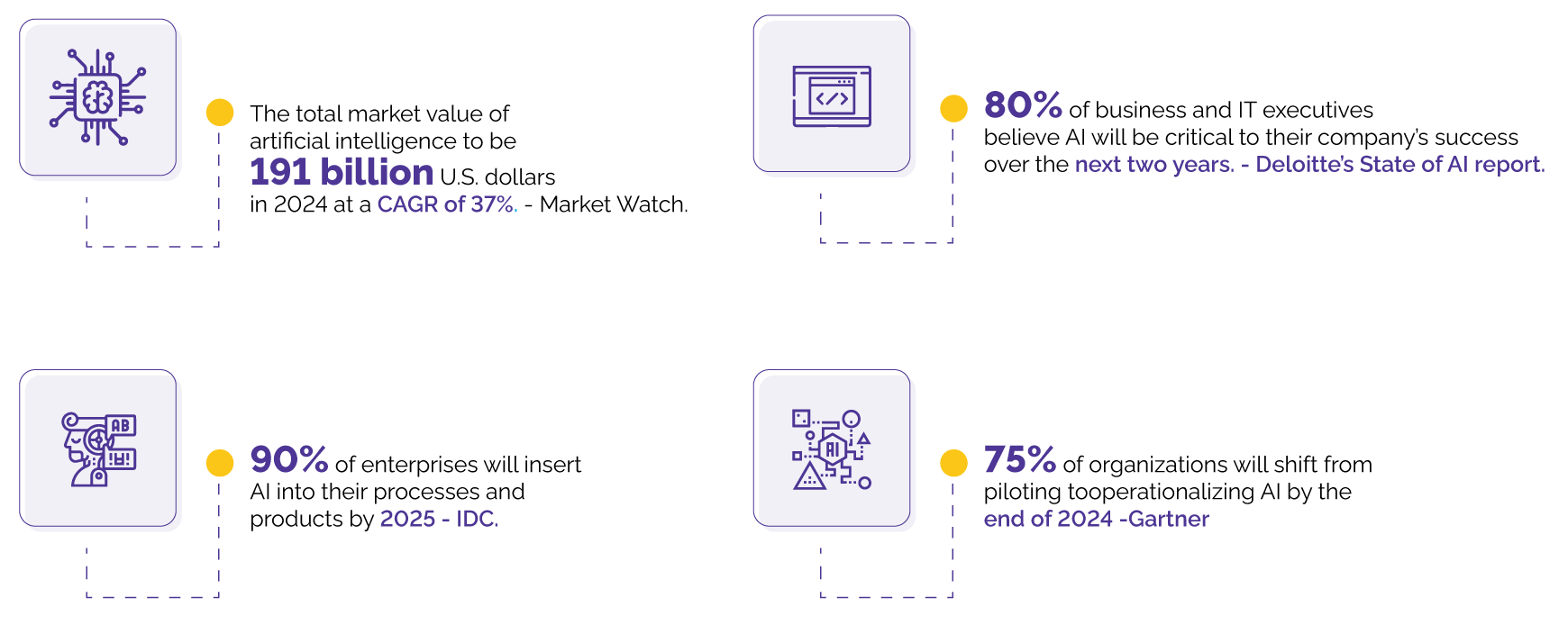
    According to IDC, 90% of enterprises will insert AI into their processes and products. It is also expected that in 2022, traditional businesses will adopt an AI-first approach to platform and digital transformation, says Forrester research. The more AI inside, the more enterprises can shrink the latency between insights, decisions, and results.

    In fact, in the coming years, AI will be democratized and become accessible to everyone across an organization. According to Gartner’s research, 50% of enterprises will devise AI orchestration platforms to operationalize AI, and 65% of application development will be done on low-code/no-code AI platforms.

    Artificial intelligence has many applications in the world that are changing the face of technology. While creating an AI system as intelligent as humans remains a dream, ML and DL algorithms already allow the computer to outperform us in many areas such as computations, pattern recognition, object detection, and anomaly detection.

    Do you agree with the points mentioned in the blog? Is there any specific difference that we’ve missed? If yes, do let me know your comments in the section below.

    Eliminate AI Model bias with HyperSense AI Studio

    Start for free

  • Top 7 AI and Data Analytics Trends to look forward in 2022

    Top 7 AI and Data Analytics Trends to look forward in 2022

    There’s no doubt that AI and analytics are already changing how businesses operate across different industries- whether through task automation, insight generation, or other use cases. In 2022, it will continue to transform the enterprises in the way they live and work, and leaders will shift their focus to adopting AI solutions that are more sustainable and scalable.

    What 2022 is going to look like for AI and Data Analytics?

    In 2021, many enterprises saw the adoption of AI in at least one function across major industries. According to McKinsey Global Survey 2021, 57 percent of respondents report AI adoption, up from 45 percent in 2020.

    In 2022, preparation is the key to AI and Analytics success. It may be tempting to push AI into legacy environments as quickly as possible; it would be wiser to adopt a more careful and thoughtful approach. AI is only as good as the data it can access, so shoring up both infrastructure and data management and preparation processes will play a substantial role in adopting future AI-driven initiatives.

    From a technology perspective, there are many discussions around low-code/no-code AI platforms and architectural approaches to analytics, like Data Fabric, composable data, and analytics, workforce augmentation, etc. Let’s look at some interesting statistics for this year.

    Data analysis

    Top AI and Data Analytics trends to keep you on the radar

    Many new developments and breakthroughs will continue to push the boundaries of what’s possible. Here are the key areas where those breakthroughs will occur in 2022:

    #1 Data Fabric will be a key foundation for the enterprise to establish a frictionless data journey

    As the data increases in volume and becomes increasingly complex, and digital business accelerates, data fabric creates an agile and data-centric environment that responds quickly to the fast pace of change. According to Gartner, the data fabric concept enables frictionless access to and sharing data in a distributed data environment. It consists of end-to-end data integration and management solution that unlocks the potential of the data and reduces data to insights journey from any environment- cloud, on-premises, or edge. It reduces the time for integration for design by 30%, deployment by 30%, and maintenance by 70% because the technology designs draw on the ability to use/reuse and combine different data integration styles.

    #2 Composable data and analytics fosters agility

    Enterprises have more than one standard tool for analytics and BI. So, introducing new technology or tool becomes a costly affair. Composable data and analytics use/reuse components from multiple data, analytics, and AI solutions to reduce costs, boost deployment speed, and encourage collaboration. It uses AI across business intelligence, data management, and predictive analytics, evolving the analytics capabilities of an organization and enabling leaders to connect data insights to business actions.

    #3 Improved decision intelligence for enterprise-wide decision support

    Decision intelligence uses emerging technologies such as AI/ML to process large amounts of data to quickly extract meaningful insights for enterprises needed to drive actions for the business. In 2022, decision intelligence has the potential to make assessments not only better, but also faster, given that machine-generated decisions can be processed at speeds that humans cannot achieve.

    #4 Rise of Low-code and No-code technologies

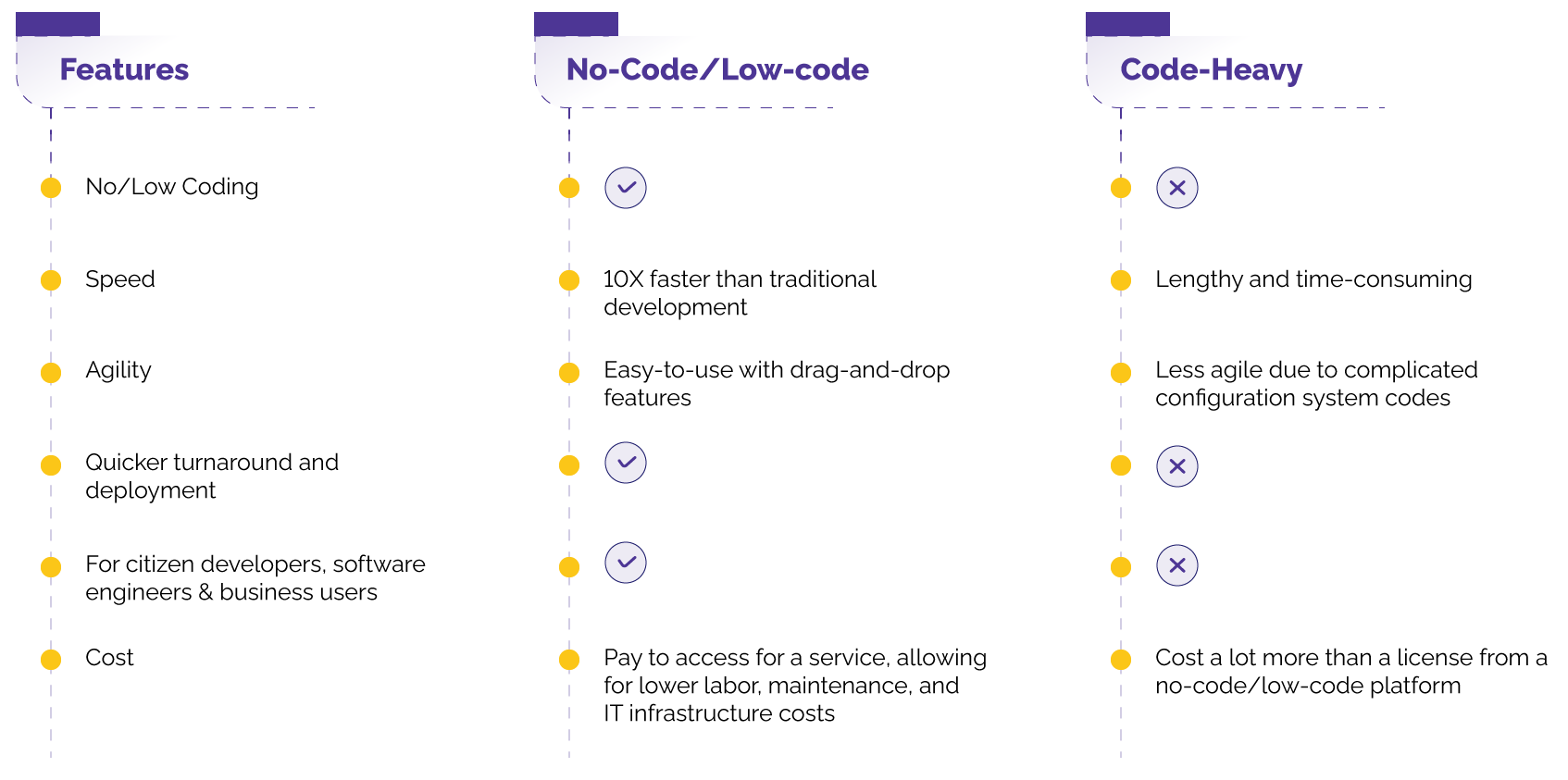
    According to Gartner, by 2023, over 50% of medium to large enterprises will have adopted low-code or no-code as one of their strategic application platforms. Also, it predicts that low-code platforms will be responsible for more than 65% of application development activity by 2024. The low-code and no-code technologies enable businesses to keep up with the rapidly changing technology landscape through innovation and by empowering business users and technical programmers to build applications with little to no coding.

    No-code/Low-code vs. Code-Heavy: What’s the difference?

    Data analysis

    #5 Ethical AI and Ethical Data Analytics become tangible

    As enterprises power AI advancements, the lack of governmental oversights has pushed the debate over the ethics of responsible AI to the fore. In 2022, we will see how ethical AI and ethical data analytics will continue to play a significant part in the simulation of innovation and economic growth, since more organizations will realize the need for responsible tech. Fairness of algorithms and data transparency are issues that will need to be addressed in the coming years as AI adoption is more widespread than ever. It will hopefully work its way towards policymakers as well.

    #6 AI will evolve more rapidly, expanding and impacting every business process

    While in 2021, most of the enterprises were still in the proof-of-concept phase of AI. 2022 will see a shift towards AI-first approaches. AI applications will be at the forefront of enterprise strategies. As AI/ML models become the norm, companies will expand AI to become every part of the department and impact every business process.

    #7 AI will become more widespread and accessible

    Previously in 2021, only big players such as Amazon, Google, Microsoft, etc., had the deep pockets to make AI/ML models a reality. In 2022, there will be more off-the-shelf technology to make AI/ML models more accessible, like readily available functionality to make applications talk, convert speech to text, and other industry-specific use cases. Also, modern workplaces are evolving with AI getting incorporated into their processes. Humans and machines will work alongside each other for quicker results. This creates a great combination of human innovation and machine intelligence.

    In 2022, AI and data analytics will not only be more prevalent but will also be more strategic. It will continue to be used to achieve productivity gains. In the coming years, AI will also be used to rethink and redesign products, services, business models, and overall strategy.

    This year, the challenges of integrating, cleaning, and processing data will continue. However, at the same time, there will be a flood of more generic AI and data-analytics platforms that will help replace manual tasks, freeing up data scientists for strategic tasks. As today’s enterprises strive to be data-driven and demand that the data be most efficient to provide a better experience, more enabling technologies will be available to ease the transition and adoption of AI across the organization.

    Do you agree with the points discussed in the article? If yes, which of the trends do you plan to adopt in your organization? Feel free to let us know your thoughts and comments in the section below if we’ve missed any important points.

    Derive Maximum Value From Your AI Investments

    Request Demo

  • How to choose an effective Business Intelligence platform?

    How to choose an effective Business Intelligence platform?

    Whether you want to integrate real-time analytics into an existing product or corporate site or re-invent your present internal reporting structure with modern analytics, choosing a Business Intelligence platform is a process not to be taken lightly. There’s a lot to think about, including the user experience, appearance and feel, vendor support, and whether or not the fundamental capabilities are sufficient. Also, the enormous time, money, and effort commitment! There are several possibilities when it comes to selecting a Business Intelligence platform. Due to the sheer number of players in the market and their seemingly indistinguishable products, purchasers find it more difficult than ever to assess comparisons between market alternatives appropriately. This option complexity tends to result in some erroneous decision-making.

    Need for BI platform

    First and foremost, determine why you require a BI platform. Are you seeking an internal solution that will enable your users to gain access to the data insights they require and assist them in making informed decisions? Are you looking for a solution for small teams or one that can scale across the organization? Or are you looking to integrate analytics into your customer-facing application(s) to gain a competitive advantage and provide real-time data to your clients? Many businesses are happy to use business intelligence as a stand-alone solution, internal portal, or data visualization tool. Others currently offer an application to their consumers, and a Business Intelligence platform would be a natural expansion of their service. It’s critical to pick a vendor whose BI product best matches your goals while assessing vendors. Although the differences are minor, you’ll be glad you chose a BI platform that specializes in your use case once you get started.

    There are many factors based on which you can choose a business intelligence platform for an organization. These are as follows:

    – Level of tech-savviness

    The majority of users will categorize themselves as Business Users, Analysts, or Developers. It’s critical to know your audience to ensure that they can interpret data in the way that best meets their requirements and abilities. However, we don’t propose isolating individuals whose user personas differ from the majority of your audience; it’s critical to choose a BI platform that caters to more than just analysts (for example). Make sure your BI platform shortlist includes one that offers an adaptive user experience or empowers any user by automatically customizing the user experience to the user’s abilities. In other words, a BI platform that gives you complete control over the entire BI process, allowing you to quickly modify it to your team’s or organization’s specific needs at scale.

    – Ask for a demo

    Requesting a demonstration of the platform’s capabilities is an excellent way to get your evaluation started. However, simply seeing a pre-recorded example or attending a group session isn’t enough. Find vendors that can customize the live demo using your actual, currently used data suppliers with whom you can have an open-ended, exciting discussion about your specific needs. Include everyone (and I mean everyone) who will play a role in determining which BI platform you will use in your final decision. It will help users and stakeholders from various parties guarantee that you’re all asking the same questions to fully comprehend how the data visualization software will satisfy your business needs.

    – Data Quality and Process

    The quality and amount of integration of their data warehouse and underlying ETL/ELT procedures is a hurdle many organizations face when evaluating their data. The centralized repository must be a data source that is unified, accessible, and correct. The most crucial stage in deploying business intelligence tools and analytics is ensuring that functional and operational data systems are trustworthy and dependable from the start.

    – Propel your BI strategy

    Even the most powerful business intelligence reporting technology is meaningless if it can’t connect to your data quickly. So you can get to your analysis faster if the analytics platform provides efficient native connectivity to your data, no matter where it lives. You should access and evaluate your data in real-time without downloading it. With little to no coding effort on your part, you should be able to query your databases quickly. Your BI platform should also give you the option of deploying your analytics in the cloud, in a hybrid environment, or on-premises. Instead of pushing you to modify or buy more products and upsetting your current data architecture, the platform should interact smoothly with your existing data strategy. It should also be simple to integrate with your company portals and other enterprise apps, allowing you to meet your customers where they are. Flexibility is crucial when selecting a Business Intelligence platform, and the total cost of ownership will be higher if the tools aren’t versatile.

    – Ease of use

    Everyone in your organization, regardless of skill level, should analyze their data and use those insights with the correct business intelligence platform. Platforms for BI should adapt to current technology and user innovation. You should select a platform that will scale as your business expands.

    Is your organization already using the BI platform? Or is it planning to buy a BI platform to make informed decisions? If yes, please tell me what factors you consider while choosing the BI platform. Let me know your thoughts in the comments section.

    A no-code software for business users to visualize, analyze, and share data insights.

    Try out for free now!

  • How to choose an effective Business Intelligence platform?

    Whether you want to integrate real-time analytics into an existing product or corporate site or re-invent your present internal reporting structure with modern analytics, choosing a Business Intelligence platform is a process not to be taken lightly. There’s a lot to think about, including the user experience, appearance and feel, vendor support, and whether or not the fundamental capabilities are sufficient. Also, the enormous time, money, and effort commitment! There are several possibilities when it comes to selecting a Business Intelligence platform. Due to the sheer number of players in the market and their seemingly indistinguishable products, purchasers find it more difficult than ever to assess comparisons between market alternatives appropriately. This option complexity tends to result in some erroneous decision-making.

    Need for BI platform

    First and foremost, determine why you require a BI platform. Are you seeking an internal solution that will enable your users to gain access to the data insights they require and assist them in making informed decisions? Are you looking for a solution for small teams or one that can scale across the organization? Or are you looking to integrate analytics into your customer-facing application(s) to gain a competitive advantage and provide real-time data to your clients? Many businesses are happy to use business intelligence as a stand-alone solution, internal portal, or data visualization tool. Others currently offer an application to their consumers, and a Business Intelligence platform would be a natural expansion of their service. It’s critical to pick a vendor whose BI product best matches your goals while assessing vendors. Although the differences are minor, you’ll be glad you chose a BI platform that specializes in your use case once you get started.

    There are many factors based on which you can choose a business intelligence platform for an organization. These are as follows:

    – Level of tech-savviness

    The majority of users will categorize themselves as Business Users, Analysts, or Developers. It’s critical to know your audience to ensure that they can interpret data in the way that best meets their requirements and abilities. However, we don’t propose isolating individuals whose user personas differ from the majority of your audience; it’s critical to choose a BI platform that caters to more than just analysts (for example). Make sure your BI platform shortlist includes one that offers an adaptive user experience or empowers any user by automatically customizing the user experience to the user’s abilities. In other words, a BI platform that gives you complete control over the entire BI process, allowing you to quickly modify it to your team’s or organization’s specific needs at scale.

    – Ask for a demo

    Requesting a demonstration of the platform’s capabilities is an excellent way to get your evaluation started. However, simply seeing a pre-recorded example or attending a group session isn’t enough. Find vendors that can customize the live demo using your actual, currently used data suppliers with whom you can have an open-ended, exciting discussion about your specific needs. Include everyone (and I mean everyone) who will play a role in determining which BI platform you will use in your final decision. It will help users and stakeholders from various parties guarantee that you’re all asking the same questions to fully comprehend how the data visualization software will satisfy your business needs.

    – Data Quality and Process

    The quality and amount of integration of their data warehouse and underlying ETL/ELT procedures is a hurdle many organizations face when evaluating their data. The centralized repository must be a data source that is unified, accessible, and correct. The most crucial stage in deploying business intelligence tools and analytics is ensuring that functional and operational data systems are trustworthy and dependable from the start.

    – Propel your BI strategy

    Even the most powerful business intelligence reporting technology is meaningless if it can’t connect to your data quickly. So you can get to your analysis faster if the analytics platform provides efficient native connectivity to your data, no matter where it lives. You should access and evaluate your data in real-time without downloading it. With little to no coding effort on your part, you should be able to query your databases quickly. Your BI platform should also give you the option of deploying your analytics in the cloud, in a hybrid environment, or on-premises. Instead of pushing you to modify or buy more products and upsetting your current data architecture, the platform should interact smoothly with your existing data strategy. It should also be simple to integrate with your company portals and other enterprise apps, allowing you to meet your customers where they are. Flexibility is crucial when selecting a Business Intelligence platform, and the total cost of ownership will be higher if the tools aren’t versatile.

    – Ease of use

    Everyone in your organization, regardless of skill level, should analyze their data and use those insights with the correct business intelligence platform. Platforms for BI should adapt to current technology and user innovation. You should select a platform that will scale as your business expands.

    Is your organization already using the BI platform? Or is it planning to buy a BI platform to make informed decisions? If yes, please tell me what factors you consider while choosing the BI platform. Let me know your thoughts in the comments section.

    A no-code software for business users to visualize, analyze, and share data insights.

    Try out for free now!