Category: Business Assurance

  • Growing Beyond Revenue Assurance: The Rise of Business Assurance

    Growing Beyond Revenue Assurance: The Rise of Business Assurance

    Traditionally revenue assurance functions have been monitoring revenue streams from switch to billing, with the primary goal of detecting leakages usually with a latency of more than 24 hours. With the success of the revenue assurance function itself being measured on the value of leakage being identified, larger the finding, greater the success of the revenue assurance function. This being a model that has been working since the age of 2G services, the entire RA functions built on the foundation of identifying leakages.

    In the rare event of having a near-flawless service allocation and metering of a revenue stream, the RA function is forced to expand controls to newer areas & technologies in the quest to find the elusive leakage. This quest of validating the purpose of the RA function’s existence begins and ends year on year proving to be a major challenge with decreasing ARPUs & cost per call/transaction.

    That brings us to an important question. Can leakage be the only measurement for a RA function?

    German car manufacturers employ a method called FMEA (Failure Method Effective Analysis) that enables them to reach a near-zero percentage of failures from design to manufacturing as one minor failure can at times be catastrophic to an end-user or lead to customer dissatisfaction. Thereby the end goal being that the absence of failures is a direct correlation to the success of risk mitigation programs, an approach that is contrary to traditional RA practices.

    In RA we are now evolving towards a similar path.  While leakage can be one parameter indicating failure of a process, the others are revenue & cost monitoring, margin management, enablement of CXOs and finally customer fulfillment that provides the base for competitive advantage.

    Evolution-of-RAFor example, as indicated in the graph on the above.

    Moving purely along the Y axis only increases the count of controls for an RA function with the sole purpose of finding leakage

    While moving purely along the X axis brings in minimal coverage that does not protect all services nor enables all functions of the business

    A linearly increasing path on the other hand provides for a path that matures the RA function with changing technology & business ecosystem while enabling various functions and driving the organization towards a data driven one.

    Digitalization has greatly expanded overall risks for telcos and in today’s reality of multi-service, multi-disciplinary offerings (eg. Banking, Retail, Digital Content etc), Revenue Assurance function need to move from just assuring revenues (with a primary business focus on EBITDA) to assuring business models, expanding focus beyond revenue management to Business Assurance.

    On-Demand Webinar- Managing Business Risks: The Growth of Business Assurance

    Download Recording

  • Are you 5G Assured? 4 Game-changing Business Assurance trends to evolve with 5G

    Are you 5G Assured? 4 Game-changing Business Assurance trends to evolve with 5G

    Even before we could be content with 4G and its value offerings, the 5th wave of telecom evolution is already here. Telecom giants from Middle East Asia, the Americas and the European geographies have already built their first publicly available prototypes in the 5G environment and are aggressively working towards building newer service models to drive unparalleled customer experiences. All said and done it is still in silos since the very process of conceiving the 5G ecosystem is underway. OEMs and integrators like Nokia and Qualcomm have also created enablement environments for the CSPs to progress with their 5G on-going projects.

    Release 16, one of the much-hyped releases by 3GPP aims to complete the IMT 2020 vision of building a fully functional 5G working environment is in progress. This, in turn, is going to change the entire scenario of business assurance.

    Here are four forecasts which are going to change the perception of looking at Business Assurance.

    1. Business Assurance practices will be services driven and customer focused.

    5G is a service driven architecture. The basic objective of 5G is to develop an integrated communications environment for driving scalability of services and Man-to-Machine interactions a reality. The evolution of 5G offerings, services and niches will be around 3 major value propositions as described in the IMT Vision 2020:

    • Enhanced Mobile Broadband
    • Ultra-Reliable Low Latency Communications
    • Massive Machine Type Communications

    More such use-cases can be seen in the diagram proposed by ITU-T for enabling IMT 2020 vision.


    The “switch to bill” outlook towards revenue assurance will soon be replaced by revenue enhancement and monetization of these freemium models of service delivery. With the first line of controls already being built and integrated into the BSS systems, the focus of business assurance will shift towards customer experience while maintaining the required financial bandwidth for sustenance and monetization of services offered.

    1. Managed services will converge for the OSS and BSS spaces.

    Managed services have evolved separately for OSS and BSS parts of the telecom ecosystem and have required special resources (manpower & machinery) for execution. However, that will no longer be the case. 5Gs service-oriented architecture with network slicing capabilities would cause business assurance functions to be staffed with professionals who have a sound understanding of networks and the business aspect of services associated with it. Strong data interpretation and the ability to co-relate, interpret and present a business outcome with a network performance measure would be in demand. Also, new areas such as Network Asset Assurance, Spectrum and Capacity Assurance, (which were previously on the edge) would now be an integral part of the overall business model.

    1. Use of Advanced Statistical Methods and Analytics for Assurance Practices

    5G, with its ability to support multiple service environments, will offer a great platform for the proliferation of Machine learning (ML) practices, both in the networks as well as the business domains. For example, ML may find use in enhancing self-organization feasibility through cognitive network management while in the business domain ML’s role would be to support QoS management in highly automated slicing environments.

    1. Integrated Security Practices will drive a whole new outlook for combating fraud

    Cyber-security and traditional fraud management practices, until now have had different paths of evolution. Since 5G will be an end to end IP based delivery platform, this will cause cyber security and fraud management practices in telecom to converge to counter new fraud scenarios that threaten the confidentiality, availability and security of the business.

    Bottomline Question: How do I ensure business readiness for venturing into 5G?    

    The readiness matrix for venturing into the 5G space can be broken into three major pillars:

    • Technology and Risk Readiness:

    While venturing into the new generation of technology, it must be ensured the current network and systems are not cannibalized. One good way to start with is to ensure backward technology integration. This, in-turn, will ensure seamless onboarding. It is also required to premeditate necessary risk controls (business, operational, compliance and financial) involved in the different stages of migration to quantify the overall risk appetite to arrive at basic business decision of “to be or not to be”!

    • Business Model Readiness:

    As stated earlier, the IMT – 2020 vision is to create business models best suited for the targeted customers. Depending on the existing value chain arrangements, the CSP can start identifying what kind of revenue stream partnerships can it afford to get into to roll-out services best suited to the proposed customer segment. It is suggested that in an economy that is cost-sensitive, sharing of capabilities (technology, manpower and resources) is the best way to start with.

    • Customer Readiness:
      Knowing the present capabilities, limitations, interests and desires of the customer is important and correlating these with the business model deliveries is imperative to the sustainability of the business. This not only helps the business earn more from the customer but also helps understand the changing patterns in their behavior much sooner and with visible effect.

    What to look in a 5G transformation assurance partner?

    To sum it up, it’s important to have an assurance partner that can support you in driving a technology transformation course that is so complex. The partner should be able to provide support at any leg of the transformation – from choosing the right model of delivery to helping realize monies out of it. The partner should be capable enough to drive decisions on risk treatment and help the business attain long term sustainability with an optimal amount of investment.

    Read the PoV to know about the journey of 5G and how CSPS can navigate through the hurdles.

    Download Now

  • The changing business model of Assurance

    The changing business model of Assurance

    It’s been more than a year since I have even looked at my phone bill, lying in my inbox, marked as read, never to be opened. Bundle of services packaged under a single price, only to change by a small margin when India moved to a single Goods & Services Tax framework.

    This is the new world of telecommunication. Select services of your liking, planned well like mine is, you would rarely be looking into your bills, scrutinizing itemized lines and stressing about your usage with  customer care.

    In a recent survey of complaints received at the CCTS (Commission for Complaints about Telecom-Television Services, Canada) while incorrect charging complaints increased by 71% Y/Y, complaints on changes to contracts increased by over 200% Y/Y.

    This trend is one of the key indicators of the change that is emerging in the space of assurance. The others being the steady and continuous interest in mitigation of risks within the partner ecosystem primarily related to contracts, margin, partner invoices, and inventory.

    What’s Changing?

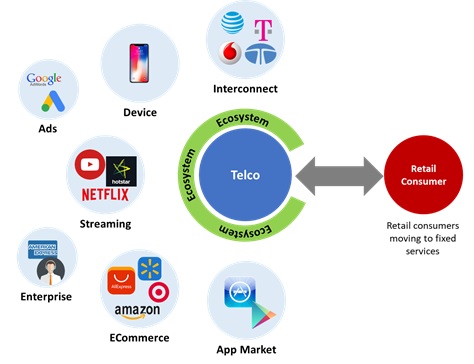
    Today with telcos moving into the domain of content providers with offerings of entertainment streaming, current affairs consumption, shopping, and many more options. All these services are bundled into a highly configurable plan that has an “all you can eat” approach as long as it is within the “Fair usage policy” means for a telco subscription, services, on-boarding, customer intelligence, and QoS are the critical assurance parameters from a retail point of view.

    However, the change being addressed has a pivotal impact from a B2B perspective from the massive complexity of the partner ecosystem.

    partner ecosystem

    Today for a partner ecosystem the risk universe includes devices, direct carrier billing, partner credibility, partner & product margins, pay-in & pay-outs, revenue sharing, contract alignment and many more which needs to be monitored & actioned on at near real time.

    Furthermore, we are not talking just about revenues but also costs and liabilities. So, the new business model of assurance, which we are referring to as “Business Assurance.”

    “Assurance is becoming a source of competitive advantage.”

    Business Assurance is not just a methodology but a major transformation in practice & technology. The new Business Assurance solution will need to:

    • Own and maintain the system that measures data quality
    • Own and maintain the business anomaly detection engines
    • Manage & drive business intelligence & insights
    • Measure and anticipate the impact of changes or offerings on customers
    • Monitor the content & partner environment for business feasibility and continuance
    • Gain a comprehensive understanding of revenue & cost breakdown in the organization
    • Help in assuring the “business model” itself, as opposed to a line of business

    In short Business Assurance is the new Revenue Assurance. It is not a question of if this transformation will happen but when will it happen? If it hasn’t yet started, it will.