Category: Partner Ecosystem Management

  • ¡Deje que el Deep Learning domestique todas las facturas que reciba!

    ¡Deje que el Deep Learning domestique todas las facturas que reciba!

    En esta era de transformación digital, todas las empresas se esfuerzan por obtener lo mejor de sus servicios aprovechando todas las capacidades disponibles. Esto no puede convertirse en realidad sin innovaciones en los productos y servicios de telecomunicaciones.

    Para satisfacer las crecientes necesidades dinámicas, digitales e innovadoras de los clientes, las empresas de telecomunicaciones necesitan expandir su cartera más allá de sus capacidades tradicionales. La digitalización está obligando a las empresas de telecomunicaciones a forjar asociaciones con los nativos digitales para innovar su oferta. Esto también significa que las empresas de telecomunicaciones necesitan una estrategia GTM mucho más rápida para sus servicios que nunca. La asociación es la clave del éxito aquí, ya que las empresas de telecomunicaciones pueden aprovechar la fuerza de sus socios. Las asociaciones no son nuevas para las empresas de telecomunicaciones; de hecho, una asociación es como una estrategia conjunta para la mayoría de los productos y servicios de telecomunicaciones.

    Gestión de una asociación rentable

    Las empresas de telecomunicaciones deben tener una estrategia de asociación para agrupar servicios, salir al mercado más rápido, darse cuenta de los beneficios y continuar innovando. Si bien todos se centran en hacer que la asociación funcione y sea exitosa, el combustible de este modelo no es más que la gestión de ingresos y costos. Si bien no es la verdadera intención de ningún socio cobrar / pagar más / menos de lo que debe ser, es necesario validar, comunicar y resolver cualquier error con el acuerdo. La identificación oportuna de las discrepancias y su resolución sin demoras es fundamental para una asociación sana y rentable. La resolución de discrepancias es, naturalmente, un proceso lento y, si no se aborda en el momento y el ritmo adecuados, puede terminar en una acumulación de facturas pendientes que conduzcan a una asociación poco saludable.

    Por lo general, los analistas leen las facturas, verifican los valores y confirman la exactitud. Sin embargo, cuando se trata de cientos o miles de facturas, existen muchas posibilidades de errores. Las empresas de telecomunicaciones deberían aprovechar la tecnología para abordar este problema de las importaciones y reconciliación de facturas de los transportistas. Se sorprenderá al ver que todavía hay trabajos publicados en el mercado para que los analistas verifiquen tarifas, elementos de costo, verifiquen facturas y realicen conciliaciones manualmente. Tales tareas son propensas a errores y agitadas, lo que eventualmente se reflejará en la calidad del resultado.

    Desafíos con las facturas de socios

    Los socios envían facturas en diferentes formatos, tipos y frecuencias a las empresas de telecomunicaciones. Dichas facturas pueden estar en formato PDF, JPG, imágenes escaneadas u hoja de cálculo.

    Las empresas de telecomunicaciones deben invertir en una solución robusta capaz de manejar todas las variantes de facturas, analizarlas, procesarlas y entregarlas para su conciliación. Invertir en una solución basada en elementos prediseñados puede ayudar hasta cierto punto. Esto funcionará si las facturas que desea procesar encajan en una de sus predefinidas. De lo contrario, es necesario diseñar, desarrollar o capacitar el nuevo diseño de la factura.

    Incluso dentro de las construcciones previas, no es muy fácil encontrar el modelo que se adapte a las necesidades. Los socios pueden seguir cambiando sus formatos de factura como parte de sus mejoras continuas. Las posiciones de campo pueden cambiar o cambiar de lo que fue entrenado. Uno puede construir reglas para discutirlas. Pero la verdadera solución a este problema debería provenir de las técnicas de aprendizaje profundo de AI / ML.

    Deep Learning (aprendizaje profundo): la necesidad del momento

    Las soluciones creadas en base a métodos de detección de objetos convolucionales basados ​​en el Deep learning pueden extraer datos de imágenes escaneadas (OCR), interpretar cualquier tipo de formato de factura, diseños y admitir la traducción de facturas en diferentes idiomas. El modelo profundo de respuesta a preguntas basado en BERT permitirá analizar los valores de los atributos de las facturas con una mayor tasa de éxito. Esto, combinado con NLP, mejora la precisión de la clasificación de los datos de las facturas. Además, busque soluciones que se puedan ampliar según las necesidades; por lo tanto, se puede lograr el paralelismo para mejorar el rendimiento.

    Subex AI Labs es útil para abordar los desafíos de OCR con facturas. Cuatro características clave del módulo de procesamiento de facturas Subex son:

    • Modelo de OCR basado en Deep learning para la extracción de datos de archivos PDF escaneados.
    • Modelo avanzado de PNL basado en BERT para clasificar con precisión los datos de las facturas, resumiendo los datos de las facturas para obtener una mejor representación.
    • Implementación distribuida para admitir el procesamiento de varias facturas simultáneamente en unos pocos minutos.
    • Método convolucional automático para la identificación y verificación del diseño de facturas para clientes conocidos.

    Nuestro módulo de extracción de facturas puede identificar automáticamente los diseños de las facturas y extraer toda la información relevante utilizando las técnicas creadas por expertos mencionadas anteriormente. Impulsamos eficiencias en sus negocios a través de la automatización de procesos para obtener información operativa para respaldar las actividades críticas de toma de decisiones y permitirle lograr una ventaja competitiva. La solución Subex Partner Settlement también le permite introducir servicios innovadores, paquetes de ofertas y productos y manejar la facturación de servicios tradicionales y digitales, abriendo así nuevas corrientes comerciales para modelos complejos de precios variables.

    ¡Interesado en saber más!

    Hablemos ahora

  • Re-inventing the Dealer Management for Telecom

    Re-inventing the Dealer Management for Telecom

    Although digital transformation has impacted almost every aspect of the telecom business, few areas still follow the traditional approach like dealer management. It is prevalent in areas where there is an underserved population, and the digital ecosystem is not so robust. The declining revenue and high cost make it difficult for Telcos to reach out to this segment. In this scenario, the dealer ecosystem or other indirect channels contribute massively to telecom operators’ overall sales.  However, reprobate dealers can exploit dealer agreements’ gaps to claim deceitful commissions by inflating the actual sales volumes. Hence, there is an immediate need to understand the reasons responsible for the revenue leakage and how Telcos can create a robust dealer ecosystem.

    Telecom operators use the offline channels of external agencies and third-party resellers to reach out to last-mile customers and smoothen the game of competitive price war, coalition & innovative customer offering, even in the era of online purchase and service delivery. This requires a convergent dealer management solution that can help Telcos create a robust dealer ecosystem.

    Challenges service providers face with a traditional Dealer Management solution:

    Capabilities in a convergent Dealer Management solution

    Huge data in Simple Compensation Out

    Transformation of a complex multitude of data to be used to derive a simplified compensation value. This includes interfacing and translation capabilities of any data from any Northbound system for Settlement processing and reporting.

    From idea to action

    Enable the SP to engage with its customers, thereby reducing the time-to-market of tailored products and services, offers, value-added services etc. It should create a tiered dealer network with immediate market offer availability from premium retail outlets to informal street vendors and rural locations and use DIY Model.

    Simplify dispute handling 

    Opting for a proactive approach for reconciliation and dispute resolution, gathering data across Network elements, Customer Billing Solution, Provisioning system to identify the issue with data mismatch for the number of records, the rate applied to records, timestamp, and other factors, to identify a dispute before it leads to revenue loss.

    Multi-tenant & SaaS platform 

    Deploying a single convergent solution facilitates features like improved collaboration, Pay as You Go, low maintenance cost with in-built capabilities like scalability, security, backup & restore improvements. A multi-tenant solution to view differentiates and still has single ownership of Partner & Incentive Management.

    Advanced Dealer Visibility 

    Equipping dealers with capabilities like dealer self-registration, dealer scores, performance-based dealer recommendations, request for inventory/place order, track order status, view invoices, statements, credit limit management/digital wallet, and payments to replenish that balance, all in one platform. With GDPR mandating a baseline set of standards, a Dealer Management solution should include comprehensive governance functions such as data security with AES and security of transactions with non-repudiation guarantees.

    To reiterate, Dealer Management needs to balance the existing challenges and future roadmap towards a Trusted, High performing, and Intelligent Solution for SP’s Volatile Dealer Network.

    What Subex Dealer Management solution can offer you:

    Strategic Capabilities

    • SaaS Model/OPEX Based/Modular
    • Multi-tenant
    • Dealer Self-Onboarding & Management
    • DIY Model

    Robust Solution

    • Scalable Business
    • Accurate & Immediate Incentive Calculation
    • Proactive Fraud Detection for all LoBs
    • Open Architecture, Open Source


    Schedule a meeting with our subject matter experts to know more about the solution.

    Schedule Now!

    Nakul Mathur
    Nakul Mathur is currently working with BSCG team as a Pre-Sales Consultant and looks after FM and PEM portfolios. His responsibilities include customer requirement gathering, solution designing and demonstrations and generating new business opportunities. He is a post-graduate in management from Symbiosis Institute of Digital and Telecom management with marketing as his majors.
  • Calificación y descuento: una forma granular de redefinir el asentamiento

    Calificación y descuento: una forma granular de redefinir el asentamiento

    Los CSP buscan regularmente nuevas formas de impulsar la adquisición de usuarios y el crecimiento de los ingresos. A medida que el ecosistema avanza hacia modelos basados ​​en asociaciones para el lanzamiento de nuevos servicios, los proveedores de servicios de comunicación se están asociando con nativos digitales de la nueva era para combinar sus servicios con los suyos y crear un valor integral para los consumidores finales. Pero la verdadera pregunta es: ¿es suficiente traer nuevos socios sin improvisar sus modelos de suscripción y liquidación? Este artículo intenta dar respuesta a esta pregunta.

    Demos un paso atrás y veamos dónde está el problema real con los modelos de asentamiento actuales. El primer problema radica en el choque de la oferta digital de Partner con la forma tradicional de liquidación de los CSP. Aunque los socios vienen con sus servicios de suscripción o modulares, los CSP siguen dependiendo de la liquidación de ingresos basada en porcentajes o del tipo de liquidación de ingresos fijos. Tomemos un ejemplo para obtener más claridad, los servicios lambda de AWS se cargan con funciones de tiempo de ejecución o utilización de recursos. Si AWS y CSP deciden asociarse en un escenario B2B2X para ofrecer servicio en la nube en una región, donde los CSP tendrán múltiples socios directos o revendedores en el mercado para vender el servicio, la única forma en que los CSP pueden llegar a un acuerdo con un socio de canal en el mercado es por reparto de ingresos o por tarifas fijas.

    El segundo problema es el sistema heredado de CSP, que no ha evolucionado para cumplir con los requisitos de los nuevos modelos de liquidación B2B. Los CSP aún confían en su sistema de facturación, diseñado en función de las necesidades de sus clientes finales. Sin embargo, ignoran por completo el hecho de que necesitan construir modelos similares para sus socios. Los modelos de clientes finales han evolucionado tanto que los operadores pueden agrupar su oferta según el gusto del cliente, la tasa de penetración en una región, la lealtad del cliente y más. Mientras que para un socio que brinda estos servicios, existe un modelo de participación en los ingresos plana, independientemente de si un socio pudiese tener un mejor desempeño que el otro socio.

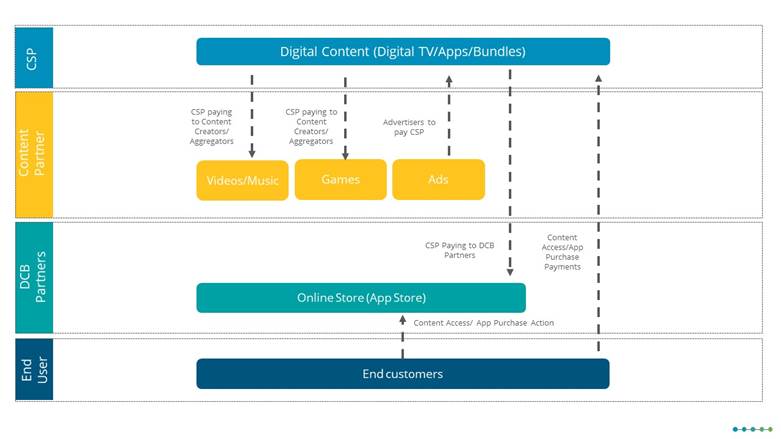
    La solución radica en cambiar la perspectiva de la mirada de CSP en el modelo de asentamiento de Partner o B2B2X. Veamos la imagen a continuación del modelo de revendedor para obtener una descripción general del modelo de liquidación B2B.

    Figura 1: Escenario de muestra de liquidación B2B2X

    En el escenario anterior, el socio de contenido proporciona varios servicios de contenido a los clientes finales a través de la plataforma CSP. Si bien la oferta de los socios de contenido es modular, no hay forma de que CSP también puedan llegar a un acuerdo modular con sus socios que dependa exclusivamente de modelos basados ​​en ingresos sin tener en cuenta la dinámica del mercado, como la tasa de penetración de un servicio en una región.

    Aquí es donde los CSP necesitan construir sus modelos (BYI), lo que puede ayudarlos a definir los modelos económicos para la liquidación, no solo en función de los ingresos fijos. Un modelo de liquidación, diseñado con base en la dinámica del mercado como la tasa de penetración de suscriptores en la región, la hora del día, el volumen del tráfico, penalizaciones, modelos basados ​​en niveles, etc.

    En conclusión, echemos un vistazo al escenario de liquidación B2B2X con estos modelos económicos implementados

    Figura 2: Modos económicos en el escenario B2B2X

    Estos modelos económicos dan a los CSP y a su equipo de marketing la libertad de granularizar sus modelos de liquidación en diferentes capas de la cadena de valor. Por ejemplo, los CSP pueden elegir diferentes modelos de liquidación económica para sus socios de contenido, mientras que en el diagrama anterior se indica un modelo diferente para sus socios DCB. Esto asegurará que los operadores tengan múltiples modelos con los que jugar para maximizar sus ingresos y proporcionar un modelo de liquidación diferente para diferentes socios que utilizan el mismo sistema.

    Para resumir, con la creciente necesidad y demanda de la oferta de paquete, CSP no debe estar solo buscando traer nuevos socios a su ecosistema y asegurarse de que los socios correctos sean recompensados, al mismo tiempo que se mantienen enfocados en la maximización de ingresos.

    ¿Quiere saber cómo nuestra facturación y aseguramiento de socios de interconexión mejorarán la visibilidad de su negocio?

    ¡Solicite una demostración ahora!

  • Top 3 Blockchain Use Cases That Telco’s can Adapt in Quick Time

    Top 3 Blockchain Use Cases That Telco’s can Adapt in Quick Time

    Blockchain as a technology comes with its own advantages and disadvantage. But using its advantages at right place and on right use case can be of huge benefit. Place where we need transparency, traceability, quick revenue recognitions, Operational efficiency and an environment with zero discrepancies. An environment where the result or actions are dependent on multiple transactions by multiple parties, where correlation of multiple transaction is important for E2E authenticity. And that is were Distributed Ledger Technology (DLT) often termed as Blockchain (as information/transactions are chained together), comes handy.

    And the Smart contracts running on top of this chained data which is nothing but business rules or we can call it check points.

    There are many ways blockchain can be used to make most out of above-mentioned benefits, few of them I am narrating below but the list is bigger and does not stop here. These use cases will only need private DLT instead of public DLT with controlled access, not a large-scale setup and simple.

     1.Blockchain based Dealer Management

    Telco’s are surrounded and dependent on dealer ecosystem. These dealers play the role of resellers for telco’s services and solutions. These indirect sales channels are more in volume as compared to direct sales channels and this is true in most of the telco’s. Dealer ecosystem value chain starts with onboarding, contracting, inventory tracking, sales and related settlements & payments.

    Key areas in this value chain where blockchain based ecosystem can play a role can be:

    • To build a transparent & trusted dealer management ecosystem
    • Fraud alerts across the value chain
    • Discrepancy free settlements and payments

    Blockchain can help track & deliver:

    • Dealer Onboarding Checks
    • Dealer contract tracking
    • Dealer Inventory allocation & tracking
    • Dealer sales verification (Claimed to be sold, but is it activated & delivered or not?)

    Blockchain can establish an ecosystem between a telco and its dealers for a transparent business and trusted financial transactions.

    2. Blockchain based Margin Management

    Overall Margin is very simple to identify i.e. Cash Out vs Cash In or we can say Cost vs Price. If it sounds so simple, then why getting perfect margins analysis is so difficult and many organizations are still struggling to figure out the exact margin on different solutions, products and services?

    Reason is also simple, it’s difficult to find and track each component that contributes to cost and then compare it with final price. There can be direct cost, indirect cost, hidden cost and we can have random cost in-between which is difficult to track.

    DLT can be used for calculation of accurate margin, but more important use of DLT in this case is to track and ensure good margin and raise red flags if margins are going down. Near real-time tracking on margin impacting factors and alerts on margin thresholds is the most important benefit we can get out of DLT based margin management solution. I am not talking about high transactions like XDR’s for margin calculation, rather we can use summary XDR’s and only final transaction in case of enterprise services. We must offload heavy transactions outside the blockchain and only register the results and key information into the blockchain.

    The key is, near real time capturing of immutable cost transaction, link them to overall service and compare it with pricing.

    3. Blockchain based Data Governance

    Data integrity across different systems and teams is utmost important when there is a data movement across organization and many key decisions are taken based on that. Any Data discrepancy in such scenario can have:

    • Direct impact on customer experience,
    • Impact on business decisions,
    • Operational inefficiency in identifying and solving the issue.

    Take an example of a typical value chain where: A Product/Offering is designed, then installed/implemented, then customer orders it, then the order is delivered, then the order is billed. Different teams and systems get involved in this value chain. If we want to ensure E2E Data integrity a governance should be setup to ensure:

    • As Designed vs As Installed
    • As Ordered vs As Implemented
    • As Ordered vs As Billed

    Feeding key data into blockchain consortium made across these systems, setting up smart contracts to implement key check points and take timely actions to solve problems in near real time.

    As stated earlier, the use cases does not stop here. Please provide your comments on more possible use cases and lets explore together.

    DLT is a technology and just DLT at core of these use cases is not enough, we need these use case solutions to be wrapped up with additional aspects which completes solution. As described below but not limited to:

    1. Onboarding
    2. Dynamic Economic models between partners and Telco’s
    3. Running analytics on the available data to achieve predictive and perspective outcomes
    4. Reports and interactive business dashboards for visualization
    5. Configurable platform to build new business use cases

    In short, what we need is Blockchain as a Service (BaaS)

    The Digital Trust portfolio at Subex can help in both existing uses cases developed at Subex Blockchain Labs and development of new use cases using blockchain expertise and these use cases comes along with required additional aspects delivered via Partner Ecosystem Management.

  • How Blockchain can help Telcos deliver more value from the ‘Content’ business

    How Blockchain can help Telcos deliver more value from the ‘Content’ business

    [vc_row][vc_column][vc_column_text]Over the last decade, the telecom industry has seen 1239% user growth and added more than 483.3 million users. This opens new avenues for telecom operators to monetize new opportunities such as content with better reach to the consumers through wireless and wired business. It also helps them with a better understanding of consumers’ dynamic and ever-changing preferences. With the pandemic forcing people to the new normal of work from home, the content business has seen a sharp rise as people spend more time-consuming OTT services. Hence ‘Content’ is one of the favorite lines of business to expand. But monetizing the content partnerships is not as easy as the traditional interconnect partnerships. The content settlement models are dynamic and complex, and each partner can have a different settlement model, making it difficult for operators to achieve efficiency.

    It’s all about Content, Content, & Content…

    With lockdown restrictions in place, access to concerts, live shows, theatres, and other entertainment sources have been curbed, which brings in a lot of scope for Telcos to fill in customers’ entertainment hunger by enabling access over the internet. A big spike for OTT services has led to a huge increase in revenue for streaming video platforms like Netflix, Amazon Prime Video, HULU, Disney+, HBO+. Partnerships models with television channels like Vodafone Play with 300 Live channels and VoD services have made the content more accessible, especially for the customers from growing economies like India.

    But this opportunity has come with its complexities – Telcos, now, cannot afford to be lax when it comes to managing multiple solutions for myriad combinations for its evolving customers. It needs to move beyond its traditional aggregator-based content partnership to more direct engagement, including its customers, to create innovative content and sell on the telco platform. The below image covers some of the known and some to-be partnership models of a Telco:

    With Telco (as Digital Service Provider) as a direct partnership with content creators (individual or companies), it can take care of some of the major challenges of Content Creators (in any form) like time spent for an exclusive distribution contract, revenue sharing (of content aggregator approx. 40% margin) and time to market.

    On the other side, Telcos wants to remove the dependency on intermediators or Content Aggregator platforms. Additionally, Telco can use its position to make some of its consumers/subscribers as Partners like an App Developer in Play Store or use this opportunity to convert its subscribers to provide innovative content or content review.

    Furthermore, Telco can carve Values Adds for its niche category to access Chatrooms with Celebrity and Personalities, and more such live marketplace opportunities with premium prices. This brings in loyalty and revenue to Telcos and keeps its consumers engaged over the network. And to mention a WIN-WIN arrangement for both Content Creator and Telco.

    Good collaboration leads everywhere

    And to bring trust and automation factors for these Partnership Models we discussed, Operators can leverage the advanced version of Blockchain Technology. Alvin Toffler said, ‘The great growling engine of change is Technology’ and Blockchain happens to bring that transformation in the Telecommunications domain.

    Blockchain technology has been around for more than a decade but recently started picking pace across industries for its transformational potential. Blockchain resolves a lot of solution complexity from ‘what to bill’ to ‘how to pay’ using a centralized, integrated, and trusted network.

    The Power Couple – Blockchain & Content

    Blockchain and Content strongly complement and supplement each other, making them a power couple. Below are some of the cases.

    Blockchain, as you see and know, will help the Telco to monetize the Content Platform. It can help get rid of Aggregator intermediaries, bringing to the table the most important and valuable propositions – Uncomplicated Business, Right Governance, and Trust. Beginning from Smart Contracts till Reconciliation, Blockchain complements and drives the common objectives. Here, the idea is to monetize blockchain technology to achieve a simple, governed, and secure platform to deploy a complete ecosystem of Content, managing its content partners till settlement and dispute over a unified solution.

    Learn how our Blockchain-based Settlements solution can help your organization

    Schedule A Demo!

    [/vc_column_text][/vc_column][/vc_row]

  • Consolide y optimice su negocio mayorista: 3 formas que puede adoptar para aprovechar al máximo su ecosistema B2B existente

    Consolide y optimice su negocio mayorista: 3 formas que puede adoptar para aprovechar al máximo su ecosistema B2B existente

    El negocio de la voz internacional eventualmente se convertirá en WhatsApp; Facebook Messenger el que lidera la carrera junto con WeChat, QQ, Viber y otros que le siguen y, en general, toman hasta 5 mil millones de usuarios activos mensuales. Microsoft Teams, Zoom, Skype se están apoderando del negocio de las conferencias telefónicas de voz para empresas, pero incluso con estos factores de impacto, el negocio de interconexión internacional está aquí para quedarse al menos durante la próxima media década.

    En la conferencia virtual GSC recientemente concluida, las empresas de telecomunicaciones destacaron el cambio en el negocio mayorista. En general, el negocio ha experimentado un repunte debido al COVID-19, pero las categorías han cambiado.

    Por ejemplo, las llamadas de voz internacionales han aumentado debido a la reducción de viajes. Pero por otro lado, el roaming se ha reducido por la misma razón.

    Debido a la situación de la pandemia, hay un cambio repentino en la dinámica del mercado y las empresas de telecomunicaciones buscan aprovecharlo al máximo.

    La Conferencia Virtual de GSC también destacó muchos hechos y enfoques que prevalecen entre los operadores en este momento. Algunos de ellos fueron:

    • Cambio en el ecosistema mediante la consolidación de seguimiento rápido
    • Iniciativas de automatización en conciliación, controles crediticios
    • Nuevas asociaciones en comercio de volumen, operaciones de intercambio
    • Investigaciones de fraude mejoradas como fraude de proveedores, Smart FAS, SIMBOX, etc.
    • Mejorar las iniciativas de ecosistemas asegurados mediante investigaciones, correcciones y prevención adecuadas en áreas como disputas, controles de crédito, cobros, calificación, etc.

    A medida que los ingresos tradicionales se están agotando, las empresas de telecomunicaciones pueden adoptar muchos cambios pequeños dentro de todo el ecosistema B2B para optimizar y proteger los ingresos. Aquí hay tres aspectos que pueden ayudar a las empresas de telecomunicaciones a lograrlo:

    • Consolidación
    • AAA
    • Prueba del futuro

    Consolidación: una empresa de telecomunicaciones típica tiene múltiples servicios B2B que se pueden clasificar en tres industrias principales:

    Venta al por mayor:

    (Concentración de voz global, mensajería, interconexión, roaming, conectividad, centros de datos)

    Digital:

    (TV, IoT, M2M, servicios de análisis de datos, servicios de seguridad, servicios OTT, etc.)

    Empresa:

    (IPVPN, IPLC, centros de datos, servicios en la nube, servicios de Internet, WiFi empresarial, etc.)

    Una solución convergente que puede consolidar y ejecutar todos estos negocios en una sola plataforma con implementaciones de múltiples inquilinos, proporciona la consolidación necesaria para optimizar tanto el gasto CAPEX como el OPEX.

    Soluciones AAA: automatizadas – precisas – aseguradas

    Solución preparada para el futuro: una solución que puede extenderse aún más a futuros negocios B2B. Los modelos económicos en evolución entre socios necesitan un sistema que pueda generar nuevos modelos mediante la configuración. Flexible para procesar y administrar fuentes de datos de varias empresas.

    La plataforma Subex Partner Ecosystem Management puede ofrecer una experiencia de gestión de socios B2B convergente que puede abordar todas las necesidades de cualquier tipo de negocio B2B de una empresa de telecomunicaciones.

    Tener múltiples soluciones de múltiples proveedores aumenta la complejidad y también el costo operativo. Subex puede ayudarlo a aumentar su estrategia B2B y proporcionar una solución convergente que puede optimizar y acelerar su viaje hacia la digitalización.

    Si quieres saber más sobre la solución

    Ponerse en contacto

  • Rating & Discounting: A granular way of re-defining settlement

    Rating & Discounting: A granular way of re-defining settlement

    CSP’s are regularly seeking new ways to drive user acquisition and revenue growth. As the ecosystem is moving towards partnership-based models for launching new services, communication service providers are partnering with new age digital natives to bundle their services along with theirs and create a holistic value for the end consumers. But the real question is – is it enough to bring in new partners without improvising their subscription and settlement models? This article tries to provide the answer to this question.

    Let’s, take a step back and see where the actual problem with current settlement models is. The first problem lies with – clashing of Partner’s digital offering with CSPs’ traditional way of settlement. Even though partners come with their subscription or modular services, CSPs’ still rely either on percentage-based revenue settlement or fixed revenue kind of settlement. Let’s take an example to get more clarity, AWS lambda services are charged with functions run time or resource utilization. If AWS and CSP decide to partner together in a B2B2X scenario to offer cloud service in a region, where CSP’s will have multiple direct partners or resellers in the market to sell the service, the only way CSP’s can do a settlement with a channel partner in the market is either by revenue sharing or fixed charges.

    The second problem is with CSP’s legacy system, which has not evolved to meet the requirements of new B2B settlement models. CSP’s still rely on their billing system, designed based on their end customers’ needs. However, they wholly ignore the fact that they need to build similar models for their partners. End customer models have evolved so much that operators can bundle their offering as per the customer’s taste, the penetration rate in a region, customer loyalty, and more. Whereas for a partner who provides these services, there is a flat revenue share model that exists, irrespective of whether one partner might perform better than the other partner.

    The solution lies in changing the perspective of CSP’s look at Partner’s or B2B2X settlement modeling. Let’s look at the picture below of the reseller model to overview the B2B Settlement model.

    Figure 1: B2B2X Settlement Sample Scenario

    In the above scenario, the Content partner provides various content services to end customers via the CSP platform. While Content partner offering is modular, there is no way that CSP can also do a modular settlement with their partners but to rely purely on revenue-based models without looking at market dynamics such as a penetration rate for a service in a region.

    This is where CSPs need to Build Their Models (BYI), which can help them define the economic models for settlement, not just based on the flat revenue. A settlement model, designed based on market dynamics such as subscriber penetration rate in the region, time of the day, the volume of the traffic, penalties, tier-based models, etc.

    In conclusion, Let’s take a re-look at the B2B2X settlement scenario with these economic models in place.

    Figure 2: Economic Modes in B2B2X Scenario

    These economic models give the CSPs and their marketing team the freedom to granularize their settlement models at different value chain layers. For instance, CSPs can choose different economic settlement models for their content partners, whereas a different model for their DCB partners is stated in the above diagram. This will ensure that Operators have multiple models to play with to maximize their revenue and provide a different settlement model for different partners using the same system.

    To summarize, with the growing need and demand of the bundle offer, CSP mustn’t be just looking into bringing new partners in their ecosystem and making sure that the right partners are rewarded, while also keeping their focus on revenue maximization.

    Want to know how our interconnect partner settlement and billing will enhance your business visibility

    Request Demo Now!

  • Consolidate & Optimize your Wholesale Business: 3 ways you can adopt to make most out of your existing B2B ecosystem

    Consolidate & Optimize your Wholesale Business: 3 ways you can adopt to make most out of your existing B2B ecosystem

    The International voice business will eventually come down as WhatsApp; Facebook Messenger leads the race along with WeChat, QQ, Viber, and others following and overall taking up to 5 Billion monthly active users. Microsoft Teams, Zoom, Skype are taking over the enterprise voice conference call business.But even with these impacting factors, the International Interconnect business is here to stay for at least for the next half-decade.

    In the recently concluded GSC virtual conference, telco’s highlighted the shift in wholesale business. Overall, the business has seen an uplift due to COVID-19, but the buckets have changed.

    E.g., International voice calling has increased due to reduced travels. But on the other hand, roaming has reduced due to the same reason.

    Due to the pandemic situation, there is a sudden shift in the market dynamics, and telcos are looking to make the most out of it.

    The GSC Virtual Conference also highlighted many facts and approaches prevalent among operators right now. Some of them were-:

    • Change in ecosystem by fast tracking consolidation
    • Automation Initiatives in reconciliation, credit controls
    • New Partnerships in volume trading, swap deals
    • Improved Fraud investigations like Provider fraud, Smart FAS, SIMBOX etc.
    • Improving assured ecosystem initiatives by proper investigations, corrections and prevention in areas like disputes, credit controls, collections, rating etc.

    As the traditional revenue is drying, telcos can adopt many small changes within the entire B2B ecosystem to optimize and protect the revenue. Here are three aspects that can help telcos achieve that-

    • Consolidation
    • AAA
    • Future proof

    Consolidation: A typical telco has multiple B2B services which can be broadly classified into 3 major industries:

    Wholesale:

    (Global Voice Hubbing, Messaging, Interconnect, Roaming, Connectivity, Data Centers)

    Digital:

    (TV, IoT, M2M, Data Analytics Services, Security Services, OTT services etc.)

    Enterprise:

    (IPVPN, IPLC, Data Centers, Cloud services, Internet Services, Enterprise WiFi etc.)

    A convergent solution that can consolidate and run all these business on a single platform with multi-tenant deployments, provides the required consolidation to optimize both the CAPEX & OPEX spending.

    AAA Solutions: Automated – Accurate – Assured

    Future proof Solution: A solution that can be further extended to future B2B businesses. Evolving economic models between partners need a system that can generate new models using configuration. Flexible to process and manage data sources from various businesses.

    Subex Partner Ecosystem Management platform can deliver a converged B2B partner management experience that can address all the needs of any type of B2B business of a telco.

    Having multiple solutions from multiple vendors increases the complexity and the operational cost as well. Subex can help you augment your B2B strategy and provide a converged solution that can optimize and accelerate your journey towards the digitalization.

    If you want to know more about the solution

    Get in touch

  •  Two ingredients to successful telecom partnerships 

     Two ingredients to successful telecom partnerships 

    Over the past few years, analysts have been touting the benefits of cross-industry partnerships between incumbents as well as challengers. Partnerships provide a way to leapfrog business, penetrate new markets, and grab a more significant share of the pie in a synergistic manner.

    Communication service providers (CSPs), the nerve-center of perhaps the most complex partner ecosystems, are no stranger to the value of partnerships. However, with digital transformation quickly replacing legacy systems and processes, these players struggle with low digital elasticity. This hinders their ability to be competitive and develop alliances quickly. Without digital tools and the right platforms, navigating the complex web of multi-partite telco partnerships can be challenging, yielding lesser value than expected.

    What are these critical platform capabilities and digital tools, and how do they deliver benefits? Let us look at some of the partnerships forged by two leading telecom players to understand these must-have features:

    Airtel’s vibrant expansion

    Over the past few years, Bharti Airtel has been aggressively innovating to extend its reach into different verticals and expand its product portfolio for its 300+ million customers. The Airtel Payments Bank, a comprehensive payments portal, saw partnerships with many players like MasterCard and HPCL in addition to products like Bharti AXA Life insurance. In September 2019, Airtel entered the OTT segment with the launch of Airtel Xstream, a digital entertainment platform that provides movies, apps, games, and TV channels. Since its release, Xstream has been forging partnerships with various media content providers, notably Netflix, Amazon Prime, and Lionsgate Play, to deliver content in India’s diverse regional languages. In keeping with its brand identity of youthfulness, Airtel is set to promote health and fitness content via Spectacom, a local upstart, to all its users. More recently, Airtel has tied up with Apollo Hospitals in a telco-healthcare deal that aims to use Airtel Thanks app to provide an AI-based COVID-19 risk assessment.

    Lessons: Identify the right partners to amplify the value

    Telcos can encourage either rigid or fluid partnerships based on internal dexterity. To foster future-ready alliances, they need to identify agile upstarts as well as incumbent players, rapidly grab and onboard them, and launch services quickly. Digital partner platforms can simplify the process of partner recruitment, clarify what tools, networks and channels are available, how to leverage existing platforms when pushing new services and products, and educate partners on how to realize value through deep customer engagement jointly.

    Verizon and Google symbiosis

    In 2013, PwC predicted that telcos could become aggregators of cloud-based enterprise services because of inherent advantages of vast networks, data, and transmission infrastructure. However, it is only in the last couple of years that we are witnessing such partnerships bloom. Take the case of Google and Verizon. In 2017, Verizon moved 150,000 of its own employees to G-Suite. After a year of trialing, Verizon migrated another 100,000 workers to the platform. Today, Verizon is an active reseller of G-Suite, using its own 4G LTE network to deliver workplace productivity and collaborative tools to enterprise customers. Verizon and Google are taking it one step further now through the introduction of YouTube-TV to Verizon individual customers in a platform-agnostic manner.

    Lessons: Deepen partnerships for sustained revenue

    It is not just about on-boarding new partners but discovering ways to keep the partnership profitable. As telcos innovate, so do their partners. Thus, any partner management solution platform must have transparent and precise ways to score partner performance. It should also simplify partner access to multiple verticals through reusable partner profiles and partner data. This is crucial to deepen relationships by visualizing how new partner products can integrate with the telco value chain, create synchrony between pricing and business models, and co-innovate for specific use cases.

    Why digital partner management solutions are important

    Having worked closely with telcos, Subex knows that partnership is the way forward, especially as CSP revenues from traditional services dip. However, on their own, telcos do not have a reputation of digital mastery and are often limited to national markets instead of global ones. Thus, while smart and long-lasting alliances is the way ahead, the right partner management system is how CSPs can get their foot in the door to unlock unprecedented value. In fact, TMforum reports that “industrial automation, remote monitoring, digital health, smart grid, smart city, and connected vehicles collectively represent a $1 trillion market by 2023.” Clearly, CSPs must evolve their digital partner ecosystems – quickly – to exploit this opportunity.

    Digital partner onboarding is the first step to successful collaboration.

    Find out how Subex can help

  • Telecom Partner Assurance through Converged Partner Management

    Telecom Partner Assurance through Converged Partner Management

    The telecommunication industry has undergone a tremendous amount of change. From offering basic communication services to people, it has now an array of digital services along with basic voice and SMS service. The B2C or retail segment has seen a surge in telecom partnerships from both telecom and non-telecom domain as the data consumption is increasing multifold. There are content aggregators, content producers, partners from media & entertainment, fitness industry, financial, healthcare and many more. The B2B partnerships are also growing as 5G takes the center stage in the developed regions. Experts estimate around 31 billion IoT connected devices by the end of 2020. There will be more enterprise partners from other industry verticals.

    As the number of partners for a telecom operator increases, it becomes more crucial to keep transparency across the partner ecosystem. Doing timely billings and settlements become a difficult task with so many partners to manage. And ensuring an error-free process becomes more challenging given the variety of partners from multi-industry verticals.

    What is the Need of the Hour?

    For a healthy partnership, the transactions must be accurately managed, rated, and settled. Delays in the settlement process are one of the biggest concerns for Telcos and its partners. Wrong invoices and mismatch of information can lead to disputes, blocked revenue, and inefficient partnerships. Also, manually managing invoices from so many partners to identify discrepancies, raising disputes, and concluding the same can be very heavy on the OPEX.

    Partner Assurance for Successful Partnerships

    Partner Assurance allows telecom operators to have a transparent partner ecosystem with efficient billing and settlements. Partner Assurance feature of Subex ROC Partner Management solution offers a complete automated process to ingest invoices, reconciling, highlighting discrepancies and automatically raise disputes. It has a template-based ingestion process of invoices directly from emails or FTP locations. You can configure threshold values for Rate and Volume discrepancies hence automatically convert qualified discrepancies to disputes.

    What benefits it can deliver

    • Zero-touch invoice reconciliation to identify and manage billing disputes.
    • Allow wholesale fraud mitigation such as shortstops and smart FAS using near real-time communication and gather evidence to have a transparent relationship.
    • Ensure transparency and trust through reports, alerts & notification
    • Long term successful partnerships

    How the Power of 5G will Redefine Partner Management

    Read Blog