Category: Blockchain

  • Simplifying Contract Management over Blockchain

    Simplifying Contract Management over Blockchain

    With the evolution of 5G, sharing of infrastructure and assets between telecom infrastructure companies and CSPs is the need of the hour. The vast operations cost involved in maintaining infrastructure and assets by CSPs is critical for optimizing and sharing infrastructures resources. CSPs need to get into an agreement with several new vendors and other CSPs as partners to meet the new business expectation. Infrastructure sharing will improve the business experience where competitors become partners to reduce their investments. Infrastructure sharing includes the mast, sites, tower, and many more. Other than this, CSPs also offer services associated with Virtual reality, IoT devices, 5G slices, etc. This requires regular onboarding of new partners to help them offer and deliver these services to the end-users.

    Once a CSPs or vendor gets into an agreement with CSPs to share their assets or provide a service, they need to maintain the contracts, which is currently a manual process or is done using a basic document management system. This data is maintained over excel or an open-source system in most places, leading to delays and errors. Currently, complexity in infrastructure sharing requires follow-up and closure of commercial agreements, which get delayed due to the complexity of negotiating the terms and conditions within timelines, which further delays the onboarding of suppliers and vendors. Due to the current situation, partners’ onboarding is a critical function at the same level as commissioning management, dealer management, tower sharing, etc.

    Due to the absence of standard policies across industries, it’s challenging to keep track of financial transactions, and hence, auditing activities are not transparent. A ready-to-use enterprise solution can be deployed for end-to-end contract management, which will simplify the process by digitally capturing the transactions and transparency in a step-by-step process.

    What is Blockchain?

    • Blockchain is a shared, immutable ledger for recording transactions, tracking assets, and building trust.
    • A decentralized, distributed ledger that stores encrypted blocks of data and chains them together to form a chronological single-source-of-truth for the data

    How can a Blockchain-based end-to-end solution help resolve the above challenges?

    Blockchain is a technology capable of hosting smart contracts that comprise the application logic of the system. Smart contracts can ensure the standardization of templates for contracts and agreements where rich queries reside over an immutable distributed ledger. Moreover, smart contracts will ensure the least manual intervention in contract life cycle processes. These processes include:

    • Template authorization
    • Contract creation & review
    • Contract negotiation
    • Contract approval
    • Contract execution
    • Contract renewal
    • Contract expiry

    How can a decentralized enterprise solution help?

    A decentralized enterprise solution can help to:

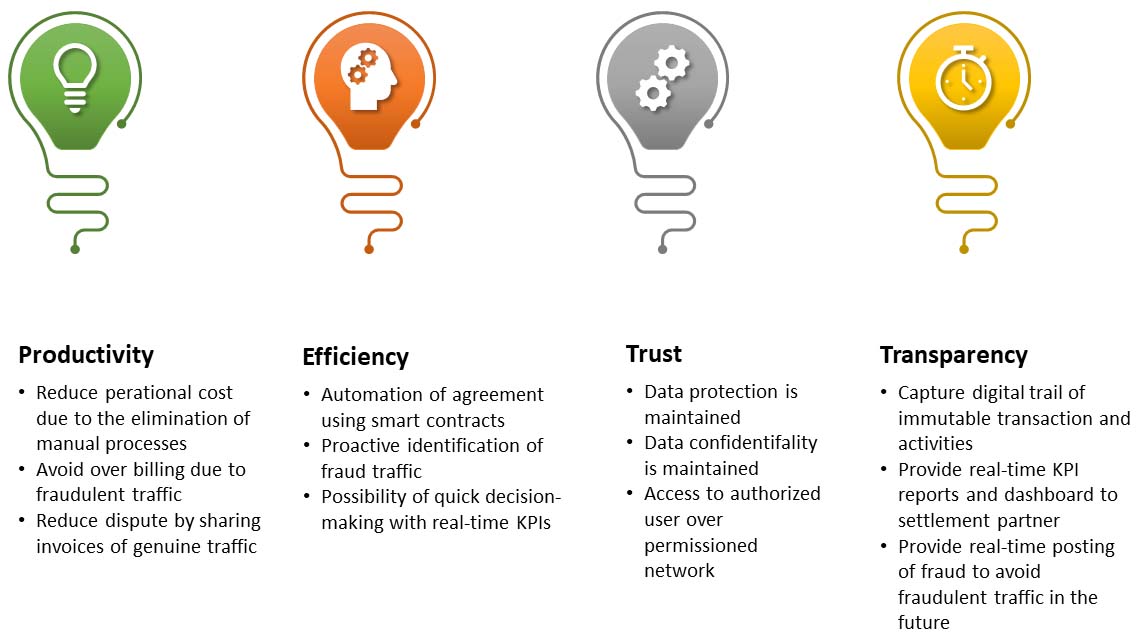
    • Productivity
      • Reduce the lead time in contract negotiation and quick onboarding process
      • Digitization and automation lead to a reduction in human resources efforts
    • Efficiency
      • Closure of agreement as per the contractual timelines and real-time tracking of status
      • Capture contract workflow with immutable timestamps, which can be quickly backtracked
      • Implement standard template for contracts via smart contracts
    • Trust
      • Agreement negotiation and T&C get captured digitally
      • Payment, penalty terms, and settlement are captured as per the contract
    • Transparency
      • Any deviation in SLA will be penalized as per the agreed contract automatically
      • Provide real-time reports and dashboard views for operators
      • CSPs, Partners, and regulatory bodies ensure that infrastructure will be shared transparently

    A permissioned blockchain with a decentralized database will simplify the process, help standardize the template, and help in the smooth execution of contract life cycle management. Blockchain will ensure that the productivity, performance, and level of trust are better by making terms and conditions of the contract visible and SLA tracking transparent to all end-users at all times, leading to minimum expenses for dispute settlement. Hence, Blockchain can help overcome the challenges of managing the contract lifecycle through a secured network.

    Download the point of view on Contract Assurance for Content Billing

    Download Now!

  • Land record-keeping over blockchain

    Land record-keeping over blockchain

    Being a second populous country and seventh-largest nation globally, Land Record keeping in India is a vast transactional activity where most processes are manual and non-digital. Digital access of records, simplification of the process to bring transparency for buyer-to-seller to-authority, and a tamper-proof ledger are extremely necessary to deal with the increasing numbers of litigation cases.

    The current set-up of land records transactions involves multiple departments like land, revenue, forest, banks, and others as key stakeholders. These numerous stakeholders are involved in the transactions, so keeping track of deadlines and SLAs is difficult and complex, leading to delay in assigning ownership or transfer of ownership, etc. Any errors in the ledger can affect ownership rights. These manual ledgers and paperwork can be easily forged, affecting the ownership and leading to boundary or land litigation disputes.

    In the absence of a will, the partition of property among successors of the deceased owner is again a complex process. Even the validation and verification of forged documents during the process is not an easy task, and it leads to delay due to complexity even it’s not accurate.

    A blockchain-based next-generation end-to-end solution is required to overcome all these issues, ensuring privacy, security, and a tamper-proof platform.

    How can a decentralized blockchain-based solution help overcome the above challenges?

    1. Multiple vital stakeholders can be onboarded on the chain to share the data through smart contracts over the private channel as and when required quickly.
    2. SLA of each stakeholder or department can be tracked easily and made available in a real-time dashboard.
    3. A golden record or ownership database can be maintained, accessible to authorized users over the chain to validate the transactions and records.
    4. This mechanism can identify fake documents by verifying them against the golden database.
    5. Dynamic parameters like ownership, mortgage information, litigation status, property tax details, etc., can be easily derived from a tamper-proof master source.
    6. Any land dispute associated with boundaries can be immediately flagged in real-time.
    7. The sanction of loans against land or property can be facilitated easily and quickly.
    8. The allocation process of new lands or property will be more transparent.
    9. Transfer of ownership can be done over an immutable platform that can quickly be backtracked and remain tamper-proof.
    10. Once land allocation or transfer of ownership is confirmed, it can be approved on distributed ledger where each transaction is signed off with a digital signature, timestamp, and digital key of the user.

    A next-generation E2E solution over blockchain would be digital, decentralized, transparent, and immutable. It could help simplify the land record-keeping process where multiple departments are involved by bringing transparency across the chain by utilizing blockchain’s key features. A tamper-proof distributed ledger among the stakeholders will increase efficiency by improving response time, real-time analysis, and data availability.

    Streamlining partnership through decentralized technology

    Schedule Demo

  • Blockchain for Billing & Charging Evolution (BCE) – Cultivating Trust in a 5G World

    Blockchain for Billing & Charging Evolution (BCE) – Cultivating Trust in a 5G World

    For many years, the telecom industry has been following a traditional approach to roaming billing and settlement, which involves exchanging Transferred Account Procedures (or TAP files) between the roaming partners. With new technologies like 5G arriving on the scene, traditional roaming settlement is set to become more complicated due to increased subscribers, partners, and traffic. As per a study by Juniper Research, the global number of roaming subscribers using 5G services will increase from 4.5 million in 2021 to 210 million in 2026.

    As proposed by GSMA, the Billing and Charging Evolution (BCE) is a next-generation approach that simplifies the settlement process. In this approach, TAP files or raw call detailed records (CDRs) do not need to be exchanged. Instead, Billing and Charging Evolution is driven by new formats like Usage Data Report (UDR), Usage Summary Report (USR), and Billing Statement Report (BSR), among others. The serving party shares these Billing and Charging Evolution reports to the served party, which are then used to generate the invoice by the serving party.

    Apart from simplifying complex multi-party settlement processes, Billing and Charging Evolution also supports new generation use cases brought on by latest technologies like 5G. This is enabled through characteristic features such as eliminating the need to exchange raw files within specific timelines as well as the need for special editors to read different TAP file formats like ASN1. Reports generated in Billing and Charging Evolution are in XML format, and these can be seamlessly exchanged to support settlement as well as reconciliation processes.

    Types of BCE reports for 5G roaming settlement

    As per GSMA guidelines, operational and financial reports should be generated and exchanged periodically. Some are mandatory, others are optional. However, all of these reports ensure the smooth execution of BCE process for 5G roaming. The types of Billing and Charging Evolution reports are:

    1. Detailed Data Report (DDR) – These are mediated records that are exchanged only in case of a dispute. In cases where all parties are in agreement, DDR is optional.
    2. Usage Data Report (UDR) – This is an optional report that can be exchanged daily or weekly. However, UDRs are mandatory for testing purposes to ensure reconciliation of detailed data.
    3. User Summary Report (USR) – This is another optional report that should be shared only after rating the traffic for the whole month but before generating the invoice. It is a prebilling aggregated summary and is mapped to the Billing Statement Report. USR can be used to reconcile both usage of as well as charges applied to network traffic.
    4. Billing Statement Report (BSR) – This is a mandatory report that should be shared monthly. It should support the charging document or invoice. Applied charges must mandatorily be available on BSR.
    5. Charging document or invoice – This is an invoice based on usage. It may also be a debit note or credit note based on dispute settlement.

    Streamlining BCE Reports with Blockchain

    Blockchain is a technology known for its immutable auditing and distributed ledger system that captures and shares information accurately among numerous verified partners. Considering the complexity expected to be brought on by 5G roaming billing and settlement, blockchain serves as a tactical solution to simplify the sharing of reports – confidentially, securely, and on time.

    Figure 1 – Application of blockchain to BCE
    Figure 1 – Application of blockchain to BCE

    Here are some ways by which blockchain brings in further efficiencies to Billing and Charging Evolution:

    • Scalability – Blockchain can easily handle millions of transactions every day in 5G roaming scenarios with its enhanced transaction processing system (TPS).
    • Efficiency gains – The exchange of UDR, USR, and BSR over blockchain will support automated reconciliation. Apart from significant cost and effort savings, faster invoicing leads to efficient settlement processes. Moreover, with BCE reports being periodically exchanged through the blockchain, operators no longer need to wait for the closure of month-end activities to reconcile or raise a dispute, if any.
    • Smart contracts – All alerts and notifications can be coded as business logic within smart contracts and triggered automatically. Smart contracts can also capture the agreed timelines and SLAs, providing a single point for monitoring.
    • Information exchange – Relevant parties can be notified and stay aware of common fraudulent traffic, which can be transparently adjusted accordingly into invoices. Further, reconciliation output can be broadcasted to relevant stakeholders or parties on a blockchain-based dashboard using APIs.
    • Real-time capabilities – Dispute findings and reconciliation reports can be shared with respective parties over the private channel in near real-time.
    • Tighter security – Transactions over blockchain ensure data security due to its immutable features.

    Conclusion

    Billing and Charging Evolution is a new generation solution for the settlement of 5G roaming. Implementing BCE over blockchain provides a platform where all participants can have their own node, thereby simplifying the settling and reconciliation processes. Using blockchain for BCE will also ensure transparency of transactional data, better scalability due to improved TPS, and provide an immutable platform that brings trust among telecom partners and blockchain network members.

    How our blockchain-based settlements solution can help your organization

    Learn more

  • Reconciliation of wholesale traffic over blockchain

    Reconciliation of wholesale traffic over blockchain

    Telecom Operators are exploring and investing in new cutting-edge technology to overcome the drawbacks of the traditional way of doing business. The traditional way of reconciliation of wholesale traffic is one such business scenario where settlement partners need to wait for the closure of the billing period to initiate the reconciliation to raise any dispute in case of any discrepancies. This delay in reconciliation leads to blockage of revenue for a longer period extending to 3 months to a year in some cases. Real-time reconciliation will improve business experience where overbilling due to fraudulent traffic will be avoided by proactive identification of fraud, and delay in dispute settlement can be avoided.

    Why Blockchain?

    Smart Contracts can be hosted over a blockchain that includes the business logic, which will ensure the real-time reconciliation of wholesale traffic using the relevant keys. The use of smart contracts will ensure digitization and transparency of the entire process from reconciliation, dispute management, and generation of credit/ debit notes. Blockchain will ensure the protection of digital key and sensitive data over the immutable distributed ledger, where blockchain will enable secured exchange of information & commercial transactions. The possibility of manipulating the data records or transactions over the blockchain is impossible, bringing trust and transparency for all the stakeholders and participants.

    How can a decentralized enterprise solution help?

    A decentralized enterprise solution can help to improve productivity, increase efficiency, bring trust and transparency.

    blockchain

    Reconciliation of wholesale traffic over blockchain ensures better productivity, transparency, trustworthiness, and a simplified process.

    Blockchain technology with a decentralized ledger can simplify the process by utilizing the permissioned blockchain where each settlement partners do not need to go back to each other for any information related to transactions or agreement. A distributed ledger will be used to keep track of KPIs and financial transactions to maintain financial settlements. Blockchain technology will allow components and features like consensus and permissioned membership services to ensure trust and transparency. Real-Time reconciliation of wholesale traffic over blockchain and identification of fraud and dispute will bring trust, transparency, improvement in revenue, and minimum expense or timelines for dispute settlement. Hyperledger capabilities allow an open-source solution for enterprises to solve challenges associated with the traditional way of doing business.

    Learn how our Blockchain-based Settlements solution can help your organization

    Schedule Demo

  • Leveraging Blockchain and AI to transform the telecom wholesale business

    Leveraging Blockchain and AI to transform the telecom wholesale business

    Blockchain and AI have been the primary focus area for Telco’s worldwide in recent time. It is astonishing to see how tech companies have open-heartedly embraced AI in their businesses, leveraging big data and boosting their profitability in the era of skewed margins. On the other hand, blockchain has been an active area of research to solve the most critical problem of ‘financial settlement.’ Telecom operators are also exploring the use of blockchain to use cases such as fraud mitigation, digital identity fraud, BCE roaming, and others to improve ROI and offset pressure from traditional businesses.

    While Blockchain and AI are new and most advanced technologies, there has been little focus on these two technologies used together. Although many divisions within a telco are using AI for automation, marketing, sales, and customer experience and are gaining a ton out of it, one department that can also benefit a lot is “wholesale.” This combination can help the wholesale business reduce its decision-making process and significantly improve the margins. Let’s look at some of the critical areas where Telco can leverage blockchain and AI together in the wholesale business.

    Deal creation

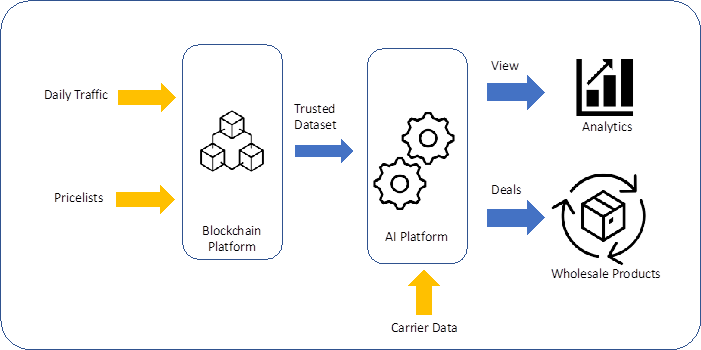
    Telecom operators and wholesale carriers’ margins rely heavily on bilateral and unilateral deals. These deals are for a specific period, where participating carriers are bound to send committed traffic to a certain destination/s per the agreement. In the modern era, having an extended deal period does not ensure profitability because of changing dynamics. What if telecom operators can build wholesale products daily or weekly based on the market trend and scenarios. Blockchain and AI can play an essential role in such a scenario. Blockchain can ensure uniformity and security by building a database of trusted data, which can be relied upon for decision-making. This data can create a data set that can train the various machine learning (ML) models to recommend the most profitable deals. There can be multiple inputs, such as the rate sheets shared by wholesale partners, daily traffic, wholesale partner’s performance, history, and more. Once these models are trained, they can forecast and build wholesale products, which ensures a higher margin with wholesale carriers.

    Figure 1: DEALS WITH BLOCKCHAIN & AI

    Dispute Settlements:

    Disputes are the major roadblocks in a telecom operator’s revenue cycle. While the bills can be settled every month or earlier depending upon the agreed cycle, dispute resolution can take months or sometimes years. Based on a recent survey, operators can take up to 15-45 days for dispute identification and confirmation on average. These disputes mainly arise due to data issues at the mediation level, arbitrations, or recommendations. Again, blockchain and AI can come to the rescue in such cases. CBAN being an agreed data exchange format in the blockchain community ensures that all the data received from the partner operators gets converted into a specified format. Partner operators can share this data daily instead of waiting till the end of the month. A scenario might arise if the operator wants to use new data for settlement, and that has been changed at the source operator side. That is where the AI models can ensure that such changes can be captured in the model itself, with minimal feature engineering, and quickly roll out these changes in production. So once again, blockchain and AI go hand in hand to ensure that such possibilities exist.

    Figure 2: CDR RECON & DISPUTE SETTLEMENTS – BLOCKCHAIN WITH AI

    Finally, innovation in the wholesale market must continue if wholesale voice trading businesses wish to remain profitable. The traditional wholesale way of working has been disrupted, and operators can still reverse or stop declining voice revenues using blockchain and AI/ML. Wholesale business and revenue growth will depend on developing new wholesale products, gaining new wholesale customers or partners, and resolving disputes faster. We’ve seen the sector’s movement into providing things like blockchain-based reconciliation, interconnection and hubbing, BCE-based roaming, fraud prevention, cloud services, machine learning and mobility, and no doubt other such services offerings will coil up as the wholesale demand for traffic change and new digital wholesale services rise up. It is now up to the traditional telecoms industry to keep pace or fall behind the dynamic digital players.

    Learn how our Blockchain-based Settlements solution can help your organization

    Schedule demo

  • ¿Cómo puede Blockchain ayudar a las empresas de telecomunicaciones a ofrecer más valor?

    ¿Cómo puede Blockchain ayudar a las empresas de telecomunicaciones a ofrecer más valor?

    Durante la última década, la industria de las telecomunicaciones ha experimentado un crecimiento de usuarios del 1239% y ha agregado más de 483,3 millones de usuarios. Esto abre nuevas vías para que los operadores de telecomunicaciones moneticen nuevas oportunidades, como contenido con un mejor alcance a los consumidores a través de negocios inalámbricos y cableados. También les ayuda a comprender mejor las preferencias dinámicas y cambiantes de los consumidores. Con la pandemia que obliga a las personas a trabajar desde casa, el negocio de los contenidos ha experimentado un fuerte aumento a medida que las personas dedican más tiempo a los servicios OTT. Por tanto, el “contenido” es una de las líneas de negocio favoritas para expandirse. Pero monetizar las asociaciones de contenido no es tan fácil como las asociaciones de interconexión tradicionales. Los modelos de liquidación de contenido son dinámicos y complejos, y cada socio puede tener un modelo de liquidación diferente, lo que dificulta a los operadores lograr la eficiencia.

    Se trata de contenido, contenido y contenido …

    Con las restricciones de bloqueo vigentes, se ha restringido el acceso a conciertos, espectáculos en vivo, teatros y otras fuentes de entretenimiento, lo que brinda un amplio margen para que las empresas de telecomunicaciones satisfagan el hambre de entretenimiento de los clientes al permitir el acceso a través de Internet. Un gran aumento para los servicios OTT ha llevado a un gran aumento en los ingresos de las plataformas de transmisión de video como Netflix, Amazon Prime Video, HULU, Disney +, HBO +. Los modelos de asociación con canales de televisión como Vodafone Play con 300 canales en vivo y servicios VoD han hecho que el contenido sea más accesible, especialmente para los clientes de economías en crecimiento como India.

    Pero esta oportunidad ha llegado con sus complejidades: las empresas de telecomunicaciones, ahora, no pueden darse el lujo de ser laxas cuando se trata de administrar múltiples soluciones para una infinidad de combinaciones para sus clientes en evolución. Necesita ir más allá de su asociación de contenido tradicional basada en agregadores hacia un compromiso más directo, incluidos sus clientes, para crear contenido innovador y vender en la plataforma de telecomunicaciones. La siguiente imagen cubre algunos de los modelos de asociación conocidos y algunos futuros de una empresa de telecomunicaciones:

    Con las Telco (como proveedor de servicios digitales) como una asociación directa con los creadores de contenido (individuales o empresas), puede hacerse cargo de algunos de los principales desafíos de los creadores de contenido (en cualquier forma) como el tiempo dedicado a un contrato de distribución exclusiva, reparto de ingresos (del agregador de contenido aprox. 40% de margen) y tiempo de comercialización.

    Por otro lado, las Telcos quieren eliminar la dependencia de intermediarios o plataformas de agregación de contenido. Además, las Telco pueden usar su posición para convertir a algunos de sus consumidores / suscriptores en socios como un desarrollador de aplicaciones en Play Store o aprovechar esta oportunidad para convertir a sus suscriptores para proporcionar contenido innovador o revisión de contenido.

    Además, las Telco pueden tallar Values ​​Adds para su categoría de nicho para acceder a salas de chat con celebridades y personalidades, y más oportunidades de mercado en vivo con precios premium. Esto genera lealtad e ingresos para las empresas de telecomunicaciones y mantiene a sus consumidores comprometidos a través de la red. Y mencionar un arreglo WIN-WIN para Content Creator y las Telco.

    La buena colaboración conduce a todas partes

    Blockchain, como usted puede saber y ver ahora, ayudará a la empresa de telecomunicaciones a monetizar la plataforma de contenido. Puede ayudar a deshacerse de los agregadores intermediarios, poniendo sobre la mesa las propuestas más importantes y valiosas: negocios sin complicaciones, buen gobierno y confianza. Desde los contratos inteligentes hasta la reconciliación, Blockchain complementa e impulsa los objetivos comunes. Aquí, la idea es monetizar la tecnología blockchain para lograr una plataforma simple, gobernada y segura para implementar un ecosistema completo de contenido, administrando a sus socios de contenido hasta la resolución y disputa sobre una solución unificada.

    Descubra cómo nuestra solución de acuerdos basada en Blockchain puede ayudar a su organización

    ¡Programe una demostración!

  • Top 3 Blockchain Use Cases That Telco’s can Adapt in Quick Time

    Top 3 Blockchain Use Cases That Telco’s can Adapt in Quick Time

    Blockchain as a technology comes with its own advantages and disadvantage. But using its advantages at right place and on right use case can be of huge benefit. Place where we need transparency, traceability, quick revenue recognitions, Operational efficiency and an environment with zero discrepancies. An environment where the result or actions are dependent on multiple transactions by multiple parties, where correlation of multiple transaction is important for E2E authenticity. And that is were Distributed Ledger Technology (DLT) often termed as Blockchain (as information/transactions are chained together), comes handy.

    And the Smart contracts running on top of this chained data which is nothing but business rules or we can call it check points.

    There are many ways blockchain can be used to make most out of above-mentioned benefits, few of them I am narrating below but the list is bigger and does not stop here. These use cases will only need private DLT instead of public DLT with controlled access, not a large-scale setup and simple.

     1.Blockchain based Dealer Management

    Telco’s are surrounded and dependent on dealer ecosystem. These dealers play the role of resellers for telco’s services and solutions. These indirect sales channels are more in volume as compared to direct sales channels and this is true in most of the telco’s. Dealer ecosystem value chain starts with onboarding, contracting, inventory tracking, sales and related settlements & payments.

    Key areas in this value chain where blockchain based ecosystem can play a role can be:

    • To build a transparent & trusted dealer management ecosystem
    • Fraud alerts across the value chain
    • Discrepancy free settlements and payments

    Blockchain can help track & deliver:

    • Dealer Onboarding Checks
    • Dealer contract tracking
    • Dealer Inventory allocation & tracking
    • Dealer sales verification (Claimed to be sold, but is it activated & delivered or not?)

    Blockchain can establish an ecosystem between a telco and its dealers for a transparent business and trusted financial transactions.

    2. Blockchain based Margin Management

    Overall Margin is very simple to identify i.e. Cash Out vs Cash In or we can say Cost vs Price. If it sounds so simple, then why getting perfect margins analysis is so difficult and many organizations are still struggling to figure out the exact margin on different solutions, products and services?

    Reason is also simple, it’s difficult to find and track each component that contributes to cost and then compare it with final price. There can be direct cost, indirect cost, hidden cost and we can have random cost in-between which is difficult to track.

    DLT can be used for calculation of accurate margin, but more important use of DLT in this case is to track and ensure good margin and raise red flags if margins are going down. Near real-time tracking on margin impacting factors and alerts on margin thresholds is the most important benefit we can get out of DLT based margin management solution. I am not talking about high transactions like XDR’s for margin calculation, rather we can use summary XDR’s and only final transaction in case of enterprise services. We must offload heavy transactions outside the blockchain and only register the results and key information into the blockchain.

    The key is, near real time capturing of immutable cost transaction, link them to overall service and compare it with pricing.

    3. Blockchain based Data Governance

    Data integrity across different systems and teams is utmost important when there is a data movement across organization and many key decisions are taken based on that. Any Data discrepancy in such scenario can have:

    • Direct impact on customer experience,
    • Impact on business decisions,
    • Operational inefficiency in identifying and solving the issue.

    Take an example of a typical value chain where: A Product/Offering is designed, then installed/implemented, then customer orders it, then the order is delivered, then the order is billed. Different teams and systems get involved in this value chain. If we want to ensure E2E Data integrity a governance should be setup to ensure:

    • As Designed vs As Installed
    • As Ordered vs As Implemented
    • As Ordered vs As Billed

    Feeding key data into blockchain consortium made across these systems, setting up smart contracts to implement key check points and take timely actions to solve problems in near real time.

    As stated earlier, the use cases does not stop here. Please provide your comments on more possible use cases and lets explore together.

    DLT is a technology and just DLT at core of these use cases is not enough, we need these use case solutions to be wrapped up with additional aspects which completes solution. As described below but not limited to:

    1. Onboarding
    2. Dynamic Economic models between partners and Telco’s
    3. Running analytics on the available data to achieve predictive and perspective outcomes
    4. Reports and interactive business dashboards for visualization
    5. Configurable platform to build new business use cases

    In short, what we need is Blockchain as a Service (BaaS)

    The Digital Trust portfolio at Subex can help in both existing uses cases developed at Subex Blockchain Labs and development of new use cases using blockchain expertise and these use cases comes along with required additional aspects delivered via Partner Ecosystem Management.

  • How Blockchain can help Telcos deliver more value from the ‘Content’ business

    How Blockchain can help Telcos deliver more value from the ‘Content’ business

    [vc_row][vc_column][vc_column_text]Over the last decade, the telecom industry has seen 1239% user growth and added more than 483.3 million users. This opens new avenues for telecom operators to monetize new opportunities such as content with better reach to the consumers through wireless and wired business. It also helps them with a better understanding of consumers’ dynamic and ever-changing preferences. With the pandemic forcing people to the new normal of work from home, the content business has seen a sharp rise as people spend more time-consuming OTT services. Hence ‘Content’ is one of the favorite lines of business to expand. But monetizing the content partnerships is not as easy as the traditional interconnect partnerships. The content settlement models are dynamic and complex, and each partner can have a different settlement model, making it difficult for operators to achieve efficiency.

    It’s all about Content, Content, & Content…

    With lockdown restrictions in place, access to concerts, live shows, theatres, and other entertainment sources have been curbed, which brings in a lot of scope for Telcos to fill in customers’ entertainment hunger by enabling access over the internet. A big spike for OTT services has led to a huge increase in revenue for streaming video platforms like Netflix, Amazon Prime Video, HULU, Disney+, HBO+. Partnerships models with television channels like Vodafone Play with 300 Live channels and VoD services have made the content more accessible, especially for the customers from growing economies like India.

    But this opportunity has come with its complexities – Telcos, now, cannot afford to be lax when it comes to managing multiple solutions for myriad combinations for its evolving customers. It needs to move beyond its traditional aggregator-based content partnership to more direct engagement, including its customers, to create innovative content and sell on the telco platform. The below image covers some of the known and some to-be partnership models of a Telco:

    With Telco (as Digital Service Provider) as a direct partnership with content creators (individual or companies), it can take care of some of the major challenges of Content Creators (in any form) like time spent for an exclusive distribution contract, revenue sharing (of content aggregator approx. 40% margin) and time to market.

    On the other side, Telcos wants to remove the dependency on intermediators or Content Aggregator platforms. Additionally, Telco can use its position to make some of its consumers/subscribers as Partners like an App Developer in Play Store or use this opportunity to convert its subscribers to provide innovative content or content review.

    Furthermore, Telco can carve Values Adds for its niche category to access Chatrooms with Celebrity and Personalities, and more such live marketplace opportunities with premium prices. This brings in loyalty and revenue to Telcos and keeps its consumers engaged over the network. And to mention a WIN-WIN arrangement for both Content Creator and Telco.

    Good collaboration leads everywhere

    And to bring trust and automation factors for these Partnership Models we discussed, Operators can leverage the advanced version of Blockchain Technology. Alvin Toffler said, ‘The great growling engine of change is Technology’ and Blockchain happens to bring that transformation in the Telecommunications domain.

    Blockchain technology has been around for more than a decade but recently started picking pace across industries for its transformational potential. Blockchain resolves a lot of solution complexity from ‘what to bill’ to ‘how to pay’ using a centralized, integrated, and trusted network.

    The Power Couple – Blockchain & Content

    Blockchain and Content strongly complement and supplement each other, making them a power couple. Below are some of the cases.

    Blockchain, as you see and know, will help the Telco to monetize the Content Platform. It can help get rid of Aggregator intermediaries, bringing to the table the most important and valuable propositions – Uncomplicated Business, Right Governance, and Trust. Beginning from Smart Contracts till Reconciliation, Blockchain complements and drives the common objectives. Here, the idea is to monetize blockchain technology to achieve a simple, governed, and secure platform to deploy a complete ecosystem of Content, managing its content partners till settlement and dispute over a unified solution.

    Learn how our Blockchain-based Settlements solution can help your organization

    Schedule A Demo!

    [/vc_column_text][/vc_column][/vc_row]

  • Combatting Wangiri Fraud using Blockchain technology

    Combatting Wangiri Fraud using Blockchain technology

    Wangiri fraud, or what we call as one ring scam, continues to haunt telecom operators even today. As per the CFCA 2019 fraud loss survey, Wangiri is one of the top 5 fraud methods with an estimated fraud loss of close to USD 1.82 billion globally. In addition to the revenue loss, Wangiri fraud adversely affects customer experience resulting in customer churn due to bill shocks. Telcos frequently update their fraud management systems with the latest hotlist/blacklists from the industry forums and other database vendors to overcome this fraud. Since these databases are not updated in real-time, telcos always end-up being on the receiving end until certain number ranges are tagged as fraud and blacklisted.

    The need of the hour is that telco fraud management systems have access to real-time information on hotlists to address this fraud and avoid revenue losses. Subex recently partnered with the Risk & Assurance Group (RAG) to provide a blockchain-based fraud management solution to our customers. We are now a part of the RAG Wangiri Blockchain Consortium, which seeks to use Blockchain technology to gather real-time industry threat intelligence about fraudsters. The consortium includes some of the world’s leading Communications Service Providers (CSP) from North America, Europe, Africa, and Asia.

    By partnering with the RAG Wangiri Blockchain Consortium, we aim to provide our customers with a decentralized and cryptographically secure blockchain ledger of fraud-related information. The first use case the consortium focusses on is Wangiri fraud, which is a global and increasing problem for telcos and their customers.

    To know more, listen to this podcast where Eric Priezkalns, Chief Executive of the Risk and Assurance Group and Nithin Gangadharan, Product Director, Fraud Management talk about the partnership, and how will this partnership benefit our ROC FMS Customers.

    Listen now

  • D-Partner unchained with Blockchain in the 5G era

    D-Partner unchained with Blockchain in the 5G era

    If you have to identify the most important element of the telecom ecosystem in the 5G era that can fuel multi-fold growth for operators, what it is going to be? If you ask for my answer, it’s D-Partner (The Partner).  Let me explain how the partner will play an important role in setting up a successful 5G ecosystem.  I will cover two aspects here:

    1. Why and how partnerships can only fuel success in 5G?

    2. Blockchain – How it brings digital trust in data exchanged between partners?

    The Potential that 5G holds

    5G ecosystem will give rise to a big parallel ecosystem of partnerships. A successful rollout of 5G will need collaboration between many partners who will fulfill different gaps in the ecosystem and eventually deliver the 5G promises. As the ecosystem develops, Telcos are expected to focus beyond just connectivity towards collaboration across the telecom value chain and different sectors, leading to the creation of new and innovative business models.

    This is the right time to unchain and unleash the power of partnership and empower the partners to build a strong ecosystem to realize the true potential of 5G.

    Different partners that telco need to collaborate can be broadly classified into below categories:

    1. Suppliers (Infrastructure, Software Vendors, Innovative service providers, etc.)
    2. Aggregators
    3. XVNO*
    4. Sales & Resellers
    5. Enterprise Partners (Enterprises in Healthcare, Smart Cities, Banking, Manufacturing, etc.)

    *XVNO=MVNO, IVNO(IoT-VNO), etc. Anyone can take a Network Slice and run innovative services on it. IoT has a big future on 5G platform and hence IoT-VNO.

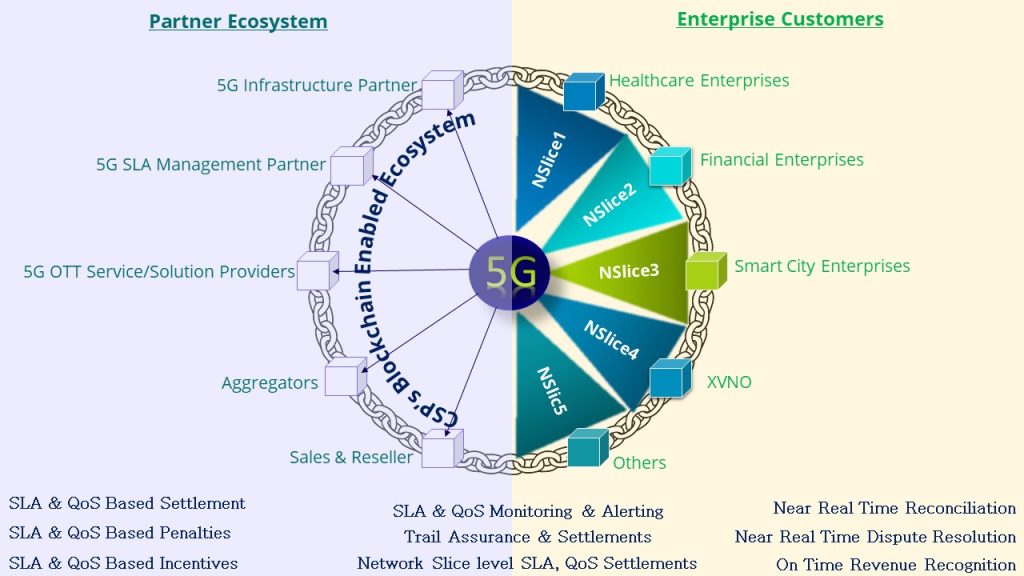
    All these partners will build a strong ecosystem to deliver the best result to end consumers, be it in B2C or B2B space. Delivering value will no longer be a play of the centralized entity, instead, this will be a decentralized ecosystem in which delivering value and the trust will be dependent on multiple entities/partners i.e. the trust itself will be decentralized. The below diagram clearly highlights how much decentralization is important going forward.

    Creation of a Trusted Decentralized Ecosystem to Deliver Value

    All these partners will be connected with different economic models to do billing and settlements. In the 5G ecosystem, SLA & QoS based economic models will be the key factor for all the billing and settlements. SLA & QoS is the key factor for 5G to be reliable, which will add a new parameter to the equation of billing and settlement which is currently transactional in nature. The 5G value chain will be dependent on many of these partners playing different roles at different points and all or related ones, are interconnected with cascading SLA’s & QoS.

    Having cascading SLA’s and with its dependency on multiple partners, who will deliver and ones who will consume the same, the need for a transparent & trustworthy environment becomes the key, which can:

    1. Update the SLA’s and delivered QoS to all relevant and impacted touchpoints in ecosystem
    2. Rating the services of each partner based on delivered SLA’s and QoS as agreed in the contract
    3. Compare and alert SLA breach based on the contracts with each partner in ecosystem
    4. Help in addressing disputes in near real-time, hence avoiding conflicts during payments and settlements

    Each of the above points translates to:

    1. Near real-time updates in a connected the ecosystem
    2. Near real-time contract monitoring
    3. Triggered events based on contractual models
    4. And above all, creation of a trustworthy the ecosystem

    Blockchain = Collaboration + Cryptography + Smart Contracts = Decentralized & Trusted Ecosystem


    The above diagram depicts how a decentralized setup will look, with multiple partners working towards building a reliable & connected ecosystem delivering the required SLA/QoS.

    For now, I leave you with this thought process and will get back to you on how we can wrap this overall decentralized environment with an E2E Partner Lifecycle Management system and its importance.

    The Decentralized Way Of Digital Partnerships

    Download Point of View