Category: Network Management

  • How to enhance accuracy and efficiency of Network Analytics for 5G

    How to enhance accuracy and efficiency of Network Analytics for 5G

    As 5G gains traction, CSPs will look to unearth its potential benefits. However, what 5G will also bring in is a compound effect of the challenges that CSPs face already.

    The Three Challenges CSPs face

    The first of these challenges pertains to the increasing capex intensity which is plaguing the telecom industry, which currently stands at 16%, the highest among any other sector in the world. The second challenge comes from the growing network complexity which is quickly as CSPs continue to pursue network-wide densification and virtualization. The final challenge comes from the fact that customer expectations, as it historically has, is rising in multiples, and with the number of connected devices and subscribers being added to the mix increasing, and leading to the an increase in data volumes, the expectations of customers is rising manifold.

    The above challenges are ones CSPs need to deal with in a 4G environment, and the 5G landscape is only set to accelerate these trends further.

    How will 5G change things

    One of the better-known advantages that come with 5G is the fact that it opens up CSPs to operator in a new arena beyond the usual consumer space: Enterprises. With 5G CSPs will play an integral instrument for driving newer use cases around IoT, industrial automation, smart cities, autonomous vehicles, robotic surgery and a lot more. What this means is that, for CSPs, 5G use cases will now bring in 3 larger use cases:

    1. eMBB (Enhanced Mobile Broadband) – which is designed for better user experiences on consumer devices, providing extreme network speeds and capacity

    2. mMTC (Massive Machine-type Communication) – which aims to provide connectivity to a huge number of devices whose traffic profile is typically a small amount of data (spread) sporadically.

    3. URLLC (Ultra-Reliable Low Latency Services) – which focusses on low latency, high reliability and high availability aspects

    With a focus around these three overarching use cases, 5G promises to deliver superior experience to not just subscribers but enterprises also. From a consumer angle, for close to 60% of smartphone users, the highest expectation for 5G is to deliver speeds faster than current mobile networks. Across the globe, data consumption is increasing by more than 40 percent every year. Video in particular will account for 75 percent of network traffic by 2024, up from 55 percent today. Networks will need to adapt from Standard and High Definition video resolution to 2K and 4K, placing higher requirements on speed and quality. Further into the future, services like AR/VR applications will put even higher requirements on network performance. This demand for better customer experience means that operators must continuously adapt and expand network capacity.

    From an Enterprise standpoint, with 5G having the capability to reduce latency to sub-milliseconds, businesses can start to consider the nexus between cloud, mobile and enterprise applications. More features and functionality can be extended to the mobile fleet and frontline employees. The use cases for ultralow latency apps can be vertical specific. This can include the financial services for high-frequency trading, as well as mining and energy companies rolling out autonomous fleets that are highly responsive to their environments. Moreover, 5G complements other emerging technologies such as AI/ML, robotics and IoT to further drive enterprise digital transformation both internally within an organization as well as externally in customer engagements.  Of course, at the end of the day, 5G is a telecom technology, and hence CSPs will be at the heart of driving 5G within the enterprise. However, this will also mean a new area where CSPs will need to direct capacity.

    What all the above add to is the need to build Superior experiences, which will be the main driver to generate new revenue stream in 5G era.

    The Need for Intelligent Capacity Management

    The main enabler to provide a superior experience will be an   approach based on Artificial Intelligence and Machine Learning. With capacity as the main enabler for raising speed to the 10x Gbps mark an Intelligent Capacity Management approach will in-turn help to meet the future growth requirements of massive device volumes.

    In line with this, an accurate capacity management process will help CSPs to differentiate themselves from the competition. Why Accuracy? Accuracy is key in any capacity management process as it directly impacts the Capex and ROI. An Intelligent Capacity Management solution built on Intelligent Data Management, Advanced Automation, and Domain-Driven Data Science, can help network planners achieve accuracy in each phase of capacity management process of Assessing, Planning and Optimizing capacity augmentations.

    Intelligent Capacity Management for Better Network Planning

    To succeed in the 5G journey, CSPs will need to make the right investments to gain competitive advantage and enhance end-user experience. However, such investments are highly cost intensive, both in terms of Capex and Opex. Any inaccuracies in the overall network investment planning can lead to unintended impacts on company financials and can create significant network inefficiencies. Hence, an Intelligent Capacity Management can help ensure accuracy to make the right Network Investment Plans.

    Intelligent Capacity Management for Better Customer Experience

    5G will also enable CSPs to increase revenues due to its potential of not only transforming mobile communications, but also completely replacing broadband internet. Considering most 5G deployments are focusing on FWA (Fixed Wireless Access) as the first use case, this is clearly the intent among most telecom operators. However, this will demand a dramatically broader capacity than CSPs are generally used to providing. This can only be achieved through an Intelligent approach to Capacity Management.

    Business Benefits of Intelligent Capacity Management

    An Intelligent Capacity Management Approach can bring about a:

    • 70%+ Increase in Accuracy
    • 80%+ Increase in Operational Efficiency
    • 7%+ Increase in Capex Efficiency
    • 10%+ Increase in ROI

    Read a case study on how we helped a Tier-I telcos increase their revenues by over 12% through intelligent network investment planning.
    Download Now

  • Network Infrastructure – Embracing disruption through innovation

    Network Infrastructure – Embracing disruption through innovation

    There are few critical junctures where industry changes its course, transforms, and readies itself for future growth. Such junctures often coincide with technology disruptions, followed by a long period of organic adoption. In this post, we will look at key disruptions that are steadily metamorphosing the telecommunications industry in modernizing their network infrastructure.

    The Virtualization Chasm

    Nearly a decade ago, industry initiatives spawned the promising technologies Software Defined Networks (SDN) and Network Function Virtualization (NFV). These technologies enable software-driven management of networks from the core networks to aggregation to access networks. The network workloads no longer reside on OEM-supplied proprietary hardware. Instead, they are packaged into virtual network functions (VNFs) and hosted on virtual environments. Over time, the virtualization concept has taken different shapes and slowly adapted to market needs. As in any technology adoption cycle, SDN/NFV adoption has encountered a “chasm” towards achieving a wider reach. The chasm, in this case, is due to transformation challenges, unproven success stories, internal system & process challenges, business prioritization, etc.

    The chasm, however, hasn’t stopped a majority of Telcos from adopting the virtualization principles to meet their current needs. One of the key developments that happened during the last decade is the virtualization of “low-hanging” network workloads such as firewalls, OSS/BSS systems, DNS, DHCP, IMS, etc. Telcos started adopting “private clouds,” i.e., virtualization infrastructure, and started hosting network workloads (VNFs) in virtual machines. This has given the Telcos a tremendous ability to optimize costs, control security policies, and scale up/down the infrastructure on a need basis.
    While a few operators have started working on agile, software-controlled, and service orchestration platforms, wider adoption still has a ways to go. The challenges of handling both physical network functions (PNF) and virtual network functions (VNFs) in the same platform, with the additional complexity of interfacing with legacy networks, persist. This is where a collaborative partnership with vendors like Subex, could bring in the expertise that enriches such transformation programs.

    Cloud Next

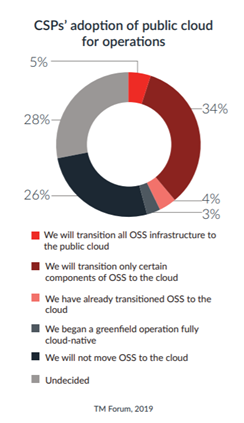
    Let’s move from network workloads to the non-network application infrastructure. The recent news of Microsoft’s $2 bn cloud deal with AT&T has created quite a stir in the telecom world. The move from AT&T to migrate all non-network OSS/BSS workloads to public clouds will usher in hyperscale cloud benefits such as lower TCO, higher agility, faster time to market, and scalability. We expect few major Telcos also to follow suit in the near term. But here is the interesting statistic from the TMForum study: only a minor segment of players is either already on the public cloud or ready to migrate OSS/BSS onto the public cloud. As expected, a large percentage of operators are either cautious or have decided not to move to the public cloud.

    Will the vendors start supporting cloud-native architectures immediately? The answer is yes, and no. There is a small set of vendors like Subex who are already on this path and will be able to support Operators in their quest towards a cloud-first strategy. At the same time, there is a more significant number of vendors who rely on the “lift and shift” strategy in near to medium term and look forward to making their offerings truly cloud-native in the longer run. This is an interesting development to watch out for.

    Open RAN

    A few years ago, the big OEMs introduced single RAN or proprietary vRAN products to market, which failed to catch the true spirit of open interfacing that Telcos were looking for. This motivated a few startups to work collaboratively on a novel idea – to run their products on commodity servers, enable software control via open interfacing protocols, and make seamless future upgrades just by pushing software patches. The outcome of this exercise is the Open RAN disaggregated networking model from the Telecom Infra Project (TIP) forum. The primary goal is to optimize the huge Capex / Opex that goes into building RAN networks in brownfield environments. Moving from access towards virtualization of aggregation and core networks, service orchestration, workload containerization, and zero-touch provisioning is slowly becoming a reality and is one of the key areas of interest for technology teams in Telcos.

    Exciting times

    Over the last decade, network infrastructure has indeed been disrupted. The trend has accelerated in the last few years with the adoption of SDN WAN, NFVi infrastructure, public cloud, Open RAN, etc. Network managers will need to make technology transformation decisions based on key factors like network agility, scalable architecture, faster time to market, superior customer experience, adaptive operations, Capex/Opex reduction, and simply being future-ready. The industry ecosystem is already witnessing the green shoots of virtualization and cloud transition. It’s an exciting time to be part of this development.

    Explore more about Network Infrastructure solution of Subex.

    Click here!

  • State of the Network and a Shout-Out to Network Heroes

    State of the Network and a Shout-Out to Network Heroes

    On display in my house is a 1926 Kellogg wall phone.  I can’t use it to place a call, but it looks great.  It’s crafted from beautifully finished oak with a candlestick earpiece and a small platform for taking notes.  It still has the original internal components, including a magneto and dry cell batteries.  The antique phone connects me to a proud lineage of engineers, technicians, field personnel, customer service staff, and network professionals (among many others) who have built this industry.  I’ve worked in telecom my entire career and have been awed by the response from operators around the globe to the current situation.

    While so many service businesses have shed workers and are fighting for survival, other sectors are faring better.  Streaming services like Netflix and online retailers like Amazon and Walmart are seeing demand surge.  We’re all familiar with the ascension of Zoom from an enterprise video-conferencing provider to a social media sensation.

    What do each of these online services have in common?  They are dependent, of course, on ubiquitous, reliable, and relatively cheap communications services. Our digital devices connect us to the people we care about, summon food, keep us entertained and allow many to continue their education.   Communications services have enabled the new “normal”: Do laundry, watch children, stroke a pet, finish a meal… all while joining a conference call!  We’ve perhaps never leaned so heavily on global communications networks.  And by extension, we’ve never been so dependent on the people building and operating these networks.

    Yet both networks and communication service providers (CSPs) are under stress.  Core networks are quite resilient and tend to be robustly engineered with the capacity to accommodate sustained surges in demand.  Edge networks, on the other hand, particularly where there is a legacy copper plant and coax, are often running hot.  No doubt, this is leading to frustration among many as their streams of Tiger King drop packets.  Wireless networks have seen changes in usage patterns and subscriber locality, double-digit increases in peak traffic, and some erosion in average data speeds in many regions.  Broadly speaking, mobile operators have been handling the workload without significant impacts on customer experience.  This is a testament not just to good planning, but to the ongoing work of network professionals who are monitoring and continually optimizing network performance.

    On the business side for CSPs, it’s been a mixed bag.  Demand for consumer services is holding relatively steady.  However, the overall economic climate will lead to an erosion of business services revenue.  Before the crisis, Analysys Mason was projecting a modest 0.7% increase in telecoms revenue.  Their revised forecast predicts a 3.4% decline across developed markets in 2020.  Despite this, operators are adding workers to their rolls to handle frontline services and are increasing salaries for essential workers in some situations. CSPs are stepping up in many cases to offer deferred payment plans, increased data caps, and contributions to various charitable causes.

    As quoted in the Financial Times, Hans Vestberg, the CEO of Verizon, said, “staff who have continued to work in the field to support customers — be they engineers or shopworkers — deserve credit. Those are the heroes.”

    I could not agree more.  Certainly, we all owe a big dose of gratitude to the frontline workers who are staffing health care facilities, delivering groceries, and looking after public safety (among so many other essential services).

    At the same time, frontline workers in the communications industry continue to be dispatched to customer locations (wearing PPE!), enter manholes, climb towers, and staff the few retail outlets that are open.  Behind them are network professionals who are staffing NOCs, data centers, and war rooms to provide critical operations support.  They are so essential that CSPs in India are making temporary living arrangements for them near telco facilities. No doubt, such accommodations are being made worldwide, with communications workers rising to the challenge of keeping global networks running.

    So here’s a shout-out to the Network Heroes!

    To understand the challenges faced by CSPs in offering quality video content over mobile devices

    Read Blog

  • A través de los ojos de un profesional de redes, cómo lidiar con la tormenta de incertidumbre

    A través de los ojos de un profesional de redes, cómo lidiar con la tormenta de incertidumbre

    El mundo de las telecomunicaciones está lleno de incertidumbre. Es durante estas situaciones de incertidumbre cuando el aumento de la demanda de los clientes y la carga en la red aumenta exponencialmente, el verdadero papel de un profesional de la red entra en juego. Durante estos momentos, cuando la red está bajo tensión, los profesionales de la red deben hacer un gran esfuerzo para garantizar la continuidad del servicio 24 × 7.

    Pero, ¿qué pasa con la “incertidumbre” que podría surgir de una calamidad natural, o interrupciones masivas del sitio, causa estrés en la red?

    En general, una red móvil sufre numerosos cambios. Estos podrían ser cambios planificados como ajuste de parámetros, optimización física, prueba / implementación de nuevas funciones, actualizaciones de software, etc., la mayoría de los cuales están dirigidos a mejorar el rendimiento de la red y la experiencia del usuario final.

    Sin embargo, por otro lado, son los cambios “no planificados” los que tienden a arrojar una llave inglesa al sistema. Estos cambios podrían ser estacionales o debidos a fluctuaciones a nivel del sistema en los elementos de la red que provocan una degradación severa en términos de rendimiento. Si tal incidente ocurriera en la hora más ocupada del día, entonces el impacto también se sentirá en el negocio.

    En ambos casos, planificados o no planificados, la acción para resolver un problema podría estar dirigida a cualquier dominio de una red, por ejemplo, radio, transporte, núcleo, etc. También requeriría la resolución de problemas de extremo a extremo y el análisis de la causa raíz.

    Tradicionalmente, los profesionales de la red manejan el impacto de tales cambios de manera reactiva, lo que a menudo resulta en casos en los que el “tiempo medio para reconocer” (MTTA) y el “tiempo medio para responder” (MTTR) potencialmente toman horas o, en algunos casos, días. De hecho, algunos casos complejos entre dominios pueden incluso quedar sin resolver.

    Sin embargo, a lo largo de los años, gracias a los avances en la automatización, los profesionales de la red han podido evolucionar hacia el manejo proactivo de dichos problemas. Al aprovechar las herramientas integradas con la experiencia en la materia, junto con los métodos estadísticos, los profesionales de la red pueden lograr una reducción significativa en MTTA y MTTR. Sin embargo, este enfoque está lejos de ser perfecto, ya que las acciones necesarias solo se pueden tomar después de que el impacto en la red ya haya ocurrido.

    Para comprender el enfoque correcto que debe adoptarse, demos un paso atrás y profundicemos en la vida de un experto en planificación y optimización de redes involucrado en la gestión del rendimiento diario de la red.

    Convencionalmente, un profesional de la red realiza un análisis del impacto de la red en un conjunto de KPI críticos y toma las medidas necesarias para mejorar el rendimiento de la red. Se invierte mucho esfuerzo en otra ronda de análisis para concluir si la acción tuvo un impacto en cascada en cualquier otro KPI importante o no. Una vez que el impacto de la acción tomada se considera exitoso, el análisis pasa al siguiente conjunto de acciones. Muy a menudo, tales acciones son tomadas por múltiples partes interesadas para mejorar el desempeño de sus respectivas regiones / grupos / sitios.

    En una red 4G, podría haber miles de contadores / KPI y cientos de parámetros, lo que hace que sea casi imposible para un ser humano analizar el impacto de un cambio de un conjunto de parámetros en todos los contadores / KPI relevantes, de extremo a extremo, diariamente. Los servicios como la transmisión de video y VoLTE a menudo requieren un análisis entre dominios para garantizar la continuidad del servicio.

    Es en tales escenarios donde Machine Learning (ML) comienza a surgir como la respuesta para manejar estas complicaciones desde una perspectiva de extremo a extremo.

    Sin embargo, el término “Aprendizaje automático” tiene una forma de introducirse en tales debates. Es, de hecho, casi en su propio detrimento a veces, ya que el aprendizaje automático casi se ve como un trabajo de magia, en el mejor de los casos, o simplemente un truco de marketing, en el peor de los casos. Casi todos lo mencionan en algún momento.

    Entonces, permítame tomarme un momento para defender por qué lo menciono ahora y por qué creo que el análisis avanzado basado en el aprendizaje automático puede resolver significativamente algunos de los problemas críticos que enfrentan los profesionales de la red.

    La respuesta corta de dos palabras sería “Agilidad” y “Precisión”. Permítanme dar más detalles.

    Un CSP puede aprovechar los modelos de ML que capturarán todos los tipos de impactos de red de manera consistente a partir de los datos de red generados en forma de contadores / KPI y parámetros a diario y ayudará a proporcionar información procesable a los profesionales de la red, que de lo contrario pasarían desapercibidos.

    Además, estos conocimientos son especialmente útiles cuando se utilizan en la planificación y gestión de eventos especiales, como la proyección de un evento deportivo mundial. En tal caso, donde se espera que aumente el aumento del tráfico, el modelo aprenderá del desempeño del evento anterior y proporcionará aportes críticos para la planificación del evento.

    Según la misma lógica, los modelos de ML generarán ideas procesables cuando se produzca una crisis y equiparán a los profesionales de la red para hacer frente a cualquier evento anormal que ocurra en tiempos de incertidumbre. Además, al aprovechar los modelos ML, los profesionales de la red pueden estar equipados para ejecutar simulaciones múltiples para realizar con precisión el análisis de impacto de la red para cualquier acción que tengan la intención de realizar en el futuro. Algunos escenarios clave que podrían gestionarse con mayor agilidad en cualquier momento, pero que adquieren una dimensión adicional de importancia durante una situación de “red bajo tensión”, serían:

    • Pronosticar con precisión el tráfico peak, la utilización de recursos y el uso de aplicaciones para planificar con anticipación
    • Optimización y ajuste de los parámetros de red para la expansión de la capacidad y la mejora de la calidad en tiempos de tendencias anormales de la red.
    • Mejora de la experiencia del cliente al realizar una correlación de calidad de experiencia (QoE) con QoS de extremo a extremo para servicios de transmisión como video Full HD.
    • Mantener la continuidad continua del servicio VoLTE de extremo a extremo.

    Como dicen, las situaciones únicas requieren medidas únicas, y durante los momentos en que la red está bajo estrés, los profesionales de la red deben hacer un gran esfuerzo solo para mantener la red a flote. Es un esfuerzo que a menudo pasa desapercibido, pero ayuda a mantener a los clientes conectados y a mantener intacta la reputación de la empresa. Machine Learning puede asumir un papel esencial en la transformación de estos “héroes de la red” en “superhéroes de la red” al equiparlos con poderes de agilidad y precisión mejoradas.

    La verdad es que la industria de las telecomunicaciones se encuentra en un punto de inflexión en el que los responsables de la toma de decisiones deben tomar una decisión sobre las capacidades que deben aportar a la red y cómo pueden equipar a sus héroes de red hoy en día. Estas decisiones críticas tomadas ahora proporcionarán beneficios en los próximos años.

    Para comprender los desafíos que enfrentan los CSP para ofrecer contenido de video de calidad a través de dispositivos móviles

    LEER BLOG

  • How to ride the storm of uncertainty through the eyes of a network professional

    How to ride the storm of uncertainty through the eyes of a network professional

    The telecom world is one that is fraught with uncertainty. It is during such situations of uncertainty when the surge in demand from customers and load on the network increases exponentially, the true role of a network professional comes into the fray. During these moments, when the network is under stress, network professionals need to put in a tremendous effort to ensure 24×7 service continuity.

    But what about ‘uncertainty,’ that might emerge from the likes of a natural calamity, or massive site outages, causes stress on the network?

    Generally, a mobile network undergoes numerous amounts of changes. These could be planned changes like parameter tuning, physical optimization, new feature trial/implementation, SW upgrades, etc., most of which are targeted towards improving the network performance and end-user experience.

    However, on the other side, it is the ‘unplanned’ changes that tend to throw a monkey wrench into the system. These changes could be seasonal or due to system-level fluctuations in network element(s) bringing severe degradation in terms of performance. If such an incident was to happen in the busiest hour of the day, then the impact will be felt in the business as well.

    In both the cases, planned or unplanned, the action to resolve a problem could be targeted towards any domain of a network, e.g., radio, transport, core, etc. It would also require end-to-end troubleshooting and root-cause analysis.

    Traditionally, network professionals manage the impact of such changes reactively, which often results in instances where the ‘mean time to acknowledge’ (MTTA) and ‘mean time to respond’ (MTTR) potentially take hours or, in some cases, days. In fact, some complex cross-domain cases can even remain unresolved.

    Over the years, however, thanks to advancements in automation, network professionals have been able to evolve towards handling such issues proactively. By leveraging tools embedded with subject matter expertise, coupled with statistical methods, network professionals can bring a significant reduction in MTTA and MTTR. However, this approach is far from perfect as necessary action can only be taken after the impact on the network has already occurred.

    To understand the right approach that needs to be taken, let us take a step back and delve into the life of a network planning and optimization expert involved in day-to-day performance management of the network.

    Conventionally, a network professional performs network impact analysis on a set of critical KPIs and takes necessary steps to improve the network performance. A lot of effort is invested towards another round of analysis to conclude if the action had a cascading impact on any other major KPIs or not. Once the impact of the action taken is deemed successful, the analysis moves to the next set of actions. Very often, such actions are taken by multiple stakeholders to improve the performance of their respective regions/clusters/sites.

    In a 4G network, there could be thousands of counters/KPIs and hundreds of parameters, making it almost impossible for a human to analyze the impact of a change of a set of parameters on all relevant counters/KPIs, end-to-end, daily. Services like video streaming and VoLTE often require cross-domain analysis to ensure seamless service continuity.

    It is in such scenarios where Machine Learning (ML) starts cropping up as the answer to handling these complications from an end-to-end perspective.

    However, the term ‘Machine Learning’ does have a way of creeping into such discussions. It is, in fact, almost to its own detriment at times, as machine learning is almost looked at as a work of magic, at best, or just another marketing gimmick, at its worst. Almost everyone brings it up at some point.

    So, let me take a moment to defend why I bring it up now, and why I believe machine learning-driven advanced analytics can significantly solve some of the critical problems faced by network professionals.

    The short two-word answer would be ‘Agility’ and ‘Accuracy.’ Allow me to elaborate.

    A CSP can leverage ML models that will capture all types of network impacts consistently from the network data generated in the form of counters/KPIs and parameters on a daily basis and will help in providing actionable insights to the network professionals, which would otherwise go unnoticed.

    Furthermore, these insights come in especially handy when used in planning and managing special events like the screening of a global sports event. In such an event, where the surge in traffic is expected to rise, the model will learn from the previous event’s performance and will provide critical inputs for event planning.

    By the same logic, ML models will generate actionable insights when a crisis strikes and will equip network professionals to deal with any abnormal events happening in times of uncertainty. Furthermore, by leveraging ML models, network professionals can be equipped to run multiple simulations to accurately perform network impact analysis for any actions they intend to perform in the future. A few key scenarios that could be managed with better agility at any point of time, but take on an additional dimension of importance during a “network under stress” situation, would be:

    • Accurately forecasting the peak traffic, resource utilization, and application usage to plan well in advance
    • Optimizing and fine-tuning network parameters for capacity expansion and quality improvement in times of abnormal network trends
    • Improving customer experience by performing Quality of Experience (QoE) correlation with end to end QoS for streaming services like full HD video.
    • Maintaining seamless end to end VoLTE service continuity.

    As they say, unique situations call for unique measures, and during times when the network is under stress, network professionals need to put a whole lot of effort just to keep the network afloat. It is an effort that often goes unnoticed, but it is one that helps keep customers connected and the company’s reputation intact. Machine Learning can take on an essential role in transforming these ‘network heroes’ into ‘network superheroes’ by equipping them with powers of enhanced agility and accuracy.

    The truth is that the telecom industry is at an inflection point where decision-makers need to take a call on what capabilities they must bring into the network and how they can equip their network heroes today. These critical decisions taken now will provide benefits for years to come.

    To understand the challenges faced by CSPs in offering quality video content over mobile devices

    Read Blog

  • ¿Por qué los operadores de telecomunicaciones necesitan una gestión de contratos basada en ia?

    ¿Por qué los operadores de telecomunicaciones necesitan una gestión de contratos basada en ia?

    Existe un adagio bien conocido de que las empresas funcionan con la confianza de las personas. Sin embargo, en el mundo práctico real, los acuerdos contractuales siguen siendo el último elemento de confianza. Los documentos del contrato brindan la garantía necesaria a las empresas de que ciertas obligaciones son legalmente vinculantes y, por lo tanto, los negocios pueden realizarse con total confianza. En ese sentido, mirando el contexto más amplio, los documentos contractuales son la fuerza impulsora que permite a las empresas funcionar sin problemas y de manera eficiente.

    Valor añadido

    En el caso de las empresas medianas a grandes, es casi imposible rastrear todos los contratos activos manualmente. Atrás quedaron los días en que los administradores de contratos indexaron manualmente todos los contratos dentro de los archivadores, actualizaron las hojas de Excel y rastrearon las copias en papel en correos electrónicos aleatorios. Imagínese como un administrador de contratos respondiendo a todo tipo de consultas provenientes de diferentes partes interesadas (como cláusulas legales, daños por responsabilidad, sanciones por incumplimiento, cronogramas de pagos, notificaciones de renovaciones, calidad del servicio, aclaraciones de reembolso, cláusulas de penalización, matrices de escalada, etc.) por miles de contratos. Teniendo en cuenta que los gerentes de contrato son los custodios de todas las solicitudes de contrato, imagínese ser responsable de este tipo de consultas día tras día. ¡Qué agotador podría llegar a ser!

    Hoy, el tiempo y las habilidades de los gerentes de contratos son más valiosos para agregar valor al negocio, en lugar de apresurarse para algunas de estas rutinas administrativas. Si bien la digitalización parece ser la respuesta más obvia, es más fácil decirlo que hacerlo. Incluso si uno puede digitalizar y llevar todos los datos del contrato a una base de datos de búsqueda, la complejidad de la contratación no termina ahí. De hecho, todo comienza cuando se crea el contrato.

    Redacción de contratos

    La redacción de un contrato es a menudo una actividad tediosa y compleja que involucra a múltiples partes interesadas. Pocas organizaciones han encontrado una forma de crear plantillas para ciertos tipos de contratos como un paso para reducir las complejidades involucradas. Sin embargo, cuando una organización típica de mediana a gran escala maneja una gran variedad de contratos, el proceso de redacción se convierte en una red larga y compleja de tareas interrelacionadas. A menudo, no hay flujos de trabajo uniformes cuando se trata de redactar un contrato, colaborar, capturar metadatos y otros detalles esenciales que lo acompañan.

    Tómese un momento para reflexionar sobre un nuevo mundo, donde usted, como administrador de contratos, puede iniciar un proceso de redacción de contratos con unos pocos clics. En este mundo, puede elegir una plantilla de contrato basada en el tipo de contrato, adaptarla e invitar a otras partes interesadas a colaborar en línea. Imagine que, de principio a fin, lo guiará, paso a paso, un sistema que realiza un seguimiento de todos los elementos necesarios, mientras el documento del contrato está en construcción. El sistema en cuestión tiene todas las características integradas necesarias, como líneas rojas, seguimiento de cambios, hilos de comentarios, referencias a otros documentos, comparación de notas, etc. Además, el sistema puede revisar contratos o cláusulas similares redactadas en el pasado, y tiene una capacidad de búsqueda todopoderosa que extrae información del repositorio. ¡Qué liberador podría ser! Como administrador de contratos, podrá contribuir a tareas de mayor valor una vez que se le “quite la mano” del tedioso proceso de redacción actual.

    Operadores de telecomunicaciones y contratación de IA

    En grandes organizaciones complejas, como los operadores de telecomunicaciones, el volumen y la variedad de contratos que se manejan a diario suelen ser altos. Los operadores deben gestionar acuerdos contractuales y establecer contactos con diversas partes, como proveedores, clientes, propietarios de tierras, arrendadores de propiedades, agencias, etc. No todos los tipos de contratos pueden ser modificados de acuerdo con el gusto del operador. Al mismo tiempo, los gerentes de contrato deben manejar cientos de variantes que abarcan diferentes regiones de operaciones. ¡La vida no es para nada simple!

    En tales casos, es importante equipar a los administradores de contratos con herramientas de automatización que puedan manejar nuevos contratos o documentos de renovación de manera más efectiva. La idea es automatizar la ingesta de contratos, indexar ciertas cláusulas importantes, generar alertas contra las líneas del contrato que se están desviando, contextualizar cada tipo de contrato y finalmente insertar los datos en un gran almacén de datos.

    Con los avances en potencia informática y almacenamiento rentable, las aplicaciones basadas en IA se están convirtiendo en una realidad en muchos dominios, y el dominio de contrato no es una excepción. Los modelos IA / ML especialmente diseñados pueden extraer datos específicos de los documentos del contrato con niveles razonables de precisión. Con el tiempo, a medida que los modelos IA / ML entrenan en nuevas variantes de contrato, los niveles de precisión mejoran considerablemente. En términos de ahorro de costos de Opex, la contratación de AI puede liberar una buena cantidad de mano de obra que se puede aplicar a otras actividades centradas en el valor en el negocio. Además, al reducir las entradas manuales y automatizar todo el proceso, la contratación de AI puede mejorar la precisión de los datos del contrato y, por lo tanto, mitigar los riesgos. Mediante la capacidad adicional de integrarse con otros sistemas, se pueden evitar posibles responsabilidades y pérdidas. Además, los gerentes de contrato pueden tener una visibilidad clara del desempeño del proveedor, lo cual es tremendamente útil durante las renegociaciones.

    Muchos operadores de telecomunicaciones ahora buscan incorporar varios niveles de automatización al aprovechar tecnologías como IA / ML y avanzar en su viaje de transformación digital. IA Contracting es uno de esos pasos importantes hacia el futuro digital.

    Para saber más acerca de cómo nuestra solución ROC Network Asset Management puede ayudar a su organización.

    DESCARGUE NUESTRO FLYER AQUÍ