Category: Partner Settlement

  • Why Buying a Partner Billing and Settlement Platform is Smarter Than Building One

    Why Buying a Partner Billing and Settlement Platform is Smarter Than Building One

    This blog was originally published in telecomlead.com

    The telecom ecosystem is expanding faster than ever. New partners. New services. New revenue streams. But with this growth comes a complex web of settlements, reconciliations, and billing cycles—especially in areas like wholesale, interconnect, roaming, and enterprise services.

    And here’s where many operators hit a crossroad:
    Should you build your own partner settlement and billing system, or invest in a trusted, ready-to-deploy platform?

    Let’s unpack why buying might be the smarter move.

    1. Revenue Doesn’t Wait—Why Should You?

    The faster you can bill, reconcile, and settle with your partners, the faster you recognize revenue.
    Pre-built platforms are market-tested and ready to go. You can automate partner management, rating, invoicing, and dispute resolution right out of the box.

    Building your own? Be prepared to wait—development timelines often stretch into years. By the time you’re ready, your partner ecosystem may have already outgrown your initial plan.

    2. Cost Isn’t Just What You See Upfront

    Buying comes with predictable costs—typically license fees, support, and scaling charges.
    Building brings hidden costs: development, maintenance, upgrades, compliance updates, and, most importantly, people. And let’s not forget the cost of delays or scope creep when priorities shift mid-project.

    Would you rather invest in growing your partner business—or in building tools that already exist?

    3. Battle-Tested Features You Can Use on Day One

    Leading platforms don’t start from zero. They come with years of industry knowledge baked in—covering multi-party settlement, roaming reconciliation, regulatory compliance, and even AI-powered traffic analysis.

    Replicating this in-house isn’t just hard—it’s a moving target. By the time you catch up, the market will have moved again.

    4. Built to Scale with You

    As new partners, services, and technologies emerge (think 5G, IoT, CPaaS), your settlement engine must scale without breaking.

    Off-the-shelf solutions evolve continuously to meet these demands. Building your own? You’ll likely hit scalability walls sooner than you think—requiring constant rework.

    5. Reliability You Can Count On

    Your settlement platform touches your bottom line every day. Downtime, bugs, or disputes can cost you real money and strain partner relationships.

    Market-ready platforms have already been proven across telecom operators worldwide, supported by expert teams who manage upgrades, compliance, and performance—so you don’t have to.

    6. Let Your Team Focus on What Matters

    You aren’t in the business of building software—you’re in the business of monetizing services.
    Let the experts handle the tech. Your focus should be on unlocking new partnerships, launching services faster, and maximizing revenue.

    Is There Ever a Case for Building?

    Yes—but only if:

    • Your operations are extremely specialized and no solution meets your needs.
    • You have a dedicated, telecom-savvy software engineering team.
    • You’re prepared for the long haul—managing updates, compliance, and scaling in-house.

    Why Buying Makes Business Sense

    Partner settlement and billing aren’t just back-office functions—they’re revenue-critical.
    A pre-built, telecom-grade platform helps you:

    • Get to revenue faster
    • Keep costs predictable
    • Scale with confidence
    • Leverage industry best practices
    • Stay focused on business growth

    Learn why pre-built billing platforms offer better ROI

    Book a Free Demo

  • The Urgent Need for AI/ML: Navigating Challenges in Partner Settlement and Route Optimization

    The Urgent Need for AI/ML: Navigating Challenges in Partner Settlement and Route Optimization

    The B2B landscape is undergoing a seismic shift, fueled by the emergence of transformative technologies like 5G, IoT, and Edge Computing. These advancements offer a plethora of opportunities for Communication Service Providers (CSPs) to innovate and tap into new revenue streams. Yet, the traditional revenue sources from interconnect and wholesale services are facing stagnation or decline, necessitating a strategic redirection towards sustainable income sources. This transformation, however, is not without its challenges.

    Challenges Galore in Partner Management

    As CSPs eagerly venture into the world of 5G, IoT, and Edge, they are met with a complex web of challenges in partner management. The landscape has evolved beyond traditional collaborations to include a diverse ecosystem of partners, ranging from enterprises to content providers and OTT players. Each partner carries its unique set of requirements and pricing models, making effective management and negotiation a formidable task.

    In addition, the launch of new services has given rise to innovative pricing models, such as revenue sharing and performance-based settlements. However, the conventional manual billing systems stumble when faced with these dynamic and intricate pricing structures. The result? Inaccuracies, revenue discrepancies, and potential losses.

    Furthermore, the era of 5G demands real-time responsiveness, leaving traditional systems ill-equipped to adapt swiftly to the dynamic market changes and the demands of partners. Timely response is crucial, as delays could mean missed revenue opportunities.

    Yet another challenge is the deluge of data generated by 5G, IoT, and Edge services. While this data holds immense potential, it poses a mammoth challenge in terms of management, analysis, and utilization. CSPs must tap into this data to make data-driven decisions, accurately forecast trends, and optimize revenue streams effectively.

    The Quest for TCO Reduction and Agility

    Amidst these challenges, CSPs are striving to reduce Total Cost of Ownership (TCO) while simultaneously preparing for a future where agility is paramount. The traditional interconnect and wholesale services, once reliable revenue sources, are now on a plateau or a decline. The pressure to trim costs while fostering innovation and revenue growth is palpable.

    Here, AI and Machine Learning (ML) emerge as indispensable allies. These technologies have a proven track record in revolutionizing business operations across industries, and the telecom sector is no exception.

    AI/ML: The Unassailable Solution

    AI and ML bring to the table a robust solution that addresses the multifaceted challenges in partner management and revenue monetization. The implementation of AI/ML technologies in the realm of Billing & Settlement is now not just a value proposition, but an imperative.

    1. Enhanced Data Analysis and Forecasting: AI/ML algorithms have the capacity to analyze extensive datasets from various sources, providing comprehensive insights for data-driven decisions, profitable deal negotiations, and revenue optimization. By examining historical transaction data, partner performance metrics, and market trends, AI/ML-powered systems empower CSPs with valuable insights.

    2. Flexibility and Agility: The dynamic telecom landscape requires pricing models, service offerings, and partnerships to evolve rapidly. AI/ML-driven use cases offer the required flexibility and agility, enabling CSPs to perform real-time what-if analyses, model various deal scenarios, and make informed decisions. This ensures competitiveness and quick responsiveness to market demands.

    3. Advanced Partner Credit Management: Partner credit management is crucial for building strong relationships with interconnect partners. AI/ML algorithms assess partner creditworthiness by considering historical payment patterns, financial data, and relevant parameters. CSPs can then define appropriate credit limits, identify high-risk partners, and proactively manage credit terms for timely settlements.

    4. Optimized Traffic Breakout: AI/ML-powered traffic breakout analysis enables CSPs to route traffic optimally through cost-effective channels while adhering to partner agreements and regulations. This enhances profitability and operational efficiency.

    5. Predictive Partner Performance Assessment: By predicting partner performance through AI/ML analysis, CSPs can identify potential underperformers and offer proactive support to boost performance. It also guides lower potential partners towards better growth opportunities, fostering mutually beneficial partnerships.

    6. Scalability and Efficiency: As CSPs expand their partner ecosystems and transaction volumes escalate, scalability and efficiency become pivotal. AI/ML-powered use cases manage large-scale data processing, automate tasks, optimize decision-making, reduce manual efforts, streamline operations, and mitigate errors.

    In conclusion, the challenges faced by CSPs in partner management and revenue monetization are substantial, yet not insurmountable. The advent of AI and ML offers a powerful solution that transcends conventional limitations. By leveraging these technologies in the Billing & Settlement domain, CSPs can achieve operational excellence, revenue optimization, and sustainable growth within the dynamic B2B landscape. The journey towards a future-ready telecom sector is paved with data-driven decisions, rapid adaptability, and thriving partnerships—all made possible through the transformative force of AI/ML.

    The Power of AI/ML in Partner Settlement and Route Optimization: Paving the Way for a Future-Ready B2B Landscape

    Download the Point of View now!

  • Using KPIs to drive profitable telco-content partnerships

    Using KPIs to drive profitable telco-content partnerships

    Digital content is vogue.

    Now, more than ever, people across the globe are consuming greater quantities of different kinds of media, including news, music, books, and films, via digital channels. The shift towards digital content is guided by many factors: online content is cheaper, more varied, readily available, supports on-demand access, and provides extreme customization, to name a few.

    Underscoring the disparity between traditional and digital channels is the fact that, during the pandemic, the viewers of online TV surpassed those of broadcast TV among Gen-Z and Millennial users. In the same demographics, more listened to music streaming services instead of radio and more accessed online news instead of physical press. As global smartphone sales proliferate and network innovation and data speeds continue to improve, digital is reaching far more users in the past year than ever before. Hootsuite’s Digital 2021 Report states that since January 2020, mobile users have grown by 93 million and mobile connections by 72 million.

    Content partnerships are exploding. Here’s why.

    Telecom operators seeking to leverage the revenue advantage of customers aggressively consuming digital media want to pursue avenues to collaborate with content creators and content aggregators. The opportunity is real: A study across 5 Asian markets reveals that 42% of users feel that having a bundled media service encourages them to spend more on their mobile or fixed-line telecom plan. It is no surprise then that video streaming, OTT, and value-added service providers are in demand.

    While this is exciting for telecom, a few bottlenecks surface. For instance, how do they decide what type of content is relevant to their subscriber base? In a sea of content providers, how do they choose the most profitable ones? Finding the answers to these questions is difficult, particularly since ascertaining such criteria lies outside the scope of a telecom operator’s core operations.

    To truly tap into the potential of content-based revenue streams, telecom operators need an innovative strategy to evaluate, choose, and measure their partners.

    Using KPIs to key partner management challenges

    From a business standpoint, telecom operators want to know whether the content provider or aggregator being onboarded is legitimate, beneficial, and provides content that is relevant to the telco’s users. Two seminal questions faced by telcos are:

    1. How do I vet partners before onboarding? 

    Before determining whether the content is relevant to a user base, one should first have an idea about different content key performance indicators (KPIs) and discover data for each of these. Some parameters to consider are content relevancy, content shares, content downloads, content popularity, and user reviews.

    Such information may reside online, within different content aggregator platforms (like ratings on IMDB or likes on Spotify), within external databases, and on internal systems. The data sources are numerous, and data must be pulled from these sources and analysed to arrive at a decision. This is a tall order for just humans to do. Each KPI varies based on the type of content, making it extremely complicated to track. Above all, none of these actions lie within the domain expertise of telecom operators.

    An automated and configurable KPI-based approach to partner onboarding equips telcos with appropriate content-specific parameters for different content partners. With this, they can easily identify partnerships that will contribute to revenue growth. A useful workflow leveraging new technologies is listed below:

    • Define content-specific KPIs to assess whether the content fits within the telco’s business model and landscape
    • Capture data using APIs from distributed but relevant data sources and map these to KPIs within a matrix
    • Integrate all data on a single platform and apply analytics to arrive at a pre-boarding score
    • Assign different thresholds based on scores to automate actions such as approval, applying conditions, re-evaluation, rejection, and more
    • Configure thresholds based on scores
    • Automate reports to recommend actions, conditions, and SLAs for on-boarding

    It will not only drive faster and informed decision-making but also promote seamless onboarding for VAS and OTT partners.

    2. How do I ensure my chosen partner is beneficial?

    Measuring partner performance is vital to ensure profitability. As users search for and find the content they enjoy, they are likely to continuously engage with the telecom operator and avail or consume services, especially if the content is curated well. This means telcos must be on top of their game, constantly assessing the type of content being made available by their partners.

    Say a content aggregator has launched a new TV series, but the telco observes that viewership is scarce. Reasons could vary: The quality of content may be poor, which is the content creator’s responsibility. The price of the series could be marked higher than usual, which depends on the content aggregator. The issue of price is significant for telcos since nearly 49% of users report that they are likely to cancel their video subscription and 38% of their music subscriptions if costs increase. Similarly, the underlying issue could be slow network speeds, resulting in a poor viewing experience. This falls under the purview of the telecom provider. In each case, the resolution lies with a different entity, i.e., revising content quality guidelines, providing a pricing discount, or upping network capacity.

    To sustain profitable long-term partnerships, telecom operators need frameworks that track partner performance and encourage consistency. Here too, KPIs bring in clarity for smarter decision-making through data that is accurate, captured in real-time, and granular for intelligent insights. Coupled with new technologies, a KPI-based approach can enhance partner evaluation by helping operators:

    • Define configurable KPIs quickly for numerous content partners based on content types
    • Leverage APIs to capture data from different systems about the customer, network, and partner behaviour
    • Conduct root cause analytics to understand and resolve issues like low engagement, missed opportunities, lost sales, and more
    • Assess the success of campaigns and promotions for new releases
    • Recommend actions to course-correct and ensure high-quality content is delivered without disruption to users
    • Simplify auditing of partners and their performance, and transform this into a proactive rather than a reactive task

    Cement partner delight and operator profitability

    Telecom operators need partner lifecycle management solutions that help them handle partner interactions in a seamless and transparent manner. The need of the hour is for a partner management system that:

    • Acts as a single point of contact to manage the relationships with providers, aggregators, and merchants on a unified platform.
    • Supports partners, end-to-end, across the journey of onboarding, negotiating, contracting, reporting, assurance, billing, reconciliation, dispute management, etc.
    • Ensures accountability and visibility, both for operators as well as partners, into processes, KPIs, and SLAs, laying the foundation for rewarding relationships.
    • Provides partner enablement through a single system to easily share documents, training materials, FAQs for partner-related requests, and other information, enabling transparent collaboration across the ecosystem.

    Integrated partner lifecycle management empowers telecom providers to find the right partners, track pricing models, assess content KPIs, and evaluate partner performance without shifting their focus from the core business. It also provides insights that can drive success in other functions such as revenue assurance, sales enablement, and network planning.

    Learn to Enable end-to-end partner lifecycle management for profitable partnerships

    Request Demo

  • Reconciliation of wholesale traffic over blockchain

    Reconciliation of wholesale traffic over blockchain

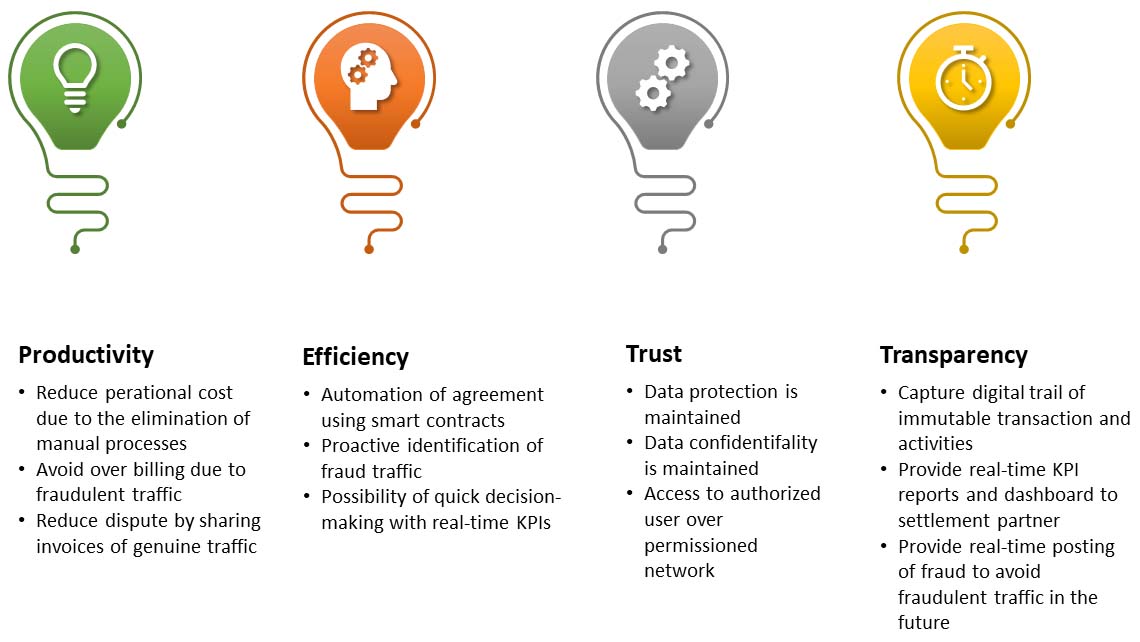
    Telecom Operators are exploring and investing in new cutting-edge technology to overcome the drawbacks of the traditional way of doing business. The traditional way of reconciliation of wholesale traffic is one such business scenario where settlement partners need to wait for the closure of the billing period to initiate the reconciliation to raise any dispute in case of any discrepancies. This delay in reconciliation leads to blockage of revenue for a longer period extending to 3 months to a year in some cases. Real-time reconciliation will improve business experience where overbilling due to fraudulent traffic will be avoided by proactive identification of fraud, and delay in dispute settlement can be avoided.

    Why Blockchain?

    Smart Contracts can be hosted over a blockchain that includes the business logic, which will ensure the real-time reconciliation of wholesale traffic using the relevant keys. The use of smart contracts will ensure digitization and transparency of the entire process from reconciliation, dispute management, and generation of credit/ debit notes. Blockchain will ensure the protection of digital key and sensitive data over the immutable distributed ledger, where blockchain will enable secured exchange of information & commercial transactions. The possibility of manipulating the data records or transactions over the blockchain is impossible, bringing trust and transparency for all the stakeholders and participants.

    How can a decentralized enterprise solution help?

    A decentralized enterprise solution can help to improve productivity, increase efficiency, bring trust and transparency.

    blockchain

    Reconciliation of wholesale traffic over blockchain ensures better productivity, transparency, trustworthiness, and a simplified process.

    Blockchain technology with a decentralized ledger can simplify the process by utilizing the permissioned blockchain where each settlement partners do not need to go back to each other for any information related to transactions or agreement. A distributed ledger will be used to keep track of KPIs and financial transactions to maintain financial settlements. Blockchain technology will allow components and features like consensus and permissioned membership services to ensure trust and transparency. Real-Time reconciliation of wholesale traffic over blockchain and identification of fraud and dispute will bring trust, transparency, improvement in revenue, and minimum expense or timelines for dispute settlement. Hyperledger capabilities allow an open-source solution for enterprises to solve challenges associated with the traditional way of doing business.

    Learn how our Blockchain-based Settlements solution can help your organization

    Schedule Demo

  • ¿Cuál es el papel de la redacción de contenido en las historias de telecomunicaciones?

    ¿Cuál es el papel de la redacción de contenido en las historias de telecomunicaciones?

    La digitalización ha cambiado la forma en que las personas viven, trabajan y disfrutan, y esto ha obligado a las organizaciones empresariales a modificar sus modelos de negocio para satisfacer los requisitos de sus consumidores en evolución. La industria de las telecomunicaciones es la más afectada por esta transformación. Las empresas de telecomunicaciones están experimentando con nuevas tecnologías y ofertas de servicios para atraer al cliente exigente. Las últimas tecnologías, aunque de naturaleza compleja, tienen mayor accesibilidad, adaptabilidad y compromiso entre los usuarios. Y una cosa que ha hecho esto posible es la penetración más amplia y profunda de la industria de las telecomunicaciones. Hoy, casi el 67% de la población mundial usa teléfonos móviles. Un total de 3.8 mil millones usan Internet, y el 52% de eso está en la red 4G. Esto ha dado a las personas acceso para consumir diferentes tipos de contenido a través de Internet.

    Cambiando el rumbo

    Las Telcos comenz a ofrecer servicios de valor agregado para contrarrestar la caída de los ingresos de voz y SMS. Pero la penetración de internet ha cambiado el panorama para los operadores. A medida que la industria de las telecomunicaciones pasa de ser solo un proveedor de servicios de comunicación a una organización más compleja que ofrece un conjunto de servicios digitales, el contenido está redactando una historia diferente. Las empresas de telecomunicaciones están ofreciendo contenido a través de su plataforma en colaboración con disruptores como los jugadores OTT. El tiempo que la gente pasa en línea también ha aumentado significativamente, con un usuario promedio que gasta 6.43 horas cada día. En 2019 se descargaron más de 200 mil millones de aplicaciones, con un gasto de $ 120 mil millones en apps y compras relacionadas con las mismas.

    COVID-19 también ha impactado el consumo de contenido, ya que los consumidores están haciendo cambios significativos en la forma en que interactúan con el contenido a través de las plataformas. Esto ha aumentado drásticamente el tiempo que se pasa en línea viendo contenido, especialmente noticias y entretenimiento. De hecho, el informe de Nielsen dice que quedarse en nuestros hogares puede conducir a un aumento de casi el 60% en la cantidad de contenido que vemos en algunos casos y potencialmente más dependiendo de los motivos. La situación actual seguramente tendrá un impacto conductual a largo plazo, y también podemos ver patrones de consumo similares en el futuro. Esta transformación ha llevado a los operadores a considerar el contenido como una oportunidad comercial de alto potencial para ahora y para el futuro.

    El camino de la experimentación

    La nueva historia de éxito se basa en la fortaleza directa del consumidor de la industria de las telecomunicaciones. Las empresas de telecomunicaciones se están aventurando en industrias adyacentes o se están asociando con los proveedores de contenido para explorar nuevas oportunidades y mantener a los clientes enganchados al servicio. T-Mobile adquirió el innovador producto de televisión Layer-3 para tomar la televisión por cable y satelital y revolucionar la forma en que las personas consumen televisión. AT&T adquirió Times Warner Inc. para ofrecer a los clientes una experiencia de entretenimiento móvil, diferenciada y de alta calidad. También lanzaron AT&T TV que se entregará a través de Internet como una alternativa a DirectTV para capturar el punto óptimo entre los usuarios de aplicaciones de transmisión y los usuarios tradicionales de servicios de televisión de pago, como la televisión por cable o por satélite. Solo para darle un vistazo, viene con una caja con Android TV que le permite cambiar entre TV en vivo y más de 5,000 aplicaciones de Google Play Store sin tener que cambiar las entradas en su televisor y acceder a aplicaciones de transmisión como Netflix, YouTube, Pandora o Spotify directamente desde su televisor.

    BT y Amazon firmaron un acuerdo para que la aplicación de video Prime esté disponible a través del decodificador de TV de BT. Telefónica también ha integrado la aplicación de transmisión de video Netflix en sus plataformas de video y televisión en América Latina y Europa.

    Airtel también lanzó Airtel Xstream a partir de USD11 (aprox.) por mes en India para captar el interés del segmento de consumidores más grande. Netflix ha creado un plan solo para dispositivos móviles para India que muestra cómo los parámetros demográficos serán de primordial importancia en su estrategia de expansión. Solo imagine la escala y el alcance del servicio que se ofrece a los consumidores y cuán complejo es administrarlos de manera transparente.

    Con 5G convirtiéndose en la corriente principal, habrá un mayor impulso en la oferta de servicios en términos de velocidad, variedad y experiencia. Los medios y el entretenimiento como el principal benefactor y que permiten formatos y aplicaciones de medios inmersivos como VR / AR y videos de 360 ​​grados, 5G promete un gran potencial para la oferta de contenido de las Telcos.

    Buscando la clave del éxito

    La oportunidad tiene sus propios desafíos para los operadores de telecomunicaciones. Las empresas de telecomunicaciones deben planificar una experiencia perfecta tanto para sus socios como para sus clientes finales. Esto incluye accesibilidad, entrega ininterrumpida de servicios, pagos sin errores y más para obtener el verdadero beneficio de convertirse en un proveedor de servicios digitales. A medida que el ecosistema se vuelve más complejo, tener un proceso de facturación y liquidación de contenido transparente y preciso puede garantizar la rentabilidad. Las empresas de telecomunicaciones deben tener la flexibilidad y la escalabilidad para construir y probar diferentes modelos de calificación y descuento, como penetración mínima, volumen de uso, compromiso de ingresos mínimos, una capacidad de pronóstico que permitirá a los operadores definir los modelos económicos para los servicios en el futuro. Aunque este no es el único desafío que deben superar. La identificación y la incorporación de socios adecuados, la capacidad de diseñar modelos económicos dinámicos y el monitoreo del desempeño de los socios y el mantenimiento de una asociación transparente solo pueden garantizar el éxito del complejo ecosistema.

    La gestión de contenido no es fácil dada la dinámica del servicio. La necesidad de la hora es una solución de facturación de contenido que pueda abordar esta naturaleza dinámica y única al mismo tiempo que permita la confianza y la transparencia en el ecosistema. Esto puede ayudar a los operadores a ofrecer una experiencia de contenido digital verdaderamente lista para usar a sus consumidores.

    Obtenga más información sobre la solución de facturación y liquidación de contenido de Subex.

    Haga clic aquí

  • Is ‘Content’ writing the new success story for Telcos?

    Is ‘Content’ writing the new success story for Telcos?

    Digitalization has changed the way people use to live, work, and enjoy, and this has forced business organizations to alter their business models to suit the requirements of their evolving consumers. The telecom industry is the one most impacted by this transformation. Telcos are experimenting with newer technologies, and service offerings to entice the demanding customer. The latest technologies though complex in nature, have higher accessibility, adaptability, and engagement among users. And one thing that has made this possible is the wider and deeper penetration of the telecom industry. Today almost 67% of the world population use mobile phones. A total of 3.8 billion use the internet, and 52% of that is on the 4G network. This has given people access to consume different types of content through the internet.

    Changing the course

    Telcos started offering value-added services to counter the falling revenue of voice and SMS. But the internet penetration has changed the landscape for the operators. As the telecom industry moves from being just a communication service provider towards a more complex organization that offers a bouquet of digital services, content is drafting a different story at all. Telcos are offering content through their platform in collaboration with disruptors like OTT players. The time people spent online has also significantly increased, with an average user spending 6.43 hours each day. More than 200 billion apps were downloaded in 2019, with a spending of $120 billion on apps and app-related purchases.

    COVID-19 has also impacted the content consumption as consumers are making significant changes to the way they interact with content across platforms.  This has drastically increased the time spent online watching content, especially news & entertainment. In fact, Nielsen’s report says that staying put in our homes can lead to almost a 60% increase in the amount of content we watch in some cases and potentially more depending on the reasons. The current situation will surely have a long term behavioral impact, and we may see similar consumption patterns going forward as well. This transformation has led operators to look content as a high potential business opportunity for now and for the future.

    The Road of Experimentation

    The new success story is built on the telecom industry’s direct to consumer strength. Telcos are venturing into adjacent industries or partnering with the content providers to explore new opportunities and keep the customers hooked to the service. T-Mobile acquired the television innovator Layer-3 to take on cable and satellite TV and revolutionize the way people consume TV. AT&T acquired Times Warner Inc. to offer customers a differentiated, high-quality, mobile-first entertainment experience. They have also launched AT&T TV that will be delivered over the internet as an alternative to the DirectTV to capture the sweet spot between streaming app users and traditional payTV service users such as cable or satellite TV. Just to give you a glimpse, it comes with an Android TV-powered box that lets you switch between live TV and over 5,000 apps from the Google Play Store without having to change inputs on your TV and access streaming apps such as Netflix, YouTube, Pandora, or Spotify right from their TV.

    BT and Amazon signed an agreement to make the Prime video application available through BT’s TV set-top box. Telefónica has also integrated the video streaming app Netflix in its video and TV platforms in Latin America and Europe.


    Airtel has also launched Airtel Xstream starting at USD11 (approx.) per month in India capture the interest of the larger consumer segment. Netflix has come up with a mobile-only plan for India that shows how demographic parameters will be of prime importance in your expansion strategy. Just imagine the scale and scope of service that are being offered to consumers and how complex it is to manage them in a seamless manner.

    With 5G becoming mainstream, there will be further boosted in the service offering in terms of speed, variety, and experience. Media and entertainment as the prominent benefactor and allowing immersive media formats and applications like VR/AR and 360-degree videos, 5G promises a huge potential for Telcos content offering.

    Looking for the Mojo

    The opportunity has its own challenges for the telecom operators. Telcos need to plan a seamless experience for both their partners and end customers. This includes accessibility, uninterrupted service delivery, error-free payments and more to realize the true benefit of becoming a digital service provider. As the ecosystem becomes more complex, having a transparent and accurate content billing and settlement process  can ensure profitability. Telcos should have the flexibility and scalability to build and test different rating and discounting models like minimum penetration, usage volume, minimum revenue commitment, A forecasting capability that will allow operators define the economic models for the services in future will go a long way.  Although this is not the only challenge that they need to overcome. Identifying and onboarding right partners, capability to design dynamic economic models and monitoring partner performance and maintaining a transparent partnership can only ensure the success of the complex ecosystem.

    Content settlement is not easy given the dynamicity of the service.  A content billing solution that can address this dynamic and unique nature simultaneously enable trust and transparency in the ecosystem is the need of the hour. This can help operators to offer a truly out of the box digital content experience to its consumers.

    Discover more on Content Billing and Settlement Solution of Subex.

    Click here!

  • Telecom Partner Assurance through Converged Partner Management

    Telecom Partner Assurance through Converged Partner Management

    The telecommunication industry has undergone a tremendous amount of change. From offering basic communication services to people, it has now an array of digital services along with basic voice and SMS service. The B2C or retail segment has seen a surge in telecom partnerships from both telecom and non-telecom domain as the data consumption is increasing multifold. There are content aggregators, content producers, partners from media & entertainment, fitness industry, financial, healthcare and many more. The B2B partnerships are also growing as 5G takes the center stage in the developed regions. Experts estimate around 31 billion IoT connected devices by the end of 2020. There will be more enterprise partners from other industry verticals.

    As the number of partners for a telecom operator increases, it becomes more crucial to keep transparency across the partner ecosystem. Doing timely billings and settlements become a difficult task with so many partners to manage. And ensuring an error-free process becomes more challenging given the variety of partners from multi-industry verticals.

    What is the Need of the Hour?

    For a healthy partnership, the transactions must be accurately managed, rated, and settled. Delays in the settlement process are one of the biggest concerns for Telcos and its partners. Wrong invoices and mismatch of information can lead to disputes, blocked revenue, and inefficient partnerships. Also, manually managing invoices from so many partners to identify discrepancies, raising disputes, and concluding the same can be very heavy on the OPEX.

    Partner Assurance for Successful Partnerships

    Partner Assurance allows telecom operators to have a transparent partner ecosystem with efficient billing and settlements. Partner Assurance feature of Subex ROC Partner Management solution offers a complete automated process to ingest invoices, reconciling, highlighting discrepancies and automatically raise disputes. It has a template-based ingestion process of invoices directly from emails or FTP locations. You can configure threshold values for Rate and Volume discrepancies hence automatically convert qualified discrepancies to disputes.

    What benefits it can deliver

    • Zero-touch invoice reconciliation to identify and manage billing disputes.
    • Allow wholesale fraud mitigation such as shortstops and smart FAS using near real-time communication and gather evidence to have a transparent relationship.
    • Ensure transparency and trust through reports, alerts & notification
    • Long term successful partnerships

    How the Power of 5G will Redefine Partner Management

    Read Blog

  • D-Partner unchained with Blockchain in the 5G era

    D-Partner unchained with Blockchain in the 5G era

    If you have to identify the most important element of the telecom ecosystem in the 5G era that can fuel multi-fold growth for operators, what it is going to be? If you ask for my answer, it’s D-Partner (The Partner).  Let me explain how the partner will play an important role in setting up a successful 5G ecosystem.  I will cover two aspects here:

    1. Why and how partnerships can only fuel success in 5G?

    2. Blockchain – How it brings digital trust in data exchanged between partners?

    The Potential that 5G holds

    5G ecosystem will give rise to a big parallel ecosystem of partnerships. A successful rollout of 5G will need collaboration between many partners who will fulfill different gaps in the ecosystem and eventually deliver the 5G promises. As the ecosystem develops, Telcos are expected to focus beyond just connectivity towards collaboration across the telecom value chain and different sectors, leading to the creation of new and innovative business models.

    This is the right time to unchain and unleash the power of partnership and empower the partners to build a strong ecosystem to realize the true potential of 5G.

    Different partners that telco need to collaborate can be broadly classified into below categories:

    1. Suppliers (Infrastructure, Software Vendors, Innovative service providers, etc.)
    2. Aggregators
    3. XVNO*
    4. Sales & Resellers
    5. Enterprise Partners (Enterprises in Healthcare, Smart Cities, Banking, Manufacturing, etc.)

    *XVNO=MVNO, IVNO(IoT-VNO), etc. Anyone can take a Network Slice and run innovative services on it. IoT has a big future on 5G platform and hence IoT-VNO.

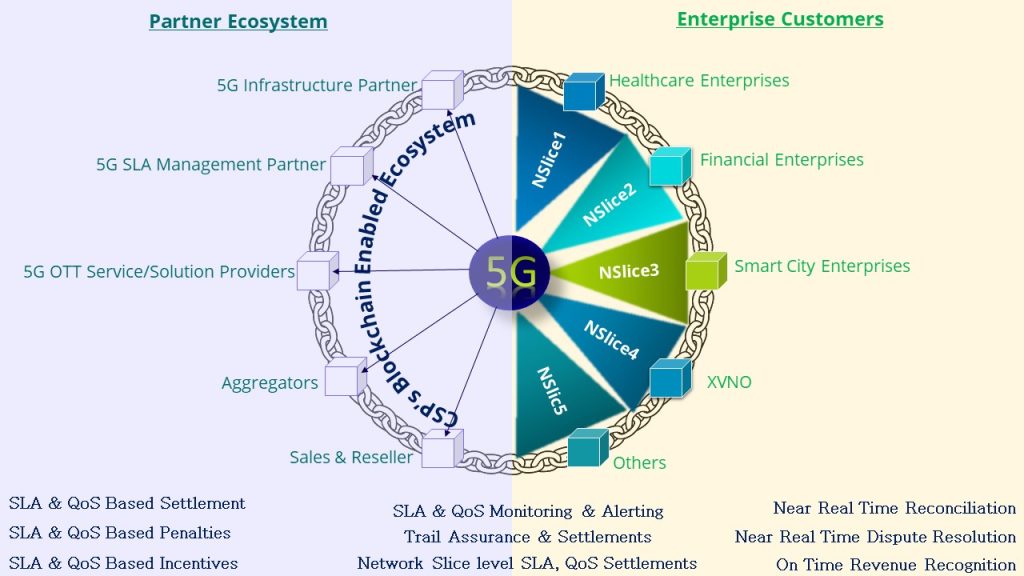
    All these partners will build a strong ecosystem to deliver the best result to end consumers, be it in B2C or B2B space. Delivering value will no longer be a play of the centralized entity, instead, this will be a decentralized ecosystem in which delivering value and the trust will be dependent on multiple entities/partners i.e. the trust itself will be decentralized. The below diagram clearly highlights how much decentralization is important going forward.

    Creation of a Trusted Decentralized Ecosystem to Deliver Value

    All these partners will be connected with different economic models to do billing and settlements. In the 5G ecosystem, SLA & QoS based economic models will be the key factor for all the billing and settlements. SLA & QoS is the key factor for 5G to be reliable, which will add a new parameter to the equation of billing and settlement which is currently transactional in nature. The 5G value chain will be dependent on many of these partners playing different roles at different points and all or related ones, are interconnected with cascading SLA’s & QoS.

    Having cascading SLA’s and with its dependency on multiple partners, who will deliver and ones who will consume the same, the need for a transparent & trustworthy environment becomes the key, which can:

    1. Update the SLA’s and delivered QoS to all relevant and impacted touchpoints in ecosystem
    2. Rating the services of each partner based on delivered SLA’s and QoS as agreed in the contract
    3. Compare and alert SLA breach based on the contracts with each partner in ecosystem
    4. Help in addressing disputes in near real-time, hence avoiding conflicts during payments and settlements

    Each of the above points translates to:

    1. Near real-time updates in a connected the ecosystem
    2. Near real-time contract monitoring
    3. Triggered events based on contractual models
    4. And above all, creation of a trustworthy the ecosystem

    Blockchain = Collaboration + Cryptography + Smart Contracts = Decentralized & Trusted Ecosystem


    The above diagram depicts how a decentralized setup will look, with multiple partners working towards building a reliable & connected ecosystem delivering the required SLA/QoS.

    For now, I leave you with this thought process and will get back to you on how we can wrap this overall decentralized environment with an E2E Partner Lifecycle Management system and its importance.

    The Decentralized Way Of Digital Partnerships

    Download Point of View

  • How Enterprise Blockchain will Change the Telecom Intercarrier Settlement Process

    How Enterprise Blockchain will Change the Telecom Intercarrier Settlement Process

    Enterprise Blockchain solution for telecom seems to be a promising development for the telecom industry as it strives to solve the challenges faced by Telcos in their settlement process. It is based on Distributed Ledger Technology (DLT) which has attracted lot of attention in the recent time to offer a  Way to record transactional data that should become a single source of truth to establish digital trust in the partnerships.

    Why Telcos are looking at blockchain as a possible solution for partner settlement? Telecom network operators across the world gets into interconnect agreement which enable a seamless communication among their customers. These agreements are executed between domestic and international operators for mobile, fixed and internet services. Telecom operators collect and store detailed activity information as events. Interconnect partners share these CDRs for the purpose of verification and settlements. This process is cumbersome, inefficient, lengthy, costly, and error-prone. Missing CDRs and discrepancies in CDRs are very common problems.

    As the interconnect revenue continues to decline it has become essential to address the blocked revenue due to disputes and to optimize the overall cost involved in resolving these discrepancies. The enterprise blockchain present a possibility that can make the settlement process error free and help the Telcos a faster and efficient access to the blocked revenue. Subex is actively working with multiple enterprise blockchain technologies to address the need.

    Subex is chairing the Linux Foundation’s Hyperledger Special Interest Group (SIG) Intercarrier Settlement subgroup to develop DLT based solution for partner settlement process. The purpose of the Special Interest Group (SIG) is to help Telcos understand the key issues in partner settlement and offer possible solutions for the same. Subex has been a key contributor in creating the solution brief. The group has been successful in defining a solution based on Hyperledger Fabric developing a working PoC which is available for demonstration for those who are interested.

    The proposed solution broadly addresses how a DLT-based solution can:

    • Converts the reactive dispute management process to more proactive process
    • Create a single source of truth, which allows network operators to access and verify billing and cross-charging data in real-time.
    • Reduce overall costs by replacing tedious processes, reducing dependency on intermediaries such as clearinghouses with simple, near real-time and error-free reconciliation and settlement process.
    • Help in evidence collection and fraud mitigation.

    DLT has shown great potential in solving issues related to fraud, errors and creating a secure data source. Given the possibilities mentioned in the solution document, the likelihood of extending it as a full-fledged solution is very high which means faster dispute resolution, reduction in overall cost and an efficient partnership that will help Telcos embrace the new technologies and innovate their services as per the need of the market.

    Link to access solution brief: Here

    Link to the Hyperledger Blog: Here

  • How the Power of 5G will Redefine Partner Management

    How the Power of 5G will Redefine Partner Management

    For an industry struggling and grappling with the speed at which new technology innovations are gaining relevance, 5G promises to be a serious game changer and the claim is completely merited. But nevertheless, telecom operators and their partners are very optimistic with the promised power that 5G will bring but are wary of the super-organizational efforts it will take to have real bottom line impact. 5G will change the equation for the industry much like the advent of cellular phones and services did when they shook the world with its possibilities.

    One Promise, Myriad Applications

    With adjacent technologies like Multi Access Edge Computing and Network functions virtualization to AR/VR that will thrive, the emergence of 5G promises to increase the number of connected smart devices.

    The use cases are many, and some are life changing. Video delivery and adverts are two areas that will significantly gain from enhanced speed, making the experiences highly personalized. The Quality of Service and SLA for each of these use case will depend on the criticality, and the acceptable thresholds will be adjusted based on the services. Quality of Experience (QoE/QoX) models will evolve for newer applications.


    With the ability to service numerous connected devices, the levels of quick and agile responsiveness are going to shake up the current equation. 5G will provide low latency needed for AR/VR enabling high speed data transfer. The impact of all these of course is a significant improvement in quality and experience!

    The impact of 5G thus, affects telecom operators of course, but also sees a lot of across industry use cases. The discoveries of new use cases will lead to the rise of modern partnerships in areas such as IoT, AR/VR, smart homes, virtualized networks, distributed cloud amongst others. So, hospitals as enterprise partners for remote surgeries, augmented reality shopping experience for brands, collaboration apps that are reinventing mainstream games – these are just some of the possibilities that will impact enterprise business as well as retail.

    However, as we move ahead, there are two aspects that need to be clear:

    • The basics of what this promised change is in terms of technology, capability and regulations
    • What operators need to do to fully optimize the powerhouse performance that is expected from 5G

    Yes, they could both be moving targets and rapidly adapting is the need of the hour.

    A Careful Hope

    The reason why caution must be exercised though it is easy to get carried away in the excitement is that the basic systemic problems remain unchanged. Tightening regulatory norms and increased compliance requirements, the global debate on privacy and data breaches, intense competition translating to depreciating profit – all these are very much alive.

    5G must be embraced by operators but there needs to be a method of adoption. There is greater scope for perimeter security and 5G will mean increased efficacies, but all of this will only come to fruition if these exercises are balanced with understanding the now-more-than-ever-importance of data analytics, AI and machine/deep learning and understanding how all of these components will be needed to offer improved service. What this means is that network operators finally have a chance to take somewhat of a centre-stage in ascertaining more control over two critical aspects

    1) Re-building their customer experience so there is a shift in perception and hopefully loyalties and

    2) Finally finding a way to ensure monetization is addressed

    Changing the Paradigm with 5G

    The journey towards 5G implementation is going to be a long and arduous one. While 4G is not something that operators can ignore entirely and shouldn’t, there must be a re-look into the operators’ own business models and relationships with key stakeholders. They need to see where deeper relationships can be forged to understand the customer’s somewhat limited yet exaggerated expectations of 5G.

    For the 5G promised change to make a significant difference, industry require alertness towards the variegated forms that disruption and transformation are going to take. The definite actions to make this happen will simply make all the difference between success and failure for the world’s telecom operators.

    To know more about Subex Partner Management solution.

    Click here