Category: Network Asset Management

  • How CSPs Are Prioritizing Sustainability with On-Site Renewable Energy Solutions

    How CSPs Are Prioritizing Sustainability with On-Site Renewable Energy Solutions

    As the telecommunications sector expands, so will its energy usage. According to Ericsson, mobile networks consume 0.6% of the world’s electricity, with estimates indicating that operators spend more than $25 billion on energy expenditures each year. As a result, for Communication Service Providers, energy efficiency and sustainability are becoming more essential problems (CSPs).

    Many CSPs are investigating on-site renewable energy options to solve these problems. By 2025, 60% of CSPs are expected to prioritise on-site renewable energy, up from less than 10% in 2022. Cell sites, data centres, and other energy-intensive places can be powered by on-site renewables, decreasing CSPs’ dependency on non-renewable energy sources.

    Several CSPs have already begun to investigate on-site renewables, with Deutsche Telekom working with Ericsson to explore solar and wind-powered cell sites, Telenor Group investigating solar and wind-based energy solutions for cell sites, and Telefónica implementing a Smart Site model for mobile site design that incorporates renewable energy sources.

    In addition to lowering the carbon footprint of CSPs, on-site renewables can assist to lower energy prices. As energy prices rise, CSPs are focusing more on energy efficiency to save money. CSPs can minimise their dependency on nonrenewable energy sources and cut their energy expenses by installing on-site renewables and energy efficiency efforts.

    CSPs and tower companies should bear in mind that various sites may require different solutions based on weather conditions and power demands as they investigate on-site renewable energy alternatives. Because of the number of bands, urban cell sites may require more power than rural or suburban sites, and solar power may not be possible in these places with today’s methods.

    CSPs should create a roadmap including network planning and operations, sustainability teams, procurement, and finance to successfully integrate on-site renewables into their networks. They should also work with vendor partners to harmonise roadmaps and objectives/targets for renewable energy usage.

    AI has the potential to significantly assist CSPs in optimising their energy use and reducing their dependency on nonrenewable energy sources. AI can help by offering predictive analytics and real-time monitoring of energy consumption. This can assist CSPs in identifying areas where energy consumption can be lowered and optimising operations to be more energy-efficient.

    Moreover, AI-powered algorithms can assist CSPs in optimising renewable energy systems such as solar panels or wind turbines to maximise energy output. AI, for example, may evaluate meteorological data to forecast the quantity of solar radiation or wind speed, which can assist CSPs in determining the best position for renewable energy systems and adjusting their output accordingly.

    Furthermore, AI may assist CSPs in identifying prospective places for on-site renewables installation by identifying sites with high energy demand and high potential for renewable energy solutions using data-driven insights. CSPs may simulate numerous scenarios and decide the most efficient solution for a specific location using AI-powered simulations, taking into consideration aspects such as weather patterns, power consumption, and cost-effectiveness.

    Another method AI may assist CSPs in reducing their carbon footprint is through optimization of Radio Access Network (RAN) operations. The RAN is the component of the mobile network in charge of connecting user devices to the network and handling data transfer. RAN is a substantial contribution to mobile network energy usage, and improving RAN operations may result in considerable savings in power consumption and carbon emissions.

    Real-time RAN data may be analysed by AI-powered algorithms to discover locations where power consumption can be lowered without affecting network performance. For example, AI may monitor traffic patterns and alter the power settings of RAN equipment in real-time to decrease power consumption while satisfying performance requirements.

    AI may also be used to improve RAN equipment placement, ensuring that the equipment is placed in the most energy-efficient areas and eliminating the need for more equipment. CSPs may dramatically cut their power usage, lower their carbon footprint, and increase network performance by improving RAN operations.

    Overall, artificial intelligence may assist CSPs in making educated decisions about energy use and the installation of renewable energy solutions. CSPs may lower their carbon footprint and contribute to a more sustainable future by employing AI to optimise their energy use and maximise the use of renewable energy.

    Finally, on-site renewable energy solutions provide various advantages for CSPs, including a lower carbon footprint, cheaper energy costs, and enhanced dependability during extreme weather events. CSPs may progress towards a more sustainable and lucrative future by emphasising on-site renewables and adopting energy efficiency programmes.

    Telco Sector Can Be a Gamechanger for Sustainability using AI/ML

    Download Point of View!

  • 5 ways to select the best asset maintenance software for optimal performance

    5 ways to select the best asset maintenance software for optimal performance

    Simplifying operations by working towards the right tools and technologies is a fundamental priority for all business owners. Choosing the right enterprise asset management software is a critical aspect of this endeavor: a robust asset management system can help you maximize the life of assets through preventive care, improve software and asset utilization and reduce unnecessary costs.

    No matter what you’re tracking, monitoring enterprise asset health and maintenance is vital to improving productivity. However, companies today have an overwhelming variety of enterprise asset management options to choose from.

    Choosing the right enterprise asset management tool for your business can be exhausting, especially if you are unaware of what to look for. In this blog, we’ll run you through some important points you should consider before purchasing asset management software.

    1. Know your business requirements in regards to user-level and technical requirements

    Business requirements include the volume of assets there are in your business, their efficiency and performance, and why do you want to track assets. In selecting enterprise asset management tools, it is implied that you look for cutting-edge usability improvements that will streamline the adoption of the software in the company and offer enhanced decision and managerial support in presenting which management tasks are most urgent at a given time.

    2. Facilitate a centralized repository for all users to access

    The enterprise asset management solution requires a centralized repository that consolidates relevant information about each asset. Other valuable capabilities are analytics and dashboards, which give a complete picture of how assets perform, and automated workflows for engineers to orchestrate networks automatically. This repository will ensure real-time monitoring that supports ‘asset analytics’, i.e., using asset KPIs to create reports that help CTOs and CFOs prioritize operations to achieve business goals.

    3. Ensure holistic visibility of your asset workflows

    Technical prerequisites contain how you plan to host the software, and what security and backup procedures you want. Also, by incorporating both your technical requirements and user-level requirements you can achieve more than the expected benefits. Analyze the standing and experience of developing the asset software of the vendor. A well-known asset tracking and management software provider is more likely to be able to offer continuing support.

    4. Reporting and analytics

    Concentrating all your assets in one location isn’t just about efficiency. It also provides you with a better summary of your asset library. Robust reporting and analytics offer insights into how your assets are being used. If you’re obtaining a lot more return out of certain assets, you might want to create more like them. You can track if valuable assets are being underutilized or spot other patterns to refine your content strategy. Management software systems also help safeguard assets from misuse by keeping a track of downloads and access.

    5. Ensure Accessibility

    You should find a fine balance between ease of use and the requirement of expertise a software requires, less training and easy to use software would save costs in operation. Your software provider should also readily provide the required training to your staff. They should also provide the support and quick interpretation of problems and solutions needed once the software is implemented. For an asset management library to serve a whole organization, administrators must be able to regulate who can access what.

    Enterprise Asset management software provides a holistic view of an enterprise asset’s lifecycle—from its procurement and implementation through its renewal and disposal. While a business could use a simple spreadsheet to track its assets, using AMS enables it to analyze data specific to each asset, enabling it to make more informed decisions about managing its assets, so choose wisely.

    To understand more about Subex’s Network Asset Management solution

    Schedule a demo!

  • What are the five most asked features of Enterprise Asset Management Software?

    What are the five most asked features of Enterprise Asset Management Software?

    The telecommunications industry is evolving rapidly and witnesses unique challenges compared to other sectors. The telecom industry stands out by way of its requirements for massive capital investment over a wide geographical spread. This requirement also extends itself to the network assets operators need, which have to be refreshed more frequently than any other industry.

    With growing changes in technologies and ever decreasing technology cycles, the telecom industry is under immense pressure to make smart Capex investments to stay competitive in today’s market. Add the auditory, regulatory requirements, and transformation from legacy to next-gen technologies, it becomes imperative for the operators to know the rate of change in their network when it comes to:

    • Rolling out new networks
    • Optimizing investments made in existing assets while ensuring seamless migration to newer technologies
    • Decommissioning and monetizing end-of-life assets

    Of course, Enterprise Asset Management software has a role to play in terms of handling network assets in the right way, to ensure Capex and Opex are kept in check. At the same time, regulatory and audit compliance is adhered to. However, operators have several asset management solutions to choose from, making it difficult to choose the right solution within the plethora of offerings.

    In such a scenario, it would be easier for CSPs to understand what features are key to their operations as a guide for choosing the right telecom asset management solution. Below is an indicative list of the top 5 features every CSP must look for within their Enterprise Asset Management software.

    1. Centralized Asset View

    With the proliferation of new technologies and service offerings, many assets are being onboarded on the network. The network and finance teams require a comprehensive view of the assets, their lifecycles, and cross-functional data.

    CSPs need a solution that can provide them with a 360o view of their assets, encompassing asset information across finance, supply chain, network planning, network operations, historical events, contract summary, licenses & security information. Such a feature also needs to provide cross-functional asset information, which is stitched into a seamless view and made easily accessible through a user-friendly UI. This will provide users the flexibility to access other functional asset data in the same place for a single, federated view of assets.

    2. Asset Tracking

    Asset Tracking during site deployments, daily operations, or decommissioning is critical for operations managers. Performing audits and highlighting process deviations are essential to fix process issues and identify operational gaps.

    CSPs need a solution that can perform electronic audits on the network to automatically identify the addition/movements/removals of assets in the enterprise and sends alerts to users if these changes are deviations from tracked workflows. This information can also be used to suggest process improvements.

    3. AI-based Contract Management

    Managing contracts in a telecom environment is a complex activity covering a broad spectrum of contract documents to be handled. It is increasingly vital for telco teams to have comprehensive contract management with automation and AI capabilities.

    Operators need a Contract Management modules that can ingest contract information from any data source, including ERP systems, map each contract to applicable network assets, and notify specific users or teams on expiry and cover contract line items. By Applying Artificial intelligence to the contract ingestion mechanism, heightened efficiencies and accuracy levels can be achieved.

    4. Spare Management

    Operator teams see a strong need to forecast the spare assets based on operational data and make data-driven decisions.

    An ideal Spare Management module can track spare assets across the network and provide spare asset information and spare levels (min, max) and spare classifications. It should also provide users with the option to initiate workflows to move spare assets for excess returns, repair and fault replacement requests. A spare management module also needs to leverage predictive analytics to compute every network site’s exact spare levels, based on historical fault data.

    5. FAR Reconciliation

    Misalignment of inventory system data and the actual network can cause operational issues that lead to poor customer experience. Similarly, mismatches between Fixed Asset Records (FAR) and the actual network can cause regulatory non-compliance and financial cost leakages.

    Operators can leverage a FAR Reconciliation module to identify discrepancies between asset data recorded within the Fixed Asset Register (FAR) and actual assets in the network. By syncing FAR records and actual assets, operators can witness better regulatory compliance that ultimately helps better assess insurance costs and reduce tax liabilities.

    Leverage end-to-end Business Intelligence across the enterprise asset lifecycle to yield significant network savings.

    Schedule for a demo

  • Software License Management: The 8 key ingredients for managing software licenses for the telecom industry

    Software License Management: The 8 key ingredients for managing software licenses for the telecom industry

    In today’s telecom world, organizations are heavily reliant on software solutions for numerous functions, including task-critical ones. As a result, software licensing can be a significant budget entity for many organizations. Effective license management is essential to preventing inaccurate tracking of software licenses and usage measurement issues that can cause budget discrepancies.

    In almost all cases, the software is sold by licensing, whether it be a perpetual license to use the software or a subscription settled monthly or yearly that must be renewed continually. To ensure that you are utilizing every penny spent out of your software assets, the first thing to do is to understand the types of licensing agreements and plan the license management accordingly.

    This is where Software license management (SLM) comes in. Software license management refers to all organizational aspects of deploying and maintaining your organization’s software assets. It is a part of the broader software asset management category.

    Given the large share spent on software licenses, an exceptional benefit of SLM is the revenue it can save you by identifying unnecessary or unused/underused software. Paying for such software can stack up to a sizable sum for each user or device covered by an unused solution. SLM enables you to track all software purchases and audit their usage, or lack thereof, in the case of unused paid subscriptions.

    Another benefit of SLM that can help in even more significant financial savings is that it enables enforcing compliance with End-User License Agreements (EULA). Any device running unlicensed software reveals you to potential financial penalties and legal issues in most circumstances.

    When following your software licenses, it is vital to know how the latest technology impacts software usage and policies. With 5G and, thereby, artificial intelligence (AI), augmented reality (AR), machine learning (ML), and the Internet of Things (IoT) picking up pace in recent years, software licensing has had to adjust to the advancements introduced by these developments.

    The extensive use of automation powered by AI and ML has impacted SLM by enabling the automatic functioning of many of the processes. This includes overlooking what programs are being used, how they are being used, and setting up control protocols to limit their usage to authorized individuals and roles. These tools can also be used in the maintenance of software to make it easier to detect violations of EULA.

    IoT devices are now present at all business and consumer levels and functions, including telecom. Observably, the SLM implications of these devices can be tricky, and the software underlying them can be challenging to manage using traditional SLM tools and procedures. It’s important to track new processes for applying SLM techniques to IoT devices to optimize your ability to utilize them. Proactive SLM allows the improvement of your IT efforts. It provides the possibility to lower costs and boost your ability to react to changing business conditions by drawing the maximum advantage of the capabilities of your software rapidly.

    As we have seen, managing your software licenses is essential to avoid the negative results associated with non-compliance. The following are points to help your telecom business to manage software licenses:

    Document software management policies

    SLM records and stores your software management policies to manage and serve when required to avoid costly surprises come audit time.

    Usage governance procedures

    Establishing controls for managing software usage across the organization and groups of workspaces is a breeze with SLM. It also ensures that only authorized users can download and use the software they are authorized to use. These management controls are critical in an era where users can effortlessly access the software at work or home on various devices. The procedures of usage of software policies in all telecom spaces should be tied to your usage governance utility to effectively onboard and offboard employees via provisioning automation.

    Software lifecycle management

    Special care must be undertaken to manage all aspects of the software lifecycle, including renewing licenses, updating information, and communicating usage parameters to employees. With SLM, it can be done efficiently.

    Usage monitoring

    It is necessary to constantly monitor which programs are present on your network, how they are being used, and who is using them to ensure that your authorization policies are working as planned and that the correct solutions are being applied for desired purposes. With SLM integrated, it is still possible to use automated and manual auditing when needed.

    Automated updating checks

    Automated discovery of software versions is available with SLM, enabling you to operate on the most recent version of any installed programs consistently.

    Reclaiming procedures

    Regularly uninstalling software that has been idle for a certain prescribed period and return it to stock for future reuse or cancellation if suitable.

    Track contracts

    SLM analyzes contract databases and procurement records to enable easy compliance with contractual conditions and viewing important contract data such as license type, number of authorized users, and expiration dates with fewer steps than manually looking through them.

    Employ license management automation

    Software License Management solutions can help optimize your license management by developing vendor licensing profiles you can use to automate the process of moderating your license status to installed software. This can help the efficiency of license management, especially in preparing for a true-up or other large-scale audits.

    Establish and track software management objectives

    To measure the effectiveness of your SLM efforts or select licenses for cost-saving objectives and track your performance about goals over time that can be achieved with proper SLM.

    With a substantial portion of software costs resulting from inadequate software management, the case for software licensing management is a strong one. According to research from Gartner, many organizations can ameliorate software spending by as much as 30% via software license optimization via best practices. Besides revenue optimization, effective SLM can generate revenue, and there are also efficiency gains to be experienced by making better use of the software your organization has acquired.

    SLM can benefit telecom organizations by helping them effectively use their software to quickly react and adapt to changing market conditions, optimize operations, and stay in compliance with EULA. At a minimum, SLM can help you track and optimize your software policies to help your managers acquire and use the tools at the right time.

    Why is Network License Management crucial for Telecom Operators?

    Download Point of View!

    References:

    https://www.yumpu.com/en/document/view/37782291/software-licensing-in-telecom-industry-an-analysis-softsummit

    https://www.bmc.com/blogs/software-license-management/

    https://www.dell.com/en-us/blog/a-fundamental-shift-in-how-telecom-networks-are-built/

    https://www.researchgate.net/publication/260591298_Licensing_Models_and_their_Impact_on_the_Telecom_Software_Industry

    https://www.cisco.com/c/en/us/buy/enterprise-agreement/resources/what-is-software-license-management.html#~conclusion

  • Infraestructura de red: adoptando la disrupción a través de la innovación

    Infraestructura de red: adoptando la disrupción a través de la innovación

    Hay pocas coyunturas críticas en las que la industria cambia su curso, se transforma y se prepara para el crecimiento futuro. Tales coyunturas a menudo coinciden con interrupciones tecnológicas, seguidas de un largo período de adopción orgánica. En esta publicación, veremos las interrupciones clave que están metamorfoseando constantemente la industria de las telecomunicaciones en la modernización de su infraestructura de red.

    El abismo de la virtualización

    Hace casi una década, las iniciativas de la industria generaron las tecnologías prometedoras de Redes definidas por software (SDN) y Virtualización de funciones de red (NFV). Estas tecnologías permiten la gestión de redes impulsada por software desde las redes centrales hasta la agregación para acceder a las redes. Las cargas de trabajo de red ya no residen en hardware propietario proporcionado por OEM. En cambio, se empaquetan en funciones de red virtual (VNF) y se alojan en entornos virtuales. Con el tiempo, el concepto de virtualización ha ido tomando diferentes formas y se ha ido adaptando lentamente a las necesidades del mercado. Como en cualquier ciclo de adopción de tecnología, la adopción de SDN / NFV ha encontrado un “abismo” para lograr un alcance más amplio. El abismo, en este caso, se debe a desafíos de transformación, casos de éxito no comprobados, desafíos de procesos y sistemas internos, negocios

    Sin embargo, el abismo no ha impedido que la mayoría de las empresas de telecomunicaciones adopten los principios de virtualización para satisfacer sus necesidades actuales. Uno de los desarrollos clave que ocurrieron durante la última década es la virtualización de cargas de trabajo de red “de bajo costo” como firewalls, sistemas OSS / BSS, DNS, DHCP, IMS, etc. Las empresas de telecomunicaciones comenzaron a adoptar “nubes privadas”, es decir, virtualización. infraestructura y comenzó a alojar cargas de trabajo de red (VNF) en máquinas virtuales. Esto le ha dado a las empresas de telecomunicaciones una enorme capacidad para optimizar costos, controlar las políticas de seguridad y escalar hacia arriba o hacia abajo la infraestructura según sea necesario.

    Si bien algunos operadores han comenzado a trabajar en plataformas ágiles, controladas por software y de orquestación de servicios, la adopción más amplia aún tiene mucho camino por recorrer. Persisten los desafíos de manejar tanto las funciones de red física (PNF) como las funciones de red virtual (VNF) en la misma plataforma, con la complejidad adicional de interactuar con redes heredadas. Aquí es donde una asociación de colaboración con proveedores como Subex podría aportar la experiencia que enriquece dichos programas de transformación.

    La siguiente Nube

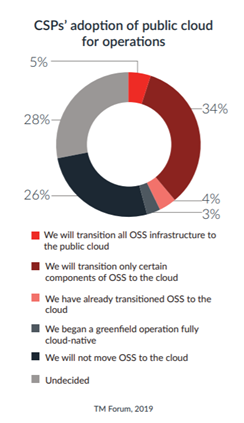
    Pasemos de las cargas de trabajo de red a la infraestructura de aplicaciones fuera de la red. La noticia reciente del acuerdo de nube de $ 2 mil millones de Microsoft con AT&T ha creado un gran revuelo en el mundo de las telecomunicaciones. El cambio de AT&T para migrar todas las cargas de trabajo de OSS / BSS que no pertenecen a la red a las nubes públicas dará lugar a beneficios de la nube a hiperescala, como un menor costo total de propiedad, mayor agilidad, tiempo de comercialización más rápido y escalabilidad. Esperamos que algunas empresas de telecomunicaciones importantes también sigan su ejemplo en el corto plazo. Pero aquí está la estadística interesante del estudio de TMForum: solo un segmento menor de jugadores ya está en la nube pública o está listo para migrar OSS / BSS a la nube pública. Como era de esperar, un gran porcentaje de operadores son cautelosos o han decidido no pasar a la nube pública.

    ¿Los proveedores comenzarán a admitir arquitecturas nativas de la nube de inmediato? La respuesta es sí y no. Hay un pequeño grupo de proveedores como Subex que ya están en este camino y podrán apoyar a los operadores en su búsqueda hacia una estrategia de nube primero. Al mismo tiempo, hay un número más significativo de proveedores que confían en la estrategia de “levantar y cambiar” a corto o mediano plazo y esperan hacer sus ofertas verdaderamente nativas de la nube a largo plazo. Este es un desarrollo interesante a tener en cuenta.

    Open RAN

    Hace unos años, los grandes fabricantes de equipos originales introdujeron en el mercado productos RAN únicos o vRAN patentados, que no lograron captar el verdadero espíritu de interfaz abierta que las empresas de telecomunicaciones estaban buscando. Esto motivó a algunas nuevas empresas a trabajar en colaboración en una idea novedosa: ejecutar sus productos en servidores básicos, habilitar el control del software a través de protocolos de interfaz abiertos y realizar actualizaciones futuras sin problemas con solo introducir parches de software. El resultado de este ejercicio es el modelo de red desagregado Open RAN del foro Telecom Infra Project (TIP). El objetivo principal es optimizar el enorme Capex / Opex que se destina a la construcción de redes RAN en entornos brownfield. Pasar del acceso a la virtualización de redes centrales y de agregación, orquestación de servicios, contenedorización de cargas de trabajo y aprovisionamiento sin intervención se está convirtiendo lentamente en una realidad y es una de las áreas clave de interés para los equipos de tecnología en Telcos.

    Tiempos emocionantes

    Durante la última década, la infraestructura de red se ha visto realmente interrumpida. La tendencia se ha acelerado en los últimos años con la adopción de SDN WAN, infraestructura NFVi, nube pública, Open RAN, etc. Los administradores de red necesitarán tomar decisiones de transformación de tecnología basadas en factores clave como agilidad de red, arquitectura escalable, tiempo más rápido para mercado, experiencia superior del cliente, operaciones adaptativas, reducción de Capex / Opex y simplemente estar preparado para el futuro. El ecosistema de la industria ya está presenciando los brotes verdes de la virtualización y la transición a la nube. Es un momento emocionante para ser parte de este desarrollo.

    Explore más sobre la solución de infraestructura de red de Subex.

    ¡Haga clic aquí!

  • ¿Cuáles son las cinco características más solicitadas del software de gestión de activos de telecomunicaciones?

    ¿Cuáles son las cinco características más solicitadas del software de gestión de activos de telecomunicaciones?

    La industria de las telecomunicaciones está evolucionando rápidamente y es testigo de desafíos únicos en comparación con otros sectores. La industria de las telecomunicaciones se destaca por sus requisitos de inversión masiva de capital en una amplia extensión geográfica. Este requisito también se extiende a los activos de red que necesitan los operadores, que deben actualizarse con más frecuencia que cualquier otra industria.

    Con los crecientes cambios en las tecnologías y los ciclos tecnológicos cada vez menores, la industria de las telecomunicaciones se encuentra bajo una inmensa presión para realizar inversiones de Capex inteligentes para seguir siendo competitiva en el mercado actual. Agregue los requisitos auditivos, regulatorios y la transformación de tecnologías heredadas a tecnologías de próxima generación, se vuelve imperativo para los operadores conocer la tasa de cambio en su red cuando se trata de:

    • Implementación de nuevas redes
    • Optimización de las inversiones realizadas en activos existentes al tiempo que se garantiza una migración perfecta a tecnologías más nuevas.
    • Desmantelamiento y monetización de activos al final de su vida útil

    Por supuesto, el software de gestión de activos de telecomunicaciones tiene un papel que desempeñar en términos de manejar los activos de la red de la manera correcta, para garantizar que el Capex y el Opex se mantengan bajo control. Al mismo tiempo, se respeta el cumplimiento normativo y de auditoría. Sin embargo, los operadores tienen varias soluciones de gestión de activos de telecomunicaciones para elegir, lo que dificulta elegir la solución adecuada dentro de la gran cantidad de ofertas.

    En tal escenario, sería más fácil para los CSP comprender qué características son clave para sus operaciones como guía para elegir la solución de gestión de activos de telecomunicaciones adecuada. A continuación, se muestra una lista indicativa de las 5 características principales que todo CSP debe buscar en su software de gestión de activos de telecomunicaciones.

    1. Vista de activos centralizada

    Con la proliferación de nuevas tecnologías y ofertas de servicios, muchos activos se están incorporando a la red. Los equipos de redes y finanzas requieren una visión integral de los activos, sus ciclos de vida y datos multifuncionales.

    Los CSP necesitan una solución que les pueda proporcionar una vista de 360 de sus activos, que abarque la información de los activos en finanzas, cadena de suministro, planificación de redes, operaciones de red, eventos históricos, resumen de contratos, licencias e información de seguridad. Dicha característica también debe proporcionar información de activos multifuncional, que se une en una vista perfecta y se hace fácilmente accesible a través de una interfaz de usuario fácil de usar. Esto brindará a los usuarios la flexibilidad de acceder a otros datos de activos funcionales en el mismo lugar para obtener una vista única y federada de los activos.

    2. Seguimiento de activos

    El seguimiento de activos durante las implementaciones del sitio, las operaciones diarias o el desmantelamiento es fundamental para los gerentes de operaciones. Realizar auditorías y resaltar las desviaciones del proceso es esencial para solucionar los problemas del proceso e identificar las brechas operativas.

    Los CSP necesitan una solución que pueda realizar auditorías electrónicas en la red para identificar automáticamente las adiciones / movimientos / eliminaciones de activos en la red y envía alertas a los usuarios si estos cambios son desviaciones de los flujos de trabajo rastreados. Esta información también se puede utilizar para sugerir mejoras de procesos.

    3. Gestión de contratos basada en inteligencia artificial

    La gestión de contratos en un entorno de telecomunicaciones es una actividad compleja que cubre un amplio espectro de documentos contractuales a gestionar. Es cada vez más vital para los equipos de telecomunicaciones tener una gestión de contratos integral con capacidades de automatización e inteligencia artificial.

    Los operadores necesitan un módulo de gestión de contratos que pueda ingerir información de contratos de cualquier fuente de datos, incluidos los sistemas ERP, asignar cada contrato a los activos de red aplicables y notificar a los usuarios o equipos específicos sobre el vencimiento y cubrir los artículos de línea del contrato. Al aplicar la inteligencia artificial al mecanismo de ingestión por contrato, se pueden lograr mayores niveles de eficiencia y precisión.

    4. Gestión de repuestos

    Los equipos de operadores ven una gran necesidad de pronosticar los activos de repuesto basándose en datos operativos y tomar decisiones basadas en datos.

    Un módulo de gestión de repuestos ideal puede rastrear activos de repuesto en la red y proporcionar información de activos de repuesto y niveles de repuesto (mínimo, máximo) y clasificaciones de repuesto. También debe proporcionar a los usuarios la opción de iniciar flujos de trabajo para mover activos de repuesto para solicitudes de devolución, reparación y reemplazo de fallas en exceso. Un módulo de gestión de repuesto también necesita aprovechar el análisis predictivo para calcular los niveles de repuesto exactos de cada sitio de la red, basándose en datos históricos de fallas.

    5. Reconciliación FAR

    La desalineación de los datos del sistema de inventario y la red real puede causar problemas operativos que conducen a una mala experiencia del cliente. De manera similar, los desajustes entre los registros de activos fijos (FAR) y la red real pueden causar incumplimiento de las regulaciones y fugas de costos financieros.

    Los operadores pueden aprovechar un módulo de reconciliación FAR para identificar discrepancias entre los datos de activos registrados en el Registro de activos fijos (FAR) y los activos reales en la red. Al sincronizar los registros FAR y los activos reales, los operadores pueden presenciar un mejor cumplimiento normativo que, en última instancia, ayuda a evaluar mejor los costos de seguros y reducir las obligaciones fiscales.

    Aproveche la inteligencia empresarial de extremo a extremo a lo largo del ciclo de vida de los activos para generar ahorros de red significativos.

    Programar una demostración

  • The Latest in the Network Asset Management Space

    The Latest in the Network Asset Management Space

    Thoughts from Subex

    The first half of the year has been an exciting one in the network asset domain. Conversations around network sharing, which we have captured a glimpse of, continue to be prevalent, which further resonates with the thoughts echoed by Brian Barnell, Managing Director, FierceWireless, last year. It will be interesting how this trend grows in the coming months, as network infrastructure itself continues to evolve.

    Another interesting trend we are seeing, and this stems further from our conversations with customers is the rising number of contracts CSPs have to deal with. Had this newsletter covered the new vendor deals CSPs are signing, the newsletter would only cover deal announcements. But that just shows us just how vital Contract Management is becoming, considering the news only covers the big announcements. In reality, these contracts easily go above and beyond the 1k figure, and CSPs are looking at ways to improvise and alleviate this challenge. BT has captured some of the risks associated with contract management, and it shows that this problem is quite real.

    On that note, here the first and latest version of our Network Asset Management Newsletter. We hope you enjoy reading it as much as we enjoyed creating it for you.

    Top News from the Sector

    Unlocking and Building Value in Telecom

    What does it mean that three of the highest-return telecom companies over the past five years are not real telecom companies? Could there be any clearer signal that the industry is under the sway of fundamental transformation than the fact that three tower companies—companies that own passive telecom infrastructure—generated higher shareholder returns from 2015 to 2019 than almost all operators? The apparent moral here is that it’s more profitable to own passive telecom assets than to operate wireless services.

    https://www.bcg.com/en-in/publications/2020/tmt-value-creators-unlocking-building-value-telecom.aspx

    Airtel and Sercomm launch virtualized TDD small cell

    Hailed as the world’s first and jointly developed by the two companies, the small cell offers a plug-and-play approach for the cloud radio network connection and will deliver enhanced efficiencies. “At Airtel, we are obsessed with our customers and adding value to their lives with our offerings,” said Randeep Sekhon (pictured), CTO of Bharti Airtel.

    https://www.capacitymedia.com/articles/3825433/airtel-and-sercomm-launch-virtualised-tdd-small-cell

    SDN eases pandemic’s telecom burden

    Software-defined networking played an important role in supporting the massive work-from-home response to the pandemic in the last few months, according to some carrier members of the National Security Telecommunications Advisory Council (NSTAC).

    https://gcn.com/articles/2020/05/15/sdn-pandemic-network-traffic.aspx

    Deep dive: what’s the deal with network sharing?

    5G is on the horizon, and it has the telcos scrambling. Upgrading telecoms infrastructure is going to be a very expensive job, ranging from fibering up a nation to purchasing active infrastructure for sites and even paying for civil engineering jobs; building passive infrastructure is not cheap! Telcos need a way to make the financials of the telecoms future work.

    https://telecoms.com/501903/deep-dive-whats-the-deal-with-network-sharing/

    Insights from your peers

    As per the 2019 annual report, Vodafone Group has put a clear strategic priority on improving asset utilization to improve return on capital.

    http://media.corporate-ir.net/media_files/IROL/77/77862/annual-reports/annual_report19/downloads/Vodafone-full-annual-report-2019.pdf

    As per the 2019 annual report, AT&T is targeting to monetize $5-$10 billion of non-core assets by 2020. On the other hand, AT&T expects to invest gross capital of $20 billion. Which means half of the investment money they are expecting to receive from monetizing the non-core assets. https://investors.att.com/~/media/Files/A/ATT-IR/financial-reports/annual-reports/2019/complete-2019-annual-report.pdf

    As per the 2019 annual report, Telefonica has set a goal to reduce energy consumption per unit of data traffic by 85% in 2025. Towards this initiative, they will initiate ‘Network Transformation’ programs specifically to shutdown legacy networks https://www.telefonica.com/documents/162467/141705152/Consolidated-Annual-Accounts-2019.pdf/2532d380-3cfd-5d90-d0d8-a475f7a4251f

    As per the 2019 annual report, BT has highlighted the risks associated with high-value contracts and potential impact on business. https://www.btplc.com/Sharesandperformance/Annualreportandreview/2019summary/assets/documents/BT_annual_report_2019.pdf

    As per the 2019 annual report, Bell has sighted the risk of hindering operational efficiency followed by dissatisfied customers due to the presence of a large number of interconnected B/OSS platforms in their ecosystem. Then they talked about implementing an operating framework to introduce the required governance in the near future.

    https://www.bce.ca/investors/AR-2019/2019-bce-annual-report.pdf

  • Network Infrastructure – Embracing disruption through innovation

    Network Infrastructure – Embracing disruption through innovation

    There are few critical junctures where industry changes its course, transforms, and readies itself for future growth. Such junctures often coincide with technology disruptions, followed by a long period of organic adoption. In this post, we will look at key disruptions that are steadily metamorphosing the telecommunications industry in modernizing their network infrastructure.

    The Virtualization Chasm

    Nearly a decade ago, industry initiatives spawned the promising technologies Software Defined Networks (SDN) and Network Function Virtualization (NFV). These technologies enable software-driven management of networks from the core networks to aggregation to access networks. The network workloads no longer reside on OEM-supplied proprietary hardware. Instead, they are packaged into virtual network functions (VNFs) and hosted on virtual environments. Over time, the virtualization concept has taken different shapes and slowly adapted to market needs. As in any technology adoption cycle, SDN/NFV adoption has encountered a “chasm” towards achieving a wider reach. The chasm, in this case, is due to transformation challenges, unproven success stories, internal system & process challenges, business prioritization, etc.

    The chasm, however, hasn’t stopped a majority of Telcos from adopting the virtualization principles to meet their current needs. One of the key developments that happened during the last decade is the virtualization of “low-hanging” network workloads such as firewalls, OSS/BSS systems, DNS, DHCP, IMS, etc. Telcos started adopting “private clouds,” i.e., virtualization infrastructure, and started hosting network workloads (VNFs) in virtual machines. This has given the Telcos a tremendous ability to optimize costs, control security policies, and scale up/down the infrastructure on a need basis.

    While a few operators have started working on agile, software-controlled, and service orchestration platforms, wider adoption still has a ways to go. The challenges of handling both physical network functions (PNF) and virtual network functions (VNFs) in the same platform, with the additional complexity of interfacing with legacy networks, persist. This is where a collaborative partnership with vendors like Subex, could bring in the expertise that enriches such transformation programs.

    Cloud Next

    Let’s move from network workloads to the non-network application infrastructure. The recent news of Microsoft’s $2 bn cloud deal with AT&T has created quite a stir in the telecom world. The move from AT&T to migrate all non-network OSS/BSS workloads to public clouds will usher in hyperscale cloud benefits such as lower TCO, higher agility, faster time to market, and scalability. We expect few major Telcos also to follow suit in the near term. But here is the interesting statistic from the TMForum study: only a minor segment of players is either already on the public cloud or ready to migrate OSS/BSS onto the public cloud. As expected, a large percentage of operators are either cautious or have decided not to move to the public cloud.

    Will the vendors start supporting cloud-native architectures immediately? The answer is yes, and no. There is a small set of vendors like Subex who are already on this path and will be able to support Operators in their quest towards a cloud-first strategy. At the same time, there is a more significant number of vendors who rely on the “lift and shift” strategy in near to medium term and look forward to making their offerings truly cloud-native in the longer run. This is an interesting development to watch out for.

    Open RAN

    A few years ago, the big OEMs introduced single RAN or proprietary vRAN products to market, which failed to catch the true spirit of open interfacing that Telcos were looking for. This motivated a few startups to work collaboratively on a novel idea – to run their products on commodity servers, enable software control via open interfacing protocols, and make seamless future upgrades just by pushing software patches. The outcome of this exercise is the Open RAN disaggregated networking model from the Telecom Infra Project (TIP) forum. The primary goal is to optimize the huge Capex / Opex that goes into building RAN networks in brownfield environments. Moving from access towards virtualization of aggregation and core networks, service orchestration, workload containerization, and zero-touch provisioning is slowly becoming a reality and is one of the key areas of interest for technology teams in Telcos.

    Exciting times

    Over the last decade, network infrastructure has indeed been disrupted. The trend has accelerated in the last few years with the adoption of SDN WAN, NFVi infrastructure, public cloud, Open RAN, etc. Network managers will need to make technology transformation decisions based on key factors like network agility, scalable architecture, faster time to market, superior customer experience, adaptive operations, Capex/Opex reduction, and simply being future-ready. The industry ecosystem is already witnessing the green shoots of virtualization and cloud transition. It’s an exciting time to be part of this development.

    Explore more about Network Infrastructure solution of Subex.

    Click here!

  • Why do Telecom Operators need AI-based Contract Management?

    Why do Telecom Operators need AI-based Contract Management?

    There is a well-known adage that businesses run on people’s trust. However, in the real practical world, contract agreements remain the ultimate element of trust. Contract documents provide the necessary assurance to companies that certain obligations are legally binding, and thereby business can be undertaken with complete confidence. In that sense, looking at the larger context, contract documents are the driving force that enable businesses to run smoothly and efficiently.

    Value-addition

    In the case of medium-to-large-sized companies, it is next to impossible to track all active contracts manually. Gone are the days when contract managers manually indexed all contracts within filing cabinets, updated Excel sheets and tracked soft copies within random emails. Imagine yourself as a contract manager answering all types of queries coming from different stakeholders (such as legal clauses, liability damages, non-adherence penalties, payment schedules, renewals notifications, service quality, rebate clarifications, penalty clauses, escalation matrices, etc.) for 1000s of contracts. Considering contract managers are the custodians of all contract requests, imagine being responsible for these kinds of queries day-in and day-out. How exhausting it could turn out to be!

    Today, contract managers’ time and skills are more precious for adding value to the business, rather than hustling for some of these clerical routines. While digitization seems to be the most obvious answer, it is easier said than done. Even if one can digitize and bring all the contract data into a searchable database, the contracting complexity does not end there. In fact, it all begins when the contract is created.

    Contract Drafting

    Drafting a contract is often a tedious and complex activity involving multiple stakeholders. Few organizations have found a way of templatizing certain types of contracts as a step to reduce the complexities involved. Nonetheless, when a typical medium-to-large organization handles a large variety of contracts, the drafting process indeed becomes a lengthy and complex web of interrelated tasks. Often, there are no smooth workflows when it comes to drafting a contract, collaborating, capturing metadata and the other nitty-gritties that come along with it.

    Take a moment to ponder a new world – where you, as a contract manager, can initiate a contract drafting process through a few clicks. In this world, you can pick a contract template based on the contract type, tailor it and invite other stakeholders to collaborate online. Imagine that from start to finish, you are guided, step-by-step, by a system that keeps track of all necessary elements, while the contract document is under construction. The system in question has all the necessary in-built features like redlining, change tracking, comment threads, references to other documents, notes comparison, etc. The system can, additionally, review similar contracts or clauses drafted in the past, and has an all-powerful search capability that digs out information from the repository. How liberating it could be! As a contract manager, you would then be able to contribute to higher-value tasks once you get ‘hands-off’ from the currently tedious process of drafting.

    Telecom Operators and AI Contracting

    In large complex organizations like telecom operators, the volume and variety of contracts that are handled on daily basis are usually high. Operators need to manage contract agreements and liaise with various parties like suppliers, customers, landowners, property lessors, agencies, etc. Not every type of contract can be templatized according to the operator’s liking. At the same time, contract managers need to handle hundreds of variants spanning across different regions of operations. Life is not at all simple!

    In such cases, it is important to equip contract managers with automation tools that can handle new contracts or renewal documents more effectively. The idea is to automate contract ingestions, index certain important clauses, raise alerts against the contract lines that are deviating, contextualize every type of contract and finally push the data into a large datastore.

    With advancements in computing power and cost-effective storage, AI-based applications are becoming a reality in many domains, and the contract domain is no exception. Purpose-built AI/ML models can extract specific data from contract documents to reasonable levels of accuracy. Over time, as AI/ML models train on new contract variants, accuracy levels improve considerably. In terms of Opex cost-saving, AI-contracting can free a good amount of manpower which can be applied to other value-centric activities in the business. Moreover, by reducing manual inputs and automating the entire process, AI-contracting can improve contract data accuracy and thereby mitigate risks. Through the added ability to integrate with other systems, potential liabilities and loses can be averted. Additionally, contract managers can have clear visibility on vendor performance which is tremendously useful during renegotiations.

    Many telecom operators are now looking to onboard various levels of automation by leveraging technologies such as AI/ML and move forward in their digital transformation journey. AI Contracting is one such important step into the digital future.

    To know more about how our ROC Network Asset Management solution can help your organisation.

    Download our flyer here

  • ..but that’s not my responsibility!

    ..but that’s not my responsibility!

    Now that’s something that we’ve all heard at our workplace at some point..and believe it or not, its not entirely incorrect.

    Traditionally most organizations have been created with a vertical structure having clear demarcation of responsibilities and identified handoff points for communication and information interchange between verticals. This was thought to be the most optimum way of assigning limited resources within the organization while allowing for specialization within verticals. Think of this organization as an architectural structure with three key layers:


    • Apex of the structure represented by executive management and strategy layer of the organization
    • Pillars represented by different verticals within the organization
    • Strong base represented by organizational infrastructure which acts as a common foundation

    While efforts are made by every organization to eliminate ‘silos’ in functioning, the inherent nature of this structure results in unidentified hand-offs, ineffective information sharing during hand-offs and compartmentalized view of processes leading to challenges in measuring, improving and most importantly identifying ownership of cross-functional processes. In many instances, different verticals end up shifting accountability of such cross-functional processes at the expense of progression. The pace at which technology, markets and customer demands are changing in present times demand a level of agility within the organizations to respond and keep pace with the market and competition. This places an enormous stress on the organizational structure, particularly on the handoffs between verticals.

    Managing millions of dollars’ worth of Network Capex within a Telco is a cross-functional process which experiences similar issues of ownership, handoffs between verticals and lack of a common, centralized view leading to ineffectual Capex tracking much less calculating effectiveness of these Capex investments or return on investments. Typically, Finance is the identified owner of Capex investments in a Telco but most Finance teams struggle with deployment of Capex in the network and more importantly tracking and calculating the return on network Capex investments as they are heavily reliant on Operations team for this information.

    Solving this Network Capex conundrum calls for a two-pronged approach, creating a cross-functional Network Capex Assurance team and enabling a supporting technological component to create a Network Capex Control framework. Lets have a closer look,

    Network Capex Assurance Team

    A cross-functional team which acts as the owner of Network Capex investments within the Telco – typically lead by the CFO or CTO. This team delivers critical insights and drives actions to enhance capital management practices in all phases of the business and comprises of representation from Finance, Planning, Procurement & SCM, Deployment, Operations and IT. The key responsibilities of this team would comprise of,

    • Custodians of Capex management processes
    • Capex planning and validation
    • Ensure data integrity across supporting systems
    • Capex tracking and analysis
    • Standardization & Reporting

    Network Capex Control Framework

    An enabling technological component which supports the Capex Assurance team in delivering their responsibilities by providing a centralized end-to-end view enabled by Network intelligence. Key insights from the framework would cover,

    • Centralized view
    • Standardized processes
    • Utilization and effectiveness
    • Capex & Opex optimization
    • Insights & Analytics

    Enabling strong capital management practices is much more than operational or process changes in the organization; it is a fundamental change in the outlook of an organization. Embracing this change will enable agility, data integrity and measures for optimization, better equipping Telcos to respond to the rate of change in the industry..and that should be everyone’s responsibility!