Tag: Fraud Dectection

  • ¿Por qué la inteligencia artificial impulsó la Gestión de fraude?

    ¿Por qué la inteligencia artificial impulsó la Gestión de fraude?

    La Inteligencia Artificial (IA) no es nueva y ha existido durante décadas. Sin embargo, con el advenimiento del big data y la informática distribuida que está disponible hoy en día, es posible darse cuenta del verdadero potencial de la IA. Desde lo que comenzó como una historia interesante en películas de ciencia ficción hasta programas como Alpha-Go que ha estado venciendo a los humanos, la IA ha ido evolucionando. La Inteligencia Artificial también se ha ramificado en múltiples subcategorías, como aprendizaje automático o machine learning, aprendizaje profundo, aprendizaje de refuerzo, etc.
    FM-1

    FM-2
    Una estrategia eficaz de gestión de fraudes (FM) incluye 3 pilares importantes: detectar, investigar y proteger. Creemos que la Inteligencia Artificial puede influir positivamente en los 3 pilares de la gestión del fraude, desde reducir los falsos positivos hasta ayudar a extraer el análisis de causa de raíz y crear una mejor experiencia del cliente en protección.

    En esta publicación, me gustaría ver el pilar inicial de la estrategia de Gestión de Fraudes: “Detección” y ver la influencia de IA en este paso tan importante. Un enfoque tradicional para la detección de fraudes ha sido a través de motores de reglas que podrían ser:

    • Condiciones en caso contrario
    • Umbrales
    • Expresiones
    • Evaluación de patrones de datos
    Estas son ampliamente conocidas como soluciones deterministas donde un evento desencadena una acción. Los mayores pros y contras de este enfoque es que se necesita la intervención humana para alimentar la lógica.

    Por ejemplo: para una detección basada en el umbral, los humanos tienen que alimentar el motor de reglas para que el recuento de registros por encima de cierto umbral sea sospechoso.

    Los siguientes diagramas muestran cómo se ve esto

    rule-engine

    Después de mirar el diagrama anterior, surge una pregunta importante, si este valor de umbral es una línea recta o puede doblarse según el comportamiento de los datos. Ahora hay formas para que el motor de reglas se comporte como se menciona en el diagrama,

    variable-threshold

    por ejemplo, en lugar de tener una sola regla, tengamos varias reglas

    • Por categoría de cliente
    • Por destino
    • Por edad de los clientes

    Y multiplique eso con otras dimensiones en los datos que son

    • Número de teléfono
    • Número de la persona que llama
    • Número llamado
    • Código de país

    Y multiplique eso con otro conjunto de medidas por dimensiones

    • Cuenta
    • Duración
    • valor

    Y arroje mil millones de volúmenes adicionales a los conjuntos de datos

    Rápidamente los equipos de FM terminan con algo como esto
    AI Blog1
    Pero lo que querían o soñaban era esto
    AI Blog2

    Ahora no digo que los equipos de FM no estén lo suficientemente capacitados para volar, pero un equipo de fraude en un proveedor moderno de Servicios Digitales debería estar más enfocado en otros factores importantes.

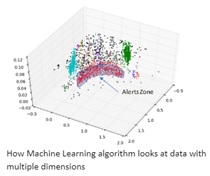
    machine-learning
    Entonces, veamos cómo una clase muy evolucionada de Inteligencia Artificial conocida como Aprendizaje Automático (Machine Learning) observa esta declaración del problema. En lugar de que los humanos alimenten la información del dominio o los umbrales, los algoritmos de aprendizaje automático extraen datos de comportamientos fraudulentos históricos y crean modelos. Estos modelos se utilizan para evaluar conjuntos de datos de producción reales para evaluar si ciertas actividades son fraudulentas o no. Una ventaja es que estos modelos son muy buenos para ver los conjuntos de datos desde múltiples dimensiones y medidas al mismo tiempo y para determinar si el evento es fraude o no.

    Este enfoque ayuda a lograr múltiples KPIs de equipos de gestión de fraude allí al aumentar la eficiencia.

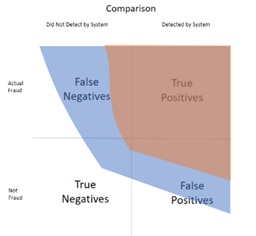
    • Mayor precisión – debido a que la inteligencia artificial puede aprender y adaptarse a los escenarios de negocios más rápido, la inteligencia artificial puede aumentar significativamente la relación positiva verdadera
    • Reducción del tiempo de detección – qué tan rápido se puede detectar un evento de fraude
    • Autoaprendizaje – cómo, durante un período, los escenarios empresariales cambiantes y la estacionalidad en los datos se pueden adoptar para la detección de fraude
    • Inteligencia contra el fraude– cómo se pueden aprender y clasificar los comportamientos del cliente o de cualquier otra entidad para una mejor detección del fraude
    • Proactividad – capacidad de extraer patrones desconocidos que no se vieron en los datos anteriormente
    FM-4

    La aplicación de Inteligencia Artificial tiene sus propios desafíos importantes y requiere un nuevo marco de pensamiento, sin embargo, al observar el Tsunami de Datos que ha afectado a los equipos de gestión de fraudes, parece que un enfoque profesional de IA solo ayudaría a los equipos de Gestión de Fraude a escalar aún más.


  • Dealing with Bypass Fraud : Think beyond the boundaries

    Dealing with Bypass Fraud : Think beyond the boundaries

    Amid the fierce competition facing the telecom industry, sometimes we listen to stories how lack of forethought of one Telco brings on illegal traffic on the network, leading to aggressive open wars and blame games among the operators affected by the fraud. The Telecom Regulatory Authority could intervene in such scenarios and encourage a competitor to block suspicious outgoing traffic if it finds out that not enough care is being taken to avert the fraud.

    Interconnect Bypass fraud is one such telecom scam costing the industry several billion dollars every year. It brings collateral damage to the networks involved, and the impact will be huge. The Telco could be imposed hefty penalty for its failure to detect and resolve the issue on time. Further, it could bring serious business implications for all participating telcos. In the process of rampant blocking of suspicious traffic, sometimes traffic of genuine customers could get blocked, leading to customer dissonance and dissatisfaction along with loss of other business opportunities.

    Here’s an example of a West African Telco who suffered massively due to Bypass fraud.

    Why did this happen?

    The West African telecom operator had been massively impacted by off-net Bypass fraud where the network of the operator was being misused to land fraudulent calls on the competitor’s network. Over time, the problem became so grave that the Regulatory Authority of the country had to step in and take charge of things. This eventually ended with the competitors blocking both fraudulent and genuine traffic from the Telco affected by the interconnection fraud.

    Investigations conducted confirmed that the huge differences between the International termination rates and local termination rates made the environment suitable for fraudsters to run their schemes. There aren’t enough KYC controls in the country to facilitate certain onboarding checks which distinguish a genuine customer from a fraudulent one.

    Impact on business

    There were multiple warnings and memos issued to the operator from the Regulator, indicating that the operator would have to face penalties if amendments are not made in time.

    Customers flooded the operator with complaints saying that their off-net calls were being barred without prior notice and for no fault of theirs and threatened that they would eventually churn out of the network if their services weren’t restored.

    The atmosphere grew so tense that instead of cooperating, the operators became more aggressive and indulged in a rat-race in trying to prove a point to the Regulator as to how better and efficient they were from the rivals in terms of detecting Bypass fraud cases.

    The solution

    With the understanding that Bypass scams are rampant, Telcos need to direct their efforts towards building knowledge-sharing forums where they can share insights on fraudster behavior and geographical locations from where most of the fraudulent calls are generated and what kind of products tend to get misused by these fraudsters to nip things in the bud.

    Telcos should understand that indulging in rat race or blaming each other will not help solve issues arising from such frauds; rather they should adopt a proactive approach to identify and prevent such scenarios in future. Instead of the Regulatory authority dictating terms to the operators, the operators must drive the authority to create nationalized framework for user identity governance.

  • Why Artificial Intelligence Powered Fraud Management

    Why Artificial Intelligence Powered Fraud Management

    Artificial Intelligence (AI) is not new and it has been around for decades. However, with the advent of big data and distributed computing that is available today, it is possible to realize the true potential of AI. From what started as an interesting story line in SCI-FI movies to programs like Alpha-Go which has been beating humans, AI has been evolving. AI also has branched out into multiple sub categories such as Machine Learning, Deep Learning, Re-enforcement learning etc.

    An effective Fraud Management (FM) strategy includes 3 important pillars: Detect, Investigate & Protect. We believe AI can positively influence all the 3 pillars of fraud management, from reducing false positives to helping in mining root cause analysis to creating enhanced customer experience in protection.

    In this post I would like to look at the starting pillar of the Fraud Management strategy – “Detection” and look at AI’s influence in this very important step. A traditional approach to Fraud detection has been through Rule Engines which could be:

    • If-Else Conditions
    • Thresholds
    • Expressions
    • Evaluating Data Patterns

    These are widely known as deterministic solutions where an event triggers an action. The biggest pros and cons with this approach is that human intervention is needed to feed the logic.

    For eg: for a threshold based detection humans have to feed the rule engine that count of records above a certain threshold is suspicious.

    Following diagrams shows how this looks like

    rule-engine

    After looking at the diagram above an important question arises, should this threshold value be a straight line or can it bend based on how data behaves. Now there are ways for rule engine to behave like mentioned in the diagram,

    variable-threshold

    for eg, instead of having a single rule lets have multiple rules

    • Per Customer Category
    • Per Destination
    • Per Age of Customers

    And multiply that with other dimensions in data which are

    • Phone Number
    • Caller Number
    • Called Number
    • Country Code

    And multiple that with other set of measures per dimensions

    • Count
    • Duration
    • Value

    And throw an additional billion volumes at the datasets

    Quickly FM teams ends up with something like this
    AI Blog1

    But what they wanted or dreamt was this

    AI Blog2

    Now I am not saying FM teams are not skilled enough to fly, but a fraud team in a modern Digital Service provider should be more focused on other important factors.

    machine-learning
    So, let’s look at how a very evolved class of Artificial Intelligence known as Machine Learning looks at this problem statement. Rather than humans feeding domain information or thresholds, Machine Learning Algorithms mine data from historic fraudulent behaviors and create models. These models are then used to evaluate real production datasets to score whether they certain activity is fraud or not. An advantage is that these models are very good at looking the datasets from multiple dimensions and measures at the same time and concluding whether event is fraud or not.

    This approach thereby helps in achieving multiple KPI’s of fraud management teams there by increasing efficiency.

    • Higher Accuracy – Because AI can learn and adapt to Business scenarios faster, AI can significantly increase True Positive ratio
    • Reduced time to detect – How fast a fraud event can be detected
    • Self-Learning – How over a period changing business scenarios and seasonality in data can be adopted to Fraud detection
    • Fraud Intelligence– How customer or any other entity behaviors can be learnt and categorized for better fraud detection
    • Proactiveness – Ability to mine for unknown patterns not seen in the data earlier
    FM-4
    Application of Artificial Intelligence has its own significant challenges and requires a new frame of thought, however looking at the Data Tsunami that has hit the fraud management teams, it looks an AI pro approach would only help Fraud Management teams to scale further.

    To learn more about how AI/ML would transform the Fraud Management Systems, Join us on our two-part series of “AI Master Class for Fraud Management” to familiarize yourself with AI/ML through a live demo.

    Register Now