Tag: Partner Management

  • Consolidate & Optimize your Wholesale Business: 3 ways you can adopt to make most out of your existing B2B ecosystem

    Consolidate & Optimize your Wholesale Business: 3 ways you can adopt to make most out of your existing B2B ecosystem

    The International voice business will eventually come down as WhatsApp; Facebook Messenger leads the race along with WeChat, QQ, Viber, and others following and overall taking up to 5 Billion monthly active users. Microsoft Teams, Zoom, Skype are taking over the enterprise voice conference call business.But even with these impacting factors, the International Interconnect business is here to stay for at least for the next half-decade.

    In the recently concluded GSC virtual conference, telco’s highlighted the shift in wholesale business. Overall, the business has seen an uplift due to COVID-19, but the buckets have changed.

    E.g., International voice calling has increased due to reduced travels. But on the other hand, roaming has reduced due to the same reason.

    Due to the pandemic situation, there is a sudden shift in the market dynamics, and telcos are looking to make the most out of it.

    The GSC Virtual Conference also highlighted many facts and approaches prevalent among operators right now. Some of them were-:

    • Change in ecosystem by fast tracking consolidation
    • Automation Initiatives in reconciliation, credit controls
    • New Partnerships in volume trading, swap deals
    • Improved Fraud investigations like Provider fraud, Smart FAS, SIMBOX etc.
    • Improving assured ecosystem initiatives by proper investigations, corrections and prevention in areas like disputes, credit controls, collections, rating etc.

    As the traditional revenue is drying, telcos can adopt many small changes within the entire B2B ecosystem to optimize and protect the revenue. Here are three aspects that can help telcos achieve that-

    • Consolidation
    • AAA
    • Future proof

    Consolidation: A typical telco has multiple B2B services which can be broadly classified into 3 major industries:

    Wholesale:

    (Global Voice Hubbing, Messaging, Interconnect, Roaming, Connectivity, Data Centers)

    Digital:

    (TV, IoT, M2M, Data Analytics Services, Security Services, OTT services etc.)

    Enterprise:

    (IPVPN, IPLC, Data Centers, Cloud services, Internet Services, Enterprise WiFi etc.)

    A convergent solution that can consolidate and run all these business on a single platform with multi-tenant deployments, provides the required consolidation to optimize both the CAPEX & OPEX spending.

    AAA Solutions: Automated – Accurate – Assured

    Future proof Solution: A solution that can be further extended to future B2B businesses. Evolving economic models between partners need a system that can generate new models using configuration. Flexible to process and manage data sources from various businesses.

    Subex Partner Ecosystem Management platform can deliver a converged B2B partner management experience that can address all the needs of any type of B2B business of a telco.

    Having multiple solutions from multiple vendors increases the complexity and the operational cost as well. Subex can help you augment your B2B strategy and provide a converged solution that can optimize and accelerate your journey towards the digitalization.

    If you want to know more about the solution

    Get in touch

  • D-Partner unchained with Blockchain in the 5G era

    D-Partner unchained with Blockchain in the 5G era

    If you have to identify the most important element of the telecom ecosystem in the 5G era that can fuel multi-fold growth for operators, what it is going to be? If you ask for my answer, it’s D-Partner (The Partner).  Let me explain how the partner will play an important role in setting up a successful 5G ecosystem.  I will cover two aspects here:

    1. Why and how partnerships can only fuel success in 5G?

    2. Blockchain – How it brings digital trust in data exchanged between partners?

    The Potential that 5G holds

    5G ecosystem will give rise to a big parallel ecosystem of partnerships. A successful rollout of 5G will need collaboration between many partners who will fulfill different gaps in the ecosystem and eventually deliver the 5G promises. As the ecosystem develops, Telcos are expected to focus beyond just connectivity towards collaboration across the telecom value chain and different sectors, leading to the creation of new and innovative business models.

    This is the right time to unchain and unleash the power of partnership and empower the partners to build a strong ecosystem to realize the true potential of 5G.

    Different partners that telco need to collaborate can be broadly classified into below categories:

    1. Suppliers (Infrastructure, Software Vendors, Innovative service providers, etc.)
    2. Aggregators
    3. XVNO*
    4. Sales & Resellers
    5. Enterprise Partners (Enterprises in Healthcare, Smart Cities, Banking, Manufacturing, etc.)

    *XVNO=MVNO, IVNO(IoT-VNO), etc. Anyone can take a Network Slice and run innovative services on it. IoT has a big future on 5G platform and hence IoT-VNO.

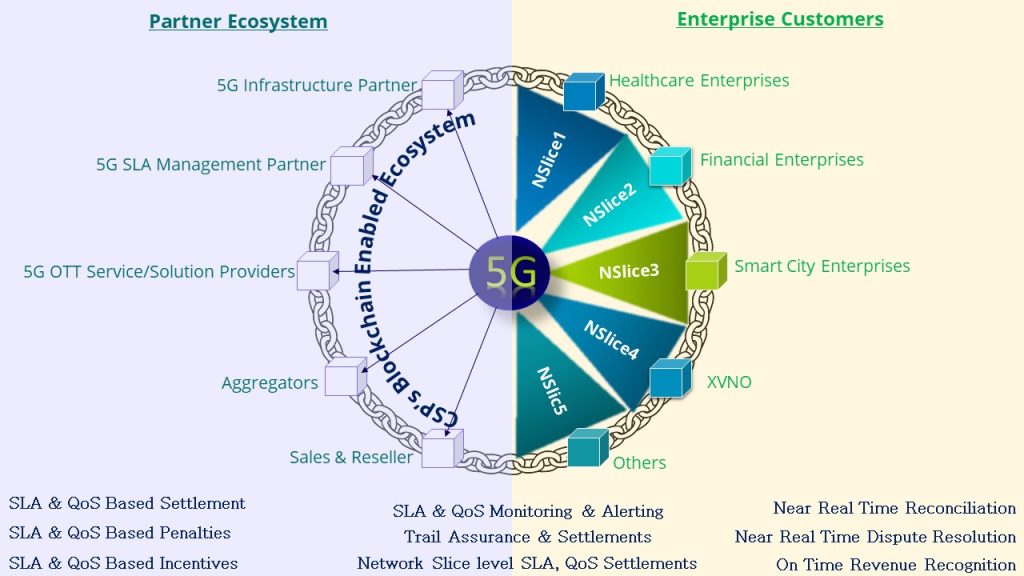
    All these partners will build a strong ecosystem to deliver the best result to end consumers, be it in B2C or B2B space. Delivering value will no longer be a play of the centralized entity, instead, this will be a decentralized ecosystem in which delivering value and the trust will be dependent on multiple entities/partners i.e. the trust itself will be decentralized. The below diagram clearly highlights how much decentralization is important going forward.

    Creation of a Trusted Decentralized Ecosystem to Deliver Value

    All these partners will be connected with different economic models to do billing and settlements. In the 5G ecosystem, SLA & QoS based economic models will be the key factor for all the billing and settlements. SLA & QoS is the key factor for 5G to be reliable, which will add a new parameter to the equation of billing and settlement which is currently transactional in nature. The 5G value chain will be dependent on many of these partners playing different roles at different points and all or related ones, are interconnected with cascading SLA’s & QoS.

    Having cascading SLA’s and with its dependency on multiple partners, who will deliver and ones who will consume the same, the need for a transparent & trustworthy environment becomes the key, which can:

    1. Update the SLA’s and delivered QoS to all relevant and impacted touchpoints in ecosystem
    2. Rating the services of each partner based on delivered SLA’s and QoS as agreed in the contract
    3. Compare and alert SLA breach based on the contracts with each partner in ecosystem
    4. Help in addressing disputes in near real-time, hence avoiding conflicts during payments and settlements

    Each of the above points translates to:

    1. Near real-time updates in a connected the ecosystem
    2. Near real-time contract monitoring
    3. Triggered events based on contractual models
    4. And above all, creation of a trustworthy the ecosystem

    Blockchain = Collaboration + Cryptography + Smart Contracts = Decentralized & Trusted Ecosystem


    The above diagram depicts how a decentralized setup will look, with multiple partners working towards building a reliable & connected ecosystem delivering the required SLA/QoS.

    For now, I leave you with this thought process and will get back to you on how we can wrap this overall decentralized environment with an E2E Partner Lifecycle Management system and its importance.

    The Decentralized Way Of Digital Partnerships

    Download Point of View

  • How Enterprise Blockchain will Change the Telecom Intercarrier Settlement Process

    How Enterprise Blockchain will Change the Telecom Intercarrier Settlement Process

    Enterprise Blockchain solution for telecom seems to be a promising development for the telecom industry as it strives to solve the challenges faced by Telcos in their settlement process. It is based on Distributed Ledger Technology (DLT) which has attracted lot of attention in the recent time to offer a  Way to record transactional data that should become a single source of truth to establish digital trust in the partnerships.

    Why Telcos are looking at blockchain as a possible solution for partner settlement? Telecom network operators across the world gets into interconnect agreement which enable a seamless communication among their customers. These agreements are executed between domestic and international operators for mobile, fixed and internet services. Telecom operators collect and store detailed activity information as events. Interconnect partners share these CDRs for the purpose of verification and settlements. This process is cumbersome, inefficient, lengthy, costly, and error-prone. Missing CDRs and discrepancies in CDRs are very common problems.

    As the interconnect revenue continues to decline it has become essential to address the blocked revenue due to disputes and to optimize the overall cost involved in resolving these discrepancies. The enterprise blockchain present a possibility that can make the settlement process error free and help the Telcos a faster and efficient access to the blocked revenue. Subex is actively working with multiple enterprise blockchain technologies to address the need.

    Subex is chairing the Linux Foundation’s Hyperledger Special Interest Group (SIG) Intercarrier Settlement subgroup to develop DLT based solution for partner settlement process. The purpose of the Special Interest Group (SIG) is to help Telcos understand the key issues in partner settlement and offer possible solutions for the same. Subex has been a key contributor in creating the solution brief. The group has been successful in defining a solution based on Hyperledger Fabric developing a working PoC which is available for demonstration for those who are interested.

    The proposed solution broadly addresses how a DLT-based solution can:

    • Converts the reactive dispute management process to more proactive process
    • Create a single source of truth, which allows network operators to access and verify billing and cross-charging data in real-time.
    • Reduce overall costs by replacing tedious processes, reducing dependency on intermediaries such as clearinghouses with simple, near real-time and error-free reconciliation and settlement process.
    • Help in evidence collection and fraud mitigation.

    DLT has shown great potential in solving issues related to fraud, errors and creating a secure data source. Given the possibilities mentioned in the solution document, the likelihood of extending it as a full-fledged solution is very high which means faster dispute resolution, reduction in overall cost and an efficient partnership that will help Telcos embrace the new technologies and innovate their services as per the need of the market.

    Link to access solution brief: Here

    Link to the Hyperledger Blog: Here

  • How the Power of 5G will Redefine Partner Management

    How the Power of 5G will Redefine Partner Management

    For an industry struggling and grappling with the speed at which new technology innovations are gaining relevance, 5G promises to be a serious game changer and the claim is completely merited. But nevertheless, telecom operators and their partners are very optimistic with the promised power that 5G will bring but are wary of the super-organizational efforts it will take to have real bottom line impact. 5G will change the equation for the industry much like the advent of cellular phones and services did when they shook the world with its possibilities.

    One Promise, Myriad Applications

    With adjacent technologies like Multi Access Edge Computing and Network functions virtualization to AR/VR that will thrive, the emergence of 5G promises to increase the number of connected smart devices.

    The use cases are many, and some are life changing. Video delivery and adverts are two areas that will significantly gain from enhanced speed, making the experiences highly personalized. The Quality of Service and SLA for each of these use case will depend on the criticality, and the acceptable thresholds will be adjusted based on the services. Quality of Experience (QoE/QoX) models will evolve for newer applications.


    With the ability to service numerous connected devices, the levels of quick and agile responsiveness are going to shake up the current equation. 5G will provide low latency needed for AR/VR enabling high speed data transfer. The impact of all these of course is a significant improvement in quality and experience!

    The impact of 5G thus, affects telecom operators of course, but also sees a lot of across industry use cases. The discoveries of new use cases will lead to the rise of modern partnerships in areas such as IoT, AR/VR, smart homes, virtualized networks, distributed cloud amongst others. So, hospitals as enterprise partners for remote surgeries, augmented reality shopping experience for brands, collaboration apps that are reinventing mainstream games – these are just some of the possibilities that will impact enterprise business as well as retail.

    However, as we move ahead, there are two aspects that need to be clear:

    • The basics of what this promised change is in terms of technology, capability and regulations
    • What operators need to do to fully optimize the powerhouse performance that is expected from 5G

    Yes, they could both be moving targets and rapidly adapting is the need of the hour.

    A Careful Hope

    The reason why caution must be exercised though it is easy to get carried away in the excitement is that the basic systemic problems remain unchanged. Tightening regulatory norms and increased compliance requirements, the global debate on privacy and data breaches, intense competition translating to depreciating profit – all these are very much alive.

    5G must be embraced by operators but there needs to be a method of adoption. There is greater scope for perimeter security and 5G will mean increased efficacies, but all of this will only come to fruition if these exercises are balanced with understanding the now-more-than-ever-importance of data analytics, AI and machine/deep learning and understanding how all of these components will be needed to offer improved service. What this means is that network operators finally have a chance to take somewhat of a centre-stage in ascertaining more control over two critical aspects

    1) Re-building their customer experience so there is a shift in perception and hopefully loyalties and

    2) Finally finding a way to ensure monetization is addressed

    Changing the Paradigm with 5G

    The journey towards 5G implementation is going to be a long and arduous one. While 4G is not something that operators can ignore entirely and shouldn’t, there must be a re-look into the operators’ own business models and relationships with key stakeholders. They need to see where deeper relationships can be forged to understand the customer’s somewhat limited yet exaggerated expectations of 5G.

    For the 5G promised change to make a significant difference, industry require alertness towards the variegated forms that disruption and transformation are going to take. The definite actions to make this happen will simply make all the difference between success and failure for the world’s telecom operators.

    To know more about Subex Partner Management solution.

    Click here

  • What is Telecom Interconnect Billing System?

    What is Telecom Interconnect Billing System?

    Interconnect is a process for telecom operators to handle calls for other operators thus allowing people who are using different networks to communicate with each other in both domestic and international scenario. Point of Interconnection is used to connect the physical interface between two different telecom operators to connect their customers. If operator A and operator B are not interconnect partners, their customers would not be able to call each other. So, to allow ease of communication, operators get into interconnect agreements with each other thus allowing good business opportunity for them.

    What is Interconnect Billing System

    It is a centralized automated solution that supports multi-party agreements with multiple service providers to use the network and facilitate the traffic routing between multiple networks like circuit-switched networks (e.g. PSTN), or computer networks (e.g. Internet). The traffic flow is regulated through the policies defined by the rules integrated in the system according to the interconnect agreement between the operators. The interconnect billing solution is capable of near real time processing to allow business optimization and help in achieving increased operational efficiency and network profitability. As the business in most of the cases is bidirectional, billing systems perform 2 key tasks-

    • Managing Deals or Bilateral Bulk Agreements
    • Partner Settlements –the incoming and outgoing invoices are taken through a net-off process where the net payable or receivables are identified

    Need for Interconnect Billing System

    • 360 ° Process Efficiencies

    Achieve accurate rating, invoicing, reconciliation and settlements with efficiency to manage interconnect, roaming and content settlements.

    • Near Real-Time Insights

    Enable fast business decision making with the help or near real time reporting to prevent losses.

    • Business Control and Transparency

    Allow better control over carrier related activities with proper monitoring system and achieve transparency with timely and insightful decision making.

    Key Features in an Interconnect Billing System

    • Billing and settlements: Manage interconnect, digital and content services
    • Roaming management: Enables settlements between partners for roaming services
    • Partner portal: Provides partner interface for business and self-service operations without unveiling the application
    • Number billing and routing: Manages interconnect billing and routing for origin-based routing (OBR) by tracking buy and sell destinations, dial code movements for terminating destinations and origin groups
    • Prepay management: Guides business relationships with new partners and mitigates business risk
    • Reconciliation: Verifies payables and receivables between partners
    • Dispute management: Minimizes disputes between partners related to payments and services
    • Multi-tenant environment: Supports mobile virtual network operator (MVNO), multi-BU environment
    • Buying, selling, routing: Optimizes transactions related to international calls

    Here is a case study to know how Subex helped a tier 1 APAC telecom operator reduced their billing cycle by almost 75% and achieved business efficiency and profitability.

    Download now!

  • Gestión de acuerdos de socios en la era digital

    Gestión de acuerdos de socios en la era digital

    La digitalización ha abierto una gran cantidad de oportunidades para que los proveedores de servicios de comunicación (CSP) en todo el mundo transformen sus ofertas de servicios tradicionales, pasando de la telefonía a las empresas basadas en contenido y alcanzando el estado de proveedores de servicios digitales (DSP). Hay un cambio de paradigma en el ecosistema de telecomunicaciones con la entrada de disruptores tecnológicos (como los jugadores OTT) que resulta en una cartera de servicios con modelos de precios competitivos. El agotamiento de los ingresos de voz y el aumento de los servicios de datos ha cambiado la dinámica de las asociaciones comerciales.

    El proveedor tradicional de servicios de telecomunicaciones ya no está aislado en el mercado y tiene múltiples colaboraciones para audio, video, contenido, análisis, nube, etc. Además, debido a la reducción de los márgenes, los operadores esperan tener contratos / acuerdos con sus proveedores y socios, lo que creará una situación de ganancia para ambas partes involucradas. Según una encuesta reciente realizada por TM Forum, los DSP tienen una oportunidad de ingresos de alrededor de $ 142 mil millones de servicios digitales. Ya sea que AT&T adquiera Time Warner por $ 85.4 mil millones o que Reliance Jio se integre con Saavn para crear la aplicación JioSaavn, las empresas de telecomunicaciones buscan implementar contenido exclusivo para sus clientes finales. Teniendo en cuenta que hay mucho que ganar, un DSP sin una oferta de contenido fuerte en el escenario actual es casi inimaginable.

    Un DSP a menudo tiene cientos de contratos de proveedores de contenido (en su mayoría con agregadores) para administrar, y hay una gran diversidad de socios que van desde un desarrollador de garaje hasta Google.

    Construyendo factores de éxito:

    El fenomenal aumento en el consumo de datos por parte de los suscriptores y el contenido gratuito está impulsando la mayoría de los negocios principales de las empresas de telecomunicaciones en la actualidad. Además de esto, pocas empresas de telecomunicaciones se están asociando con jugadores OTT para proporcionar contenido exclusivo y servicios especializados en forma de paquetes premium. Las suscripciones OTT dirigidas por operadores se han convertido en el nuevo modelo de negocio que genera ingresos y segmentos de clientes.

    Building Success Factors
    Fuente : IHS Markit

    Impulsar nuevos modelos de negocio: el creciente nivel de complejidad

    Inicialmente, se intercambiaron hojas de tarifas entre socios para facturar el uso de los servicios. Más tarde celebraron acuerdos bilaterales para liquidar los ingresos entre ellos. Ahora, las empresas de telecomunicaciones se están moviendo a contratos digitales al asociarse con proveedores de contenido y otros jugadores OTT. Estos contratos digitales implican calificaciones de nivel o bandas / junto con exclusiones / descuentos. Los compromisos y la calificación basados ​​en parámetros específicos han aumentado el nivel de complejidad con respecto a la calificación y el cobro a sus socios.

    Pasemos por 3 tipos de acuerdos que se ejecutan entre socios en estos días:

    Existen varios escenarios de acuerdo (acuerdos) entre el operador y el socio de contenido basados ​​en diferentes modelos de negocio. Además, los modelos de ingresos compartidos han evolucionado desde un esquema de porcentaje fijo a en un enfoque basado en niveles o bandas a traves de los distintos escenarios de productos.

    1. Un acuerdo basado en nuevas suscripciones

    Número de nuevas suscripciones   Participación en ingresos

    0 – 500                                            P %

    501 – 2000                                     Q %

    2001 y más                                     Q % y % adicional T % por número de suscriptores >2000

    Según el acuerdo del socio, si las nuevas suscripciones son negativas para un mes en particular, no se realizará ningún pago al socio para ese mes.

    2. Un acuerdo basado en promociones

    Los ingresos compartidos entre las partes serán mensuales. El período de promoción puede ser de unos pocos meses o puede ser continuo. Si el usuario se suscribe al contenido de

    Meses                  Participación en los ingresos

    1 mes                           P %

    2 Meses                       Q %

    3 meses y más             R %

    3. Un acuerdo basado en la penetración en el mercado.

    En este escenario, el operador puede compartir los ingresos en función de la penetración de los suscriptores en un área. La complejidad involucrada aquí es que el nivel de penetración de cada mercado es diferente del otro. Además de esto, hay ciertas áreas donde el radio se define con respecto a un punto de referencia. A los suscriptores dentro del radio se les cobrará una prima y, en consecuencia, la participación en los ingresos.

    En el escenario competitivo del mercado actual, las asociaciones se han convertido en una necesidad para los operadores de telecomunicaciones y avanzan mediante la firma de contratos innovadores y complejos. Los ejemplos mencionados anteriormente de contratos / acuerdos digitales son algunos de los modelos que hemos tratado recientemente. En el futuro, veremos muchos de estos modelos con mayor complejidad y definiciones de contratos digitales innovadores.

    Si está interesado en saber más sobre la gestión de contratos mayoristas complejos

    ¡DESCARGUE AHORA EL SEMINARIO WEB GRABADO!

    Have you negotiated or signed any complex contract recently? Let us know in the comments section below. Looking for partner who can help you handle complex contact? Talk to us.
  • How Industry Trends are Impacting Telecom Partnerships

    How Industry Trends are Impacting Telecom Partnerships

    Trends that are creating a shift

    With democratizing access to technology, more and more people are embracing it and telecom is one of the industries which is most affected by this shift. More and more people will have mobile by 2020 and the amazing thing is the revenue of this user acquisition will be driven by data consumption as compared to voice/SMS or other traditional services which were the base of telecom offering till recent time.

    Operators are sensing the shift happening in the user choices and trying to figure out ways to stay in the competition. Mobile broadband connection to increase from 55% of the total in 2016 to 73% by 2020. The number of smartphone users will reach 5.7 billion by 2020 which means more and more people will be using data as a telco service and be a part of the digital ecosystem. Mobile data is expected to grow at a CAGR of 47% till 2020.

    If we see the driving factors behind this shift, OTT, content and other digital service providers have played a major role. See the below graph on how the composition of services has changed over time.

    It’s not only the addition of new partners to the digital ecosystem, but the traditional wholesale is also evolving. Here are the new trends which we can see happening in wholesale.

    Implications on Telcos due to digitalization

    Telcos no more work in silos as they are disrupted by the new age service providers hence looking for new partners to offer competitive and exciting services to its consumers. The below chart shows the changes happening in the telecom industry. This is forcing telcos to search for innovative and unique economic models.


    New Possibilities for Telcos

    These trends have opened a lot of possibilities to explore additional business avenues and try new economic models. The telco revenue mix is also changing with the partner mix as we can see in the graph and it is impacting the way telcos operate and manage partnerships in a traditional format. Hence the partner lifecycle management is also becoming imperative for telcos to embrace the digital revolution. For example, there will be 25 billion connected things by 2025 with enterprise verticals as the main drivers. Blockchain in telco has so far been limited to roaming but experimentation could take this further, especially if eSIM came to smartphones.

    Smartphone connection will increase to 79% of the total mobile connection bringing in new customers. Over a fifth of the world’s markets will have launched 5G by 2020, spending a combined $244 billion on networks in the process which will bring new capabilities for telcos.

    How Telcos can Embrace Digitalization Successfully

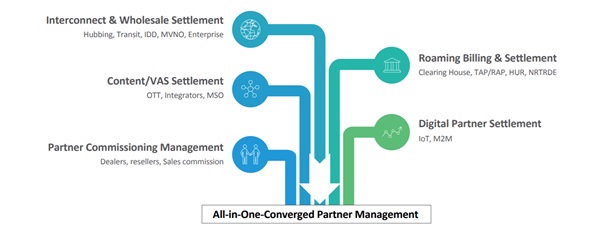
    The need of the hour is a unified solution which can cater to all the requirement of the ecosystem. The system should be able to provide visibility for everyone in the ecosystem to establish trust among the partners. Right from efficiently managing the partner onboarding, to partner settlements and dispute management, the system should be able to make the whole journey seamless for both traditional and digital service partners. The below image shows some of the capabilities of the system.

    This unified solution will allow telcos to transition through the changing paradigm and add agility and scalability to the business to embrace any new technology and consumer behavioral shift.

    To learn how telcos can leverage partnerships to gain competitive advantage

    Watch the Webinar now!

  • Choosing the Right Converged Partner Management Solution

    Choosing the Right Converged Partner Management Solution

    What is a Converged Partner Management Solution?

    Converged partner management is a unified solution which caters to the entire gamut of partner needs of a telecom operator. The platform addresses the needs of both traditional and digital partners by spreading across different domains and helps to handle the complex relationships between the suppliers and vendors of the telecom operator.

    Why you need a Converged Partner Management Solution

    Over the last decade, digitalization has transformed the communication service provider (CSP) landscape. It has created a need to achieve market differentiation in response to the evolving customer profiles and prevail over emerging challenges from disruptive services. Telco revenues from legacy voice and SMS are on the decline and there is high CAPEX associated with network innovation. Telcos can turn this around by evolving as Digital Service Providers (DSPs). But the biggest challenge in this transformation is to bring both traditional and new digital partners together to create an integrated industry specific solution. But the success rate of these partnerships and integrations is very low as it comes with multiple challenges. Inefficient partner onboarding process, tariff management for multiple plans, billing and invoice reconciliation while taking OPEX into consideration. Based on a research 70% of partnerships fail due to trust and clarity of business relationships. There is a need of sustainable partnerships which can create value for everyone in the ecosystem.

    In this scenario, a converged partner management approach proves beneficial from both business and service perspectives. From the business perspective, a converged platform will help to visualize the partners’ business. It will consolidate partners into a single contractual binding and bundle the offerings, settlements, and payments across the entire domains. A converged partner management solution packs features that give CSPs freedom to experiment with NGN service offerings such as content management without having to worry about the scalability of its billing function. The solution enables telecom operators to have all their business partnerships in one single place and makes it easier to access information and make efficient business decisions. This is especially important as different partners insist different models in measuring the business impact and ROI.

    How to Choose the Right Converged Partner Management Solution

    Selecting a partner management solution to manage your partnerships efficiently is not an easy decision. The solution should complement the operations of the service provider and offers features and functionalities that remove operational errors and smoothen the partner management process.

    Below are the key features you should look for in a Converged Partner Management Solution

    Partner Self Onboarding: The partner onboarding platform can support self-boarding, manual onboarding and in some cases, a mix of both. The self-boarding platform will play a significant role in the digital era, giving the DSP the ability to perform most of the onboarding activities by automating the process like partner scoring on configurable KPIs and other partner details.

    Partner Scoring- Pre-Onboarding & Post Onboarding: Partner scoring can assist an operator to take pre and post onboarding decisions based on business KPIs, and this can be combined with standard agreed contracts to make the complete process automated.

    Defining the Partner Business: Defining the businesses of both traditional and digital partners is a complex process especially in the context of service offerings, revenue sharing and service agility. The business for traditional partners such as interconnect revolved around exchange of voice, SMS and usage of other services so the contract includes bilateral deals for settling the traffic and event rates. On the other hand, contract with digital partners like OTT players, content providers, VAS companies, MSOs, integrators, app developers, IoT and M2M service providers involves complex revenue sharing model as the settlement may be based on usage of resources, impressions/ clicks on the website, readings from metered equipment, among others. A converged partner management solution will help telcos to implement revenue sharing models that can be fixed, shared or a hybrid depending on the nature of the partner business.

    End-to-End Billing and Settlement: Helps the business to define rules and apply them to the events acquired to generate the final revenue figure to both the DSP and the partner. The system achieves this through accurate rating and charging, real-time updates, and on-time bill and statement generation.

    ETL (extract, transform, load) to Track and Process Events: The ETL tool is required to process different types of events from various sources and transform them to respective entities by extracting the relevant information. Considering the dynamic and open nature of the DSP ecosystem, the ETL tool should be flexible enough to handle the frequent onboarding of new partners and build mediation capability supporting ingestion and normalization of data from multiple partners in different formats.

    Partner Communication and Self-Care: A converged platform should enable a consolidated communication portal to manage all the operational aspects of the business including contractual updates, bills, settlements, credit debit notes, trouble ticketing, and dispute management. The portal should also be integrated to the backend systems to orchestrate each operational aspect towards the respective system for action and resolution. Finally, it should feature open APIs that enable quick integration with third-party systems.

    Visibility of Partner Business: Real-time visibility ensures transparency across the businesses. Through real-time analytics of reports, alerts and notifications, the converged platform can enhance the visibility and reporting across different channels.
    all-in-one-PS

    Are You Ready?

    New age partnerships require transparency and trust between the partners to create a robust ecosystem. A Converged Telecom Partner Management solution will help telcos to manage these new age partnerships efficiently and enable them to drive new business models. This will also reduce the time to market for new offers and packages and allow telcos and partners to acquire new customers and add new revenue streams.

    Are you ready for a converged partner management solution to succeed in the new age digital ecosystem?

    Download the Webinar recording!

  • Leveraging partnerships to succeed in the digital ecosystem

    Leveraging partnerships to succeed in the digital ecosystem

    The Fourth Industrial Revolution has dynamically altered the global communications landscape, creating both challenges and opportunities for communication service providers (CSPs). Consumers have become increasingly demanding with respect to consistent experiences across multiple devices, and CSPs are gradually transforming into providers of advanced digital services such as bundled broadband, mobile apps, and interactive customer-centric content. This transformation into a digital service provider (DSP) is not easy and CSPs are fraught with multiple process and software challenges during this shift.

    Moving from Interconnect Partnerships to Strategic Partner Management

    In an intensely competitive market, CSPs face immense pressure from over the top (OTT) content providers such as Google and Facebook who have direct consumer outreach. Provision of more customized, automation enabled services through large partner ecosystems is the norm. The increasing complexity of emerging markets coupled with initiatives such as smart cities will open big digit growth opportunities capable of being handled only by huge curated partner collaborations.

    Earlier, telecom operators entered into interconnect partnerships with other telecom operators mostly to leverage mutual networks for voice and messaging services. However, the proliferation of smartphones and high-speed internet services has led to a burgeoning increase in the number of partners providing a diverse range of services, leading to a shift from conventional interconnect systems to complex partner management relationships.

    The Partner Management Market Is on an Upward Swing

    And rightly so, considering there are about 23 vendors offering a certain level of partner management functionality globally. According to analysts, the partner relationship management market (including software and services) is estimated to stand at US$ 850 Million today and is projected to increase to about US$ 1.65 Billion by 2023[1]. The entire ecosystem is expected to undergo certain strategic functional shifts, industry and geography notwithstanding. The coming years will witness new buyer personas across diverse channel types – and channel sales and marketing professionals will realize the importance of third-party influencers in reaching new buyers. The thrust will be on providers of partner management solutions to function as trusted partners – helping widen a brand’s outreach and influence the success journey in unimaginable ways.

    The need for Converged Partner Management

    The telecommunications wholesale market is growing rapidly with fierce competition and dwindling profit margins. Given the enormity of transactions and immense complexities surrounding a multi-party ecosystem, it is necessary to adopt effective partner management solution to ensure better service quality levels.

    [1] https://go.forrester.com/blogs/partner-relationship-management-prm-comes-of-age/

    To learn how telcos can leverage partnerships to gain competitive advantage

    Watch the webinar now!

  • Las 5 razones principales por las que los operadores de telecomunicaciones deberían explorar contratos de socios innovadores – Subex Limited

    Las 5 razones principales por las que los operadores de telecomunicaciones deberían explorar contratos de socios innovadores – Subex Limited

    La industria de las telecomunicaciones ha evolucionado a lo largo de los años en la economía digital a través de innovaciones tecnológicas. El cambio entre la generación de redes está progresando rápidamente, y eso tiene un impacto en los casos de uso de negocios y los sistemas BSS / OSS que son parte de este ecosistema. Si bien hoy hay un gran revuelo sobre 5G, el lanzamiento de 4G todavía está en progreso en ciertas regiones. 5G ha abierto una serie de nuevas oportunidades de negocios con realidad aumentada, autos autónomos, transformación de la atención médica y más. Con este ritmo y agilidad sin precedentes en el negocio, las asociaciones desempeñan un papel muy importante para los proveedores de servicios de comunicación (CSP), y necesitan estar bien equipados para gestionar la complejidad de contratos mayoristas y así lograr el éxito.

    Estos son los 5 impulsores para que los CSP firmen contratos con innovadores modelos de precios económicos:

    • 1. Ecosistema cambiante de la industria de las telecomunicaciones.

    La industria de las telecomunicaciones está experimentando un cambio radical en el escenario actual con múltiples socios en el ecosistema digital. Un CSP ya no está aislado en el mercado, sino que es una parte integral de un ecosistema vital. Están colaborando con diferentes proveedores y socios para proporcionar productos diferenciadores y con contenido innovador para servicios digitales de la nueva era, como la transmisión de audio y video a pedido. Todo esto coloca a los CSP en el meollo de toda la acción. Con una infraestructura robusta y la capacidad de procesar datos en grandes volúmenes, esta es una posición única que se puede aprovechar en este escenario cambiante.

    • 2. Nueva Liga de Clientes y Socios

    La dinámica cambiante en la industria ha dado lugar a una nueva liga de clientes que son agresivos y precisos. Es necesario que haya transparencia en todos los aspectos del negocio. Los plazos de los contratos son cada vez más cortos y exigentes, mientras que los modelos de negocio de los CSP no se han adaptado para satisfacer estas demandas.

    Las asociaciones son muy variadas, ya que la demanda de contenido mejor e innovador sigue creciendo, y esto podría variar desde un canal, una empresa de juegos hasta un creador de contenido individual. Las alianzas estratégicas son clave, y la transparencia también es esencial aquí. Con socios no tradicionales para estos nuevos tipos de contenido, el modelo de negocio debe ser adaptable y receptivo.

    • 3. Abrazando la digitalización

    Atrás quedaron aquellos días en que los CSP se centran simplemente en intercambiar hojas de tarifas entre socios para facturar el uso de los servicios. El precio se ha vuelto cada vez más competitivo. Los márgenes se están reduciendo más rápido de lo que puede crecer la nueva CAGR empresarial. Darse cuenta de las devoluciones lleva más tiempo de lo habitual. Entonces, ¿cómo está reaccionando el mercado? Bueno, la reacción ha sido explorar contratos no convencionales impulsados por volúmenes de datos. La complejidad de la calificación, ha aumentado en los contratos digitales con calificaciones de nivel slab/exclusiones / descuentos y compromisos.

    • 4. El contenido es el rey

    Bill Gates no se equivocó a fines de los años 90 cuando escribió un artículo prediciendo cómo se ganaría dinero real al compartir contenido en línea. La última década ha visto una incursión masiva por parte de los CSP en el espacio de contenido con el pretexto de la diversificación. Hace unos años, NBC Universal (adquirido por Comcast) y Time Warner Cable (adquirido por AT&T) se consideraron más como un cambio para el mercado del video que para las telecomunicaciones. Pero con la nueva tecnología digital para distribuir contenido, y no solo los canales de medios tradicionales, los CSP han ganado importancia allí. Los CSP se están asociando con los jugadores OTT para proporcionar contenido exclusivo y servicios de audiencia especializados en forma de paquetes premium. Las suscripciones OTT dirigidas por operadores se han convertido en el nuevo modelo de negocio que impulsa los ingresos a través de segmentos de clientes específicos.

    • 5. El ascenso del Edge Computing

    Dado que se espera que miles de millones de dispositivos IoT se usen en todo el mundo en los próximos años, la informática Edge jugará un papel fundamental para aprovechar la conectividad de datos de alta velocidad. Las asociaciones se volverán vitales con una mayor colaboración de proveedores en las áreas de dispositivos de borde como sensores, almacenamiento, computación y alimentación, etc. Los CSP se convertirán en la columna vertebral de esta red al proporcionar la conectividad requerida a todos los socios involucrados en el ecosistema.

    Si está interesado en saber más sobre la gestión de contratos mayoristas complejos

    Regístrese para el seminario web

    Debolina Ray

    Debolina is a seasoned professional who specializes in Telecom Partner Settlement, Route Optimization, Interconnect Billing and Order Management/Provisioning. She has over 10 years of experience in the Telecom industry and has a vast exposure to customers from all regions. Debolina currently works as a Technical Product Manager where she manages the product management for the Cost Analytics Portfolio of Subex. She is an active contributor on various forums like Actuate, QlikTech, and is also a voracious reader and an active blogger.