
Category: Digital

  • Strategies for Telcos to drive the digital economy Part 1

    Strategies for Telcos to drive the digital economy Part 1

    In an ever-changing state of communication, innovation has become quintessential force that is driving the digital economy. Looking at the current trends, every organization wants to go digital. Being digital holds different meaning for different organizations based on the nature of their business.

    But when it comes to the telecom world, going digital is more of a catchup rather than a race to be a pioneer. A lot of non-telco players are already digitalized from day one, and that too by using CSP’s platform and customer base. Rise of OTT players and other disruptors have done a significant damage to the traditional voice and text business as well. The consulting leaders such as Ovum and McKinsey predict the success of OTT players in capturing a significant share of telco services.
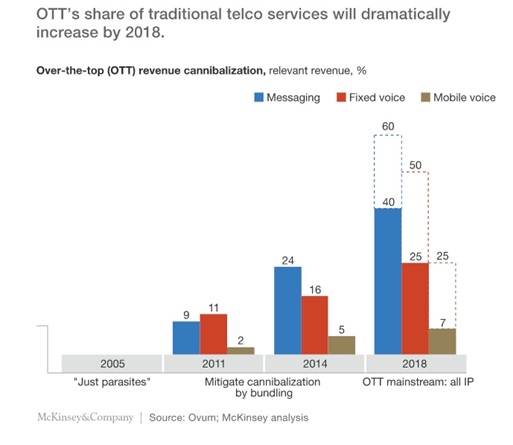
     

    OTT's share


    As the number of years ascends, the revenue graph takes an inverse fall and this analysis makes it important for CSPs, who have the best of world resources in the form of capital, customer base, infrastructure and brand name, to start doing things differently by shifting their focal point from just a traditional to a mix of traditional and digital services. Now is the time for the CSPs to take the process of metamorphosis seriously.

    (Based on GSMA figures,) The period starting from 2016 to 2020 will witness substantial ballooning of the data and connectivity indicating clearly that digitalization is going to play a pivotal role in service providers growth and thus will help in balancing the loss incurred due to reducing revenues from traditional services.
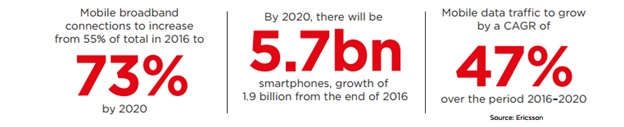
     

    mobile-broadband-connection


    The transition from communications service provider (CSP) to Digital Service Provider (DSP) cannot be a quarantined approach. It requires partnership with innovators/disruptors to bring in new services and experiences. Confederation of progressive vendors with digitalized vision is indispensable in providing solutions that can support this transition. CSP to DSP transformation approach cannot be concentrated around only new revenue streams. Industry experts have defined DSP as a service provider whose, not only services, but also operations are under the single umbrella of digitalization. One who provides services as well as operations, both digitalized.

    We have a strong view that there are lot other areas which are still left untapped.

    Looking at the current scenarios, there are 6 key strategies that are listed based on the idea of helping CSPs in increasing their revenues by bringing innovation and creativity in their existing services, acceptance of new technologies, sustaining demanding customer base and reducing operational & transformation expenses. Below is the list of our 6 key digitalization strategies that are recommended for a progressive CSP during its transformation.

    In my next blog I will elaborate on these strategies in detail and discuss how it will help CSPs to transform themselves into DSPs and thus help them to drive the digital economy. Stay tuned!
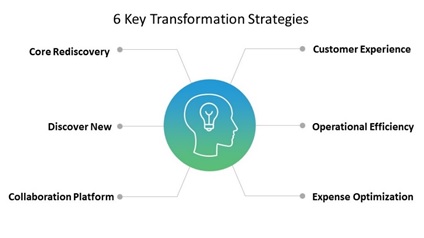
     

    transformation-strategies


  • The Future Success of Telecom Lies in Revenue Assurance

    The Future Success of Telecom Lies in Revenue Assurance

    As the telecommunications industry anticipates the next wave of growth triggered by digital disruption, there are a few developments that demand critical attention from telcos. These trends have had a direct impact on the way telecom services are delivered, often impacting the revenue streams of operators. Let’s look at the top trends that impacted telecom revenue and see how the telcos needs to devise a revenue assurance strategy to deal with these changes.

    Revenue Assurance in OTT Era

    The IP revolution that swept the telecom industry over the past decade have brought in immense opportunities for OTT players; but for telcos, it was the beginning of a cataclysm marked by cut-throat competition and revenue loss. Since then, the journey of telcos has never been easy. As OTT players took away the bigger pie, operators had to redefine their business strategies to safeguard their revenue streams. Thus, their priority shifted from traditional services to the new digital offerings that largely rely on IP networks. As the journey commenced, a series of new challenges emerged in the service delivery.

    With a large bouquet of offerings encompassing voice, data and video streaming, revenue management becomes a critical concern for telcos. The complexity associated with subscriber management and invoice management has created the need for a real-time revenue assurance (RA) platform designed around analytics capabilities. The automated RA capabilities ensure that the tariffs are implemented uniformly across all subscribers and that the billing system is free from all types of errors.

    Technology Integration in OSS

    One of the key challenges involved in a telecom provider’s transition to a digital service provider (DSP) is to integrate the transactions from different types of networks – say 3G, 4G or IP networks – to a common operations/business support system (OSS/BSS) system. Traditional systems at most telcos were purpose-designed for circuit switched networks and their revenue assurance use cases revolved around batch processing of data. To meet the complex demands created by the new digital offerings, the OSS/BSS needs to evolve to support multiple network topologies. They need to also possess the capabilities to handle large volume of data generated from disparate channels.

    The modern approach to revenue assurance allows creation and maintenance of network inventory, network fault management, and automated provisioning of services through real-time analytics. This approach goes beyond the traditional way of analyzing the basic data for billing to identify aspects that impact quality of service (QoS) and customer experience.

    Telecom Fraud and Revenue Assurance

    The impact of telecom frauds such as international revenue share fraud and SIMbox cloning on telcos’ revenues is huge. Global Fraud loss estimate is about $29.2 Bn annually (Source: 2017 Global Fraud Loss Survey) for instance. The risk grows multifold as the telcos move to advanced networks like LTE. Due to the high bandwidth and the advanced capabilities of the devices connected to these networks, monitoring these activities becomes a real challenge.

    Real-time revenue monitoring is the only way to address the revenue loss associated with call frauds. The telco should implement a robust fraud management practice that helps them analyze both expected and historical usage pattern to proactively address revenue leakage. With real-time analytics, usage can be monitored across different types of services – voice, data and video streaming. A comprehensive fraud management strategy must also encompass other aspects of providers’ environment including the sales channels, networks and the OSS.

    In a nutshell : The digital journey of telcos has just begun. Considering the future opportunities, telcos cannot slacken their pace of digital transformation. As challenges around revenue assurance grow higher in the evolving technology landscape, priority should be given to safeguard the revenue across all channels.

  • Customer Analytics:  Walking in the Customers Shoes

    Customer Analytics: Walking in the Customers Shoes

    In the first blog in this series on customer analytics, the technique of Customer Journey Mapping (CJM) was discussed as a way to follow how customers move from one touch point to the next, and track their emotional well-being during those interactions. In the last blog I described how using a persona to represent a group of customers would allow marketing to get a better understanding of customers. In this blog I will explore how Customer Journey maps can be created for persona to visualize an idealized journey for the group represented. This is now becoming a well-accepted technique for not only improving user experience in software design, but also in the design of products, digital and conventional marketing channels, architecture and many other areas.

    There are two basic approaches for creating persona. One is to base the persona on in-depth research of the customers within a market segment, and the other is to base the persona on intuition, sometimes referred to as a provisional persona. In reality, it makes most sense to use a combination of research and intuition, and then verify the persona with those who have front line contact with customers. Generally customers belonging to a company’s biggest market segment would be targeted first and a primary persona is created to represent them. If the team creating the persona do not have direct knowledge of the customers in that segment then they will need to conduct research to understand the values and motivations of the group.

    Once a persona has been defined then it’s possible to look at how the company would engage that persona in a sale, and the hope is that the persona would follow each engagement at every touchpoint, even long after they’ve made the purchase and are using the product. The framework for this is known as the Customer Lifecycle. There are many versions of this but they all share some basic stages, as described by Jim Sterne and Matt Cutler in a paper called “E-metrics, business metrics for the new economy

    • Reach: Trying to get the attention of the people we want to reach.
    • Acquisition: Attracting and bringing the reached person into the influence sphere of our organization. 
    • Conversion: When the people we reach or have a more established relationship with, decide to buy something from us.
    • Retention: Trying to keep the customers and trying to sell them more (cross-selling, up-selling).
    • Loyalty: We would like the customer to become more than a customer: a loyal partner and even a ‘brand advocate’ Moments of truth

    This can be represented either horizontally or in a circular lifecycle type chart

    The Customer Life Cycle – Source: E-Metrics Business Metrics for the New Economy by Jim Sterne and Matt Cutler

    The persona journey describes how it’s anticipated that a particular persona would move through the lifecycle. It would describe the channels through which it’s expected they are made aware of a product, how it’s expected they would research the product and what would motivate them to make a decision to buy. Key points in the journey where customers decide whether to continue or abandon the process are known as ‘Moments of Truth’, a term coined by Jan Carlzon, the well-known CEO of SAS Airlines who turned the company around in just a couple of years.

    Walking in the customers shoes in this way is not easy, and would normally be done as a workshop with representatives from across an organisation, but it’s an exercise that can provide many useful insights. Service quality gaps, cross channel alignment, ways to better engage customers and align internal teams are just a few of the many benefits that come from journey mapping. When idealised journey maps are compared with the actual journeys that customers take then many preconceived ideas about how customers see and engage with the company may get thrown out and fresh ways to engage, retain and acquire new customers be discovered.

    In the next part of this customer analytics based series of blogs I will be looking at the security implications of big data and advanced customer profiling, and how regulators around the world are trying to protect an individual’s right to be treated equally by large corporations.

  • Customer Analytics : Gen X and Y and the Millennial Divide

    Customer Analytics : Gen X and Y and the Millennial Divide

    We live in a world where technology is like a digital liquid that’s flowed around every aspect of our lives. There’s no doubt that technology can help to oil the craggy wheels of daily life, and while some find this enabling and liberating, others consider the intrusion to be more insidious. Working out where people stand on this issue is generally just a simple matter of checking their birth date. Many born before 1980 tends to view social and on line everything with suspicion, whereas those consumers born after that date, referred to as Generation Y, or Millennials, are far more comfortable with social media and sharing everything online. In a recent report from Pew research it was shown that the Millennials are much greater users of social media than their parents.

    This is probably because Millennials are the first generation that have grown up entirely with the internet and mobile phones.  They are ‘digital natives’. It’s difficult to know exactly what effects this has on general culture, but one surprising change is that Millennials tend to be far more optimistic that their parents were when they were young. While Generation X and before are more inclined to have a cynical and pessimistic attitude towards the future, a recent report by the Pew Research Centre, Millennials in Adulthood, has found that, despite feeling detached from politics or religion and burdened by debt and recession, the Millennials are inexplicably much more optimistic. According to a recent Gallup poll, eighty percent of millennials, aged 18 to 29, feel positive about the future and say their standard of living is improving.  The reasons for this relentless optimism are unclear but researchers at Pew have pondered that it may be down to more nurturing parenting, or perhaps it’s because millennials always feeling at the centre of their own social network.

    Another characteristic of the millennial generation is that, contrary to predictions that technology would free us all from work, they are now working harder and are more driven to succeed than ever before. In his book ‘Generational Teaching: Motivating the Minority’ Christopher Alan has also found that Millennials are ‘more polite and considerate’, ‘attentive and respectful’ and prefer to work in teams rather than in a hierarchy. Goldman Sachs also says that they are also more health conscious and savvy than earlier generations.   But, as ever, the picture is never that simple, because it seems that the Millennial generation is itself divided in two, as Pew Research has written

    Just 40% of adults ages 18 to 34 consider themselves part of the “Millennial generation,” while another 33% – mostly older Millennials – consider themselves part of the next older cohort, Generation X.

    This all has very great implications on marketing, and how companies should reach out to different generations. Connecting with customers is one of the greatest challenges marketers face, and capturing Millennials is now one of the key battlefields for competing companies. As Leah Swartz of Millennial Marketing says

    ‘When it comes to fashion and shopping, there isn’t a more important demographic for retailers to reach than millennials.’

    Goldman Sachs have even put together an infographic dedicated to marketing to Millennials in which they identify several key things to consider when marketing to the ‘largest generation in US history’. In summary they are

    • Living at home longer
    • Marrying later
    • Sharing, not owning
    • Exercise choice in purchasing
    • More health conscious

    From a non-millennials perspective it may seem that they are so immersed in instant messaging and playing computer games that they are oblivious to the real world, but, on the contrary, millennials are very much aware of the state of the world. It’s just that this revolution is a lot quieter than the ones before, taking place as it does silently from the screens of our phones and laptops. The silence is an illusion. The volume of noise is now measured in packets of data rather than decibels, and it’s loader than ever. If companies don’t engage with different generations of customers on their own ground then they will not be heard at all.

    In my next blog I will look at how Millennials and other demographic groups can be better served by adopting a customer-centric approach to marketing.

  • Reporting “The Smart Way” in RA

    Reporting “The Smart Way” in RA

    “As is”
    Read the news using your favorite news app on your smart phone or device? Notice how the app renders news items that are important to you or of interest to you and stacks them together with short headlines followed by a short summary thereby making sure that one wouldn’t need to feel short of time finding what really needs to be read.

    Is this done in your RA department?

    The below diagram illustrates how majority of the RA departments report the necessary information to all concerned departments and how the subsequent action items are publicized and owned by various departments.

    Reporting2

    In majority of RA functions the following gaps exist in the reporting of findings and their subsequent action points:

    • Reports rarely designed with specific information that is immediately consumable by target audience
    • Reports rarely designed with specific requirements to the target audience than can be easily converted to action items
    • Majority of the RA operations use one reporting template for all business functions

    “Smart Reporting”
    The below figure illustrates the ideal modus operandi that requires to be followed in a RA reporting structure.

    Reporting1

    Key improvements in the model are as follows:
    • Reports specifically designed to target audience. For example: Reports to CxO will address revenue & cost savings, key mitigation measures taken, not exceed a time length of 5 minutes and requiring specific actions / escalations
    • All reports to address specific actions required from various business functions and will be time bound
    • Organizational news feeds will be made part of RA reporting

    Here the emphasis is on smart reporting, which can be quickly consumed and acted upon.

  • A Digital Future for Everyone

    A Digital Future for Everyone

    Baroness Martha lane Fox, Internet pioneer and co-founder of lastminute.com,  has recently launched a campaign to try raise public and government awareness as to how the internet can benefit everyone, rather than just being a corporate billboard for advertising.   It is entitled DOT EVERYONE, a play on the .com extension used by commercial websites.

    As a business women in the late 90’s Baroness Fox realised the potential of the internet to provide an economical channel through which services could be delivered directly to the public.  Lastminute.com thrived on scooping up the unsold seats for holidays and west end shows and making them immediately available to the public with an easy to use search engine.  It was a business model that was uniquely suited to the internet, since it dealt with a data product that would become obsolete very quickly and targeted a geographically disparate market.  The internet provided the perfect channel through which such a product could be made available to a huge market in the minimum of time.  It is now Europe’s largest travel and leisure website.

    Today she is working to enlighten the British government and public as to how those characteristics of the internet that lastminute.com exploited could also serve the public good.  Her DOT EVERYONE campaign has three key strands

    1. To help educate all of us, from all walks of life, about the internet. The internet is the organising principle of our age, touching all our lives, every day. As the late activist Aaron Swartz put it, “It’s not OK not to understand the Internet anymore”.
    2. To put women at the heart of the technology sector. Currently there are fewer women in the digital sector than there are in Parliament.
    3. We (the British government) should aim for a much more ambitious global role in unpicking the complex moral and ethical issues that the internet presents.

    While these messages were aimed primarily at UK government, they are really aspirations that should apply equally to governments everywhere. In this blog I am looking at the first of those messages.  In order to “educate all of us”, it is essential that good internet services are made available to all of us.  Baroness Fox goes on to say

    “We need to make sure that those in power understand how the internet can help us redefine public services, improve the lives of the most vulnerable, bolster our economy.” 

    Key to this redefinition of public services is the usability of government websites.  By improving the usability of websites it is hoped many more interactions with government will happen as self-service transactions, resulting in substantial cost savings.  A good user experience can result in improved quality of service for much lower cost.   In a letter written to the government in 2010 Fox states

    “It seems to me that the time is now to use the Internet to shift the lead in the design of services from the policy and legal teams to the end users.”

    In other words, governments must cut through red tape and design services around user needs.

    Along with improving the quality of transactions on government websites it is also recommended that services should be made available through API’s such that external organisations can directly utilise government services, as well as making them more widely available to re-sellers.

    “We should put government transactional services and content where people spend their time on the web, rather than always expecting them to go to Directgov.” (government website)

    By exposing API’s to third party vendors then not only are external companies able to directly interface to those services, but they also able to offer them on to other consumers, thereby extending the reach of the service providers.  For example, Ebay and Facebook often carry ads for third party organisations that post their content via the Ebay and Facebook API’s.

    A third recommendation is that services should be centralised through a single portal.  This will improve ease of access, but will also result in removing duplication.

    The recommendations that Baroness Fox has made are already making a substantial difference to how consumers interact with government, and will continue to drive government to improve services and embrace the digital age.  In the words of Baroness Fox

    “What digital is about, what the internet allows, is a radical redesign of services. Cheaper, better, faster.”

    It’s a revolution that affects everyone.