Category: General

  • Capex Optimization:  A strategy for growth, or defense?

    Capex Optimization: A strategy for growth, or defense?

    The battle is heating up and speeding up in virtually every market. Customers want the newest, latest, greatest handsets, products, and services.  But how long has this battle been heating up, really?  The answer is simple:  Since the 1980’s.  All that has continued to change are the tools used by the operators in the battle.  Let’s examine the latest tools being used in the Americas and understand how that impacts Capex.  The results may be surprising:

    In what is arguably the start of the latest rounds of “artillery”, T-Mobile launched free roaming to over 100 countries in 2013, and started attracting customers by the millions away from the likes of AT&T and Verizon.  After the immediate dust settled and the program was seen to actually be viable, AT&T responded with paying the early termination fees for converting subscribers from T-Mobile.  In the process, flat rate plans with expanded data benefited all of us, as T-Mobile and AT&T both offered non-contract based data allotment increases, for no cost (and in many cases, lower costs) to existing subscribers, to shore up their retention numbers.

    Verizon has taken a more conservative approach, saying they have the largest 4G network, which has caused AT&T to counter with having the fastest 4G network.  Not to be left behind, T-Mobile responded with offering to roll over unused data, and to unleash attractive unlimited plans via their recently acquired MetroPCS brand.

    All the while, Sprint, the last major national carrier in the mix, has been losing market share while “sprinting” to greatly expand their 4G network.  In the recent weeks they have jumped into the market with a very viable message, aimed directly at AT&T and Verizon, to cut subscriber bills in half…literally.  They even took out an ad in the most expensive slot in the world:  The American Super Bowl.  This ad was designed to “apologize” to AT&T and Verizon.

    And now the latest, and perhaps most interesting move, has been the international expansion of some operators into Latin American markets.  The model is simple:  Buy a Latin operator network.  Re-brand it to your internationally known name.  Offer local services that extend all the way into North America.  No roaming or interconnect, and all local calling.  This is a major threat to long-time incumbents in the Latin market, and it’s already happening. Three years ago I was asked what I thought the impact of 4G/LTE would be to the markets.  I made a quite possibly crazy prediction that 4G was going to upset the way we understand roaming and interconnect, simply due to the fact that data, VoIP, and the new products that were going to ride on femtocells and wifi / wimax were going to totally change the playing field.  Could it be that something similar is gathering momentum today?

    What is the common thread in all of these battles in the Americas market(s)?  Quite simply, the operator revenues are not growing, or are not growing at the pace to keep up with Capex spend.  Networks are being extended and evolved not to add revenue, but instead to sustain revenue.  Here’s an example:  In the last 24 months I have moved my entire family to 4G.  My bill decreased.  More data was added to my plan.  My bill again decreased.  I then expanded my home DSL to a 30x increase in speed.  My bill stayed flat.  All of this involved more network capacity and expansion in products and services.  But I was not further monetized…I was just retained.

    Capex optimization, if pursued for growth, could be considered a great goal and something to strive toward.  However, if Capex optimization is pursued to simply maintain your revenues (and market share), this should no longer be considered a goal, but instead a critical strategy for longer term survival.

    So ultimately, how do operators monetize networks?  Perhaps the question needs to be focused on monetizing customers – by turning attention toward strategies that get more share of wallet.  Operators should invest Capex into supporting behavioural shifts in their customers.   Mobile wallet, xBanking, xCommerce, etc, need to be provided as revenue-generating services by the operators, for those customers.  It’s no longer about getting money for network services…it’s now about getting money from supporting a behaviour facilitated by those network services.

  • Spreadsheets and the Underwater Analyst

    Spreadsheets and the Underwater Analyst

    You’re an Analyst so you love data, right? Data is the oxygen of an organisation, but just as a living creature needs a heart and clean arteries to keep its oxygen infused blood flowing smoothly, an organisation also needs to maintain its systems and system interfaces to keep that data flowing smoothly and efficiently. As an analyst you will probably feel physical pain if your supply of data is cut off, and may even begin to experience panic attacks, but a good analyst will persevere in finding a cause of the blockage and find a way around it. That’s why we have spread sheets everywhere. Spread sheets are like virtual scuba tanks for an analyst, providing a personal supply of data to play around with in a world where the usual source is either unreliable to completely unavailable. What’s even worse is that the supply of data is generally under someone else’s control, which will often be your resident IT group. Need a report on Sales for a new product by region? Ask IT. Need the data on a daily instead of weekly basis? Better ask IT to change the extract. Need to know which customers are churning by a specific market segment? You guessed it.

    So you get a report to tell you everything about everything, stick it into a monster spread sheet and start to play. But then the data changes. It’s no longer relevant and you haven’t been able to get an update. You’re blind and the presentation is tomorrow morning! You are facing the same reality that countless organisations are facing across the globe, which is that data held in spread sheets and on laptops around the organisation starts turning stale as soon as it’s loaded, and that can lead to organisational paralysis. Despite the promise of flexibility and agility spread sheets can actually cause inflexibility, as functional silo’s become more divided and inter-functional processes break down.

    There must be a better way. If only the data was always to hand and you didn’t need to go to IT cap in hand to get a report that is obsolete before it’s delivered. If only you could get instant access to the data you need in an enterprise strength repository that automatically loads data 24/7, and then provides you with all the tools you need to transform, enrich, aggregate, correlate, forecast and generate beautiful charts to make sense of it all. Then imagine that the product that does all this is the core for a wide range of integrated solutions from billing to network management, asset assurance and cost management, and that you, or anyone else in the organisation, is now able to pull up to the minute analytics out from any those systems, as well as any other systems within your organisation, from one central portal. Then you would be looking at the Subex ROC, the powerhouse at the core of a comprehensive range of products that put control back in your hands.

  • The Importance of Peripheral Vision

    The Importance of Peripheral Vision

    The air is clear and fresh at 6000 feet, and I can see the snow covered roofs of the chalets in the valley below.  Just ahead a pristine white slope punctuated with a few hundred moguls’ presents a challenge for my knees and stamina, but also a whole lot of fun. From the top I pick my line, turn my skis to the edge, take a deep breath and push off.   My ski instructor has admonished me to keep my shoulders facing down the slope and not to run straight into the bumps, but go up the sides and pivot near the top such that I use the slope of the bump to control my speed. The first few turns go well but as the slope steepens so my speed increases I become focussed on one thing, which is just to stay in control. Then it happens. From out of nowhere another skier, even more out of control than me, is flying in from the right side on a collision course. My only course is to swerve to the left and straight into the nearly vertical face of big mogul I was hoping to avoid. The wipe out is messy and leaves me with one ski on and the other cheerfully bouncing away down the slope on its own.   As I stumble down the slope to retrieve my other ski I remember the other thing my ski instructor reminded me do, which was to always be mindful of my peripheral vision, since that how you avoid unpleasant surprises. It also made me think about the importance of peripheral vision in other areas of life. We typically think of peripheral vision as an ocular skill, but it’s also a great skill to develop when trying to steer a project or even an entire company through the bumps of market forces and competition.

    In their book ‘Peripheral Vision: Detecting the Weak Signals That Will Make or Break Your Company, Day and Schoemaker describe how successful companies often share one key characteristic, which is that they remain vigilant of the ‘weak signals’ that come from the edges of the organisation, and this allows them to be highly adaptive. It’s often the case that someone in an organisation knows about an issue that ‘blindsides’ a company long before it happens, but just didn’t have the right channels of communication to the person who needed to know. The problem isn’t lack of data, but lack of appropriate filtering to isolate the signals from the noise, and providing the channels through which that data can reach those strategic thinkers who are vigilant and can take action.  It’s not about what you know, but what you don’t know.

    Subex Ltd. developed the ROC, (Revenue Operations Centre), to not only sit at the centre of their suite of award winning products, but also to assimilate data ‘signals’ from all areas of a business to provide a high level view of those KPI which let executives know that things may not be going to plan. Through a combined process of ETL and data federation ROC provides a conduit through which those faint signals can be collected, amplified with advanced analytics, filtered, and then channelled in near real time to the right people.

    Executives need to ask the right questions. They need to ask why they didn’t know something was going to happen before it happened. To do that they need to improve their peripheral vision, keep vigilant and always be ready to act on the signals coming in from the edge of their business.

  • The threat of Signaling!

    The threat of Signaling!

    Signaling level risks, specially fraudulent accesses from connected SS7 networks, is one area which is making a lot of noise in the assurance and security functions of Telecom organizations today.
    The focus on the matter is such that most of the industry conferences talking about the current and next gen threats have a lot of matter being presented and shared on this topic – both from the operators and vendors alike.

    What is it ?
    The signaling level risks generally refer to SS7 (2G/3G) and Diameter (4G) level vulnerabilities (inherent or configuration based) which exposes operators to hacks/frauds through signaling control commands specially in roaming and interconnect scenarios. The scenario becomes more risky considering a normally configured SS7 infrastructure of an operator is accessible to any other operator in this world, either directly or through certain number of hops.
    Now, just consider a situation where a rogue operator exists or a group of hackers with a malicious intent have got access to SS7 signaling of any less-secure operator in this world.
    The losses due to signaling risks, while are still quite speculative, are expected to run in billions every year. Artificial inflation of traffic (specially A2P & P2A SMSes), Spamming, Spoofing, Refiling, profile modification, unlawful tracking, unethical disruptive activities from competition etc. are examples of some risks which have been found to be existing NOW with an estimated 100% infection rate.

    Why is it happening ?
    The SS7 signaling based vulnerabilities have been existing since very long, but have become part of news headlines recently due to certain revelations made by famous ethical hackers at certain high profile security conferences.
    Some industry pundits make a point, which most of my industry connections agree with, is that these risks exist mostly due to the fact that operators tend to create unreliable partnerships and configure unregulated access (like open GT access, acceptance of any signaling command etc.) which enables malicious parties to connect to operators networks and conduct fraudulent activities very easily.
    There have also been discussions around existence of services exploiting these signaling level vulnerabilities being offered in the grey markets through rougue hacking communities for a price.

    Can you eradicate these risks ?
    Ideal Solution: Operators need to sanitize their access configuration on SS7. Rethink, Reidentify, Reevaluate and Reconfigure the access levels.
    But this is really difficult or maybe nearly impossible to achieve due to some practical issues on the ground, such as:

    • Most of the SS7 networks were configured long time back – There is an expertise issue operators are facing wrt SS7 networks now which limits their capability in terms of reconfiguration of SS7 based networks
    • It is a time consuming activity, which, would also lead to a lot of efforts on re-testing connectivity with all the partners, attracting a lot of investment
    • It may lead to reconfiguration of the signaling level configuration at the network level, and in certain instances, would require network downtime – A complete NO-NO for a lot of players out there. Situation becomes even more problematic for countries where Telecom Networks are considered a National Infrastructure.
    • Lastly, not every operator will take up this activity for many different reasons including the reasons like operators not participating in the awareness meetings/conferences being organized around the world or even like some rogue operators participating in malicious activities deliberately.

    The problem becomes much more trickier from the fact that even one infected, unsecure or rogue operator in the world will continue to pose a threat to everyone else. And sanitizing each operator against these threats is a feat which is very unlikely to be achieved.

    It is now unanimously being accepted that SS7 signal based networks are here to stay (atleast 10 years in developed markets and 20-25 in developing or lesser developed countries) and even their vulnerabilities, which are expected to grow by huge amounts considering the limelight it has received recently.

    The bigger problem which has started giving sleepless nights to the fraud & security functions in operators moving towards 4G and setting up their networks over diameter protocol (provides 4G signaling framework) does not have native security standards inbuilt, but requires security mechanisms to be implemented on top, a practice always found susceptible to gaps). Also, the access methods are similar to SS7, so it exposes 4G networks to similar signaling risks as SS7.

    What can be done now ?
    For now, an approach of detection would be ideal until the industry identifies a way to plug these vulnerabilities around the world, which is definitely a few years away with a lot of research hours of investment.
    An approach of detecting malicious signaling requests in your network still has few complexities to manage:

    • High false positive rates – A lot of signaling requests appearing to be malicious come out as configuration issues from the partners. Hence, domain expertise is essential to filter out ‘needle from the haystack’.
    • Sheer size of signaling data to be analyzed – big data support is required.
    • Skill set – This activity will surely require a knowledge upscaling and may be difficult for the traditional teams like fraud and risk management to absorb. Even teams like security, with less focus on fraud domain know how, is expected to find it difficult to add this activity in their set of responsibilities.

    I feel industry partnerships with vendors, possessing both the domain knowledge, right skill set and technology built on big data platform is the way to go.

    These partnerships, considering no-one has a complete answer to this rampant problem of signaling vulnerabilities as of now, need to be built on solid vendor capabilities, while being both liberal and experimental to give room for exploration.

  • The Re-Emergence of Convergence

    The Re-Emergence of Convergence

    Operators and global industry forums continue to wrestle with the question of whether or not to merge their fraud and security teams/work-groups to cope better with criminals who are breaking in through IP-based networks in order to derive profit for themselves (or their causes), or just to wreak havoc and disruption on their “enemies”.  Fraudsters are not just partaking in the traditional crimes of bypass fraud, roaming, Dial Through, AIT/PRS, Call Selling fraud etc., but also the exciting new stuff…. Phishing, malware, spoofing, DDoS, Trojans etc.

    One can be forgiven for thinking that fostering closer links between fraud and security domains is breaking new ground in terms of responding to the threats posed by 4G/LTE, NextGen, the continued growth of e/m-commerce and the proliferation of data passing over networks.   I guess it is a sign of my advancing years that I can’t help feeling that we have been here before…

    15 years ago, when I was prepping for an interview for my first job in the fraud management arena, I was listening open-mouthed as a fraud expert was explaining to me the finer points of PBX Hacking.  Thinking back, two things were very clear:-

    1. The Operator in the UK already had a merged fraud and security group (which they later separated out, then subsequently re-merged again, by the way).
    2. The main advice to combat PBX Hacking was prevention, not detection… and that meant security prevention. The operator was keen to tell its business customers that they needed to physically lock away their PBX equipment, protect their passwords, switch off unnecessary/vulnerable services such as DISA/Voicemail, carry out security awareness training for switchboard operators, support staff, suppliers, use barring at switch or extension level, keep PBX call logging records to see hacking attempts before they succeed, shred old copies of internal directories, vet their security/cleaning staff, etc. etc.   The FMS only stepped in when all the prevention activities failed and the PBX was breached.  By the time that happened, operators were already losing money directly, if they were responsible for the switch, or indirectly if their customers were liable.  Customers may have been unwittingly facilitating the fraud by their lack of security awareness etc. but even so, if a small business – used to paying perhaps $1000 a month for calls, suddenly gets a bill for $20000, they are going to fight it, refuse to pay it or be unable to pay it.  The indirect cost to the operator of customer complaints, disputes, potential court cases, damage to the brand, bad publicity, negotiated settlements, debt write-off and churn etc. can cost far more than the original bill.  It was a lose/lose situation… unless you were the fraudster.

    These days, with the emergence of 4G/LTE, IP-based Networks, perpetrators are still committing the same underlying crime for the same motives as before, but now they are breaking in through a host of different entry points, wearing better disguises, carrying bigger SWAG bags and using faster getaway vehicles.  In truth, many operators are struggling to keep up with the high number and seemingly unpredictable nature of these attacks.

    Security teams are traditionally very good at preventing access to networks, but they are not perfect.  The pace at which network elements, components, interfaces and transactions are increasing is making it impossible for all the preventative measures to be in-situ from day one.  Not to mention the surfeit of off-the shelf tools that fraudsters can use to break in to more and more lucrative areas of daily commerce.

    In practice, Prevention alone cannot succeed.  Detection, Analysis and Response are also essential elements of the fraud management cycle.

    Cycle

    So, my point is this…. security and fraud teams cannot operate in silos.  Security teams must continue to try and prevent malicious intrusion as much as possible.  That requires taking in a lot of real-time data from the access points, identifying the nature of the content and the data patterns and quickly blocking anything that looks dubious.  But when the intruder gets in (and they do in their numbers), that is when the fraud team can also play their part.

    Whilst the security team controls corporate IT networks, how well can they police the mobile workers and the homeworkers, the tablet users, the App Store/Android Users etc.?  And if you think that profiling subscribers was difficult historically, how much harder is it when you can’t even define what a subscriber is, let alone track their behaviour.  In the new world, the relationship between account holder, subscriber and product/service is not always obvious.  Also, the billing relationships for transactions can be mind-boggling.  Couple this with the speed at which these transactions are taking place and the value of services and content being passed across a proliferation of bearers, and you have a minefield to negotiate.

    This is where a good Fraud Management System can supplement an operator’s security tools.  An FMS must now be equipped to take in much larger volumes of data than before, in many different forms and process it much quicker.   Any reputable FMS vendor will now be offering solutions with large scale, flexible data handling tools (including probe / deep packet inspection events), internal/sales partner audit logs/feeds, inline service/transaction monitoring, exhaustive rules engines (real-time, in-line and statistical), subscriber grouping & profiling features, reference data including Hotlists/Blacklists, fraud and device “fingerprinting” capabilities, ID verification, alarm prioritisation and established, flexible workflows, with a range of analytics tools and visualisation features.  All these components – in the hands of an experienced and well-managed fraud operations outfit – will help to choke fraudsters and drive them out to look for easier targets.

    So, in summary, don’t let the security guys take all the strain at the prevention stage.  Share the data, share the knowledge and spread the load to the fraud team for a more comprehensive response.

    To get more information about Subex Fraud products please click here.

  • Mobile data offloading & Revenue Assurance

    Mobile data offloading & Revenue Assurance

    Emergence of mobile data offloading

    Though mobile data offloading is not new to the industry it is catching steam off late and that has made operators around the world take notice. The factors that are driving mobile data offloading is the ever growing smart phone market giving people the option of streaming any content of the internet right on to the palm of their hands.

    Surprisingly it is not “work on the move” that is making a large percentage of the populace download content through their smart phones extensively but the driving factor happens to be  streaming of video content from sites such as YouTube that ranks at the top of data usage .

    Key industries can’t afford to ignore the trend especially when recent industry research predicts that nearly 50-60% of the data would be offloaded by the year 2017 by either WiFi, WiMax or Small cells with WiFi being a major player over the latter two.

    Why offload with begin with?

    At a time when cellular operator costs are going up due to investments in 3G and 4G network evolution, WiFi still ranks at the top for data offloading primarily due to 3G/4G pricing, poor signal reception indoors and WiFi’s higher bandwidths offerings with little or no interference.

    The three factors put together are the leading cause for smart phone / tablet data usage being offloaded to a WiFi network.

    A simple iPad sales figures of 2012 provides a interesting insight into the fact that 9 out of 10 iPads are only WiFi show casing a interesting find that cellular data services has been given a miss at the highly sought iPad retail market itself

    “A little known fact is that contrary to popular belief a smart phone / tablet also uses lesser battery when connected to a WiFi network accounted due to the lower signal strength requirement.”

    The benefactors

    Apart from the end users who get excellent bandwidth, speed and zero interference reception; the businesses which provide broadband services to end users cash in by filling in the gaps between the cell towers, literally.

    A few OPCOs in the wireless business who also double up by providing broadband services in the form of ADSL or FOC loop back their users into their network business.

    How can RA help?

    Analytics, analytics, analytics!!!

    “The true potential of analytics is only limited by ones own imagination of what can be done with an array of data at your disposal”

    Here RA’s primary role comes in as a revenue enhancer or opportunity loss identifier and not as the more commonly known roles of “leakage identification”.

    From an RA perspective looping in key information of users such as the data usage pattern over cellular and WiFi and overlaying them over various dimensions of demographics, content, customer categorization and lifestyle components will provide an insight on potential cellular onload or offload opportunities which can be monetized by provision value add or add on services to potential users.

    From an operators perspective this insight can increase revenues especially in regions where a good smart phone markets show below par cellular data usage therein operators can increasing their service offerings to targeted localities and users in the form small cells, WiFi, or  WiMax.

  • Using the ROC to re-shape industry big-data usefulness

    Recently I have watched several vendors in our markets talk about Big Data, and the technologies they are supporting to manage that data. What I’m trying to understand in all these announcements, however, is “what does that mean for me, the user?” … or put more directly, “so what?”
    There are great numbers out there. With all the buzz about Exadata and Hadoop being made in the market, operators have reason to take notice of what’s being achieved: 1 billion loaded records per hour; 10x-13x storage savings; 70% decreases in DB license costs… Subex is also seeing similar fantastic numbers, and in many cases we are now benchmarking 40x faster performance that these other vendors’ results. Subex has supported Exadata for some time, is seeing significantly stronger results using Vertica, and will be supporting Hadoop in the coming months (including the Hadoop + Vertica hybrid, which is proving to be the best performing architecture anywhere in the industry). But still the question remains: So what?
    Vendors in our market have continued to allude to the ability to process data faster and save costs. But what else can this increased data power do for you? That should be the question being asked and answered. For this, Subex has strategically employed these new data processing advantages right in the heart of the ROC suite – which now enables our operator customers to not only see those “default” benefits of faster processing (decreased hardware, decreased costs, etc.), but to also extend their business intelligence into other critical business areas (in many cases, real time), including:
    – Customer Experience and propensities to Churn
    – Enterprise Margin analytics
    – Aggressive network and service Time to Exhaustion analytics
    – Service impact “what if” propensities and analysis
    – Distributed fraud support in wholesale parent/child enterprise relationships
    – Deep packet inspection and response for IP fraud detection and cost management
    – Immediate wholesale cost/benefit analysis with carrier trading
    – Analytics insights into root causes underlying specific issues in costs and revenues
    – Preventative security insights to plug loss exposure before it happens
    – Predictive product analytics to understand the internal impact of a product offer
    – Etc.
    These are but some of the areas operators should be looking for answers from within that new data processing capability…not just faster dashboard updates for current processing. Big Data remains useless if you can’t process new insights and intelligence from within its unstructured foundation. By positioning all relevant new performance technology advances into the heart of the ROC suite, every Subex application will benefit from the improved performance, while be positioned to share that data across other ROC solutions in the suite. This strategic approach will ultimately enable operators to model and extract far more critical intelligence for all the questions above, and more!

  • The Capex Snorkel Effect

    The Capex Snorkel Effect

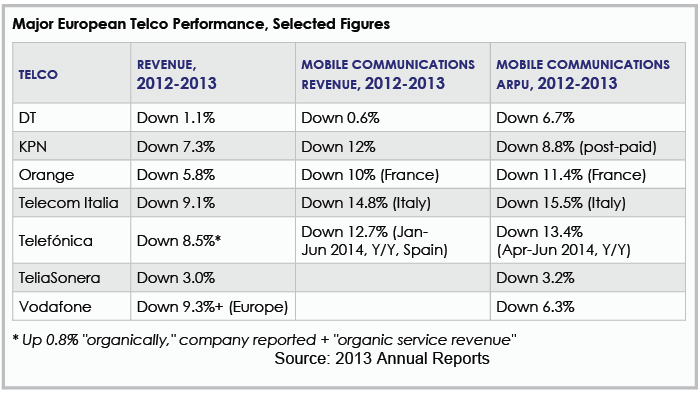
    I just read through an interesting, somewhat validating article from Alex Leslie of Billing Views, talking about operator revenues and margins.  In a nutshell, revenue and ARPU are down across virtually every major operator in Europe, according to their own annual reports, and almost all were down by double digits!

    I can’t help but believe that this is true in other regions as well, and the problem continues to be growing year on year.  Are we surprised?  When I moved my family to a new mobile operator, leaving another after 9 years, we leapt into the 4G world with all new handsets, 10x the speed, 10x the data, unlimited everything else, and our price went down.  Only 6 months later they lowered my plan price yet again, as part of a national retention promotion.  So why should dropping revenues and shrinking margins surprise anyone?

    The fact is they don’t surprise anyone, but they do worry CFOs and Boards, as shrinking (and in some cases, negative) margins are the final result of the trend.

    The trend has to stop at some point…through mergers, spectrum purchases, policy controls, or even government intervention…it has to stop.  But how far will it go beforehand, and how does an operator stay strong in the face of an industry trend that seems (for the moment) unstoppable?

    The answer may be more straight-forward then you think:  Focus on Capex maximization.  Period.  However this doesn’t mean slash budgets – although that is the current tactic in play across the industry.  What it does mean, however, is sweat the maximum efficiency out of your purchases that you can.  Why can programs like Subex Asset Assurance find tens, and now hundreds of millions of dollars in asset recapture opportunities across an operator’s business?  While there are many answers to that question, the fact remains that we are finding massive sums of Capex that operators can recycle right back to the top line.

    Therefore the formula remains, quite possibly, this simple:  Maximizing Capex allows operators to build and transform their networks more completely, quickly, and efficiently, which puts them in a market strength position.  Think of it as having a longer snorkel than your competitors as financial crisis waters are rising…

  • T-Mobile’s excellence in Revenue Assurance with Subex’s Managed Services

    T-Mobile’s excellence in Revenue Assurance with Subex’s Managed Services

    T-Mobile USA, Inc. is rewriting the rules of the wireless carrier game with the “Un-Carrier” strategy. As a result they are currently the fastest growing wireless company in the USA and are now supporting 50.5 million customers. Michael Rimkus, T-Mobile USA’s Vice President, Internal Audit & Risk Management, will be presenting how his skilled Revenue Assurance Team has been supporting T-Mobile’s explosive growth and the benefits they have realized by taking advantage of Subex’s Managed Services to support his team’s increased mandate and growth.

    Challenged by manual based methods, about 9 years ago, T-Mobile selected and deployed Subex’s ROC-RA solution. This powerful tool immediately delivered results to the Revenue Assurance team; and, with the several audits and controls initially created, T-Mobile’s core revenue stream was secured. However, with the dynamic nature of the wireless business, change was constant. The RA team matured and took on many more revenue based investigations and grew into discovery on cost leakage. As the company’s revenue and cost assurance requirements increased, the team responded to meet the needs from a discovery perspective. Passed up was the operational side, which didn’t have the right resources to advance the tools at the same rate as the dynamic nature of the RA team and company. Nearly 2 years ago, T-Mobile introduced Subex Managed Services (MS) and the advancements are impressive.

    By adding Subex’s Managed Services to the Revenue Assurance Team, T-Mobile now has the expertise to match the speed of change and advancements in the world of revenue and cost assurance. The Subex tool is powerful, and with a staff that can automate, optimize, creatively configure, monitor and analyze multiple streams of information and data, the combined RA team brings increased value to the company. Michael will discuss: the evolution of the tool; the RA team; and the introduction of MS into the environment, which is taking T-Mobile to the highest levels of revenue assurance excellence.

  • “A cup of coffee commits one to 40 years of friendship” – Turkish Proverb

    “A cup of coffee commits one to 40 years of friendship” – Turkish Proverb

    Istanbul is a city of seeming contradictions, a confluence of the old and the new.  Scratch slightly beyond the surface and one would be awed by the profound depth of culture and the warmth and hospitality of the Turkish people.  Istanbul has been described as a magical bridge between the east and the west and we can see the diversity to this day in this beautiful city. This is a city which has ingrained the best of all, and became more prosperous for it. I cannot imagine a better place for Subex to host its annual User Conference.

    When we think of user conferences, we think of warm, open spaces. We think of sharing, collaboration and evolution. We think of inclusive growth. All of these are feelings and thoughts I associate with Istanbul. The roster of industry leaders who have so graciously decided to share their time, knowledge and wisdom with all of us is truly humbling. The number of operator registrations this year has been a record high (over 150), and in this we as Subex feel the weight of responsibility to deliver value to our customers.

    Of course, delivering value becomes a significantly easier task when you have esteemed guests like:

    Gerd Leonhard (Futurist, Author, Keynote Speaker, Think-Tank Leader & Strategist)
    Alex Leslie (Publisher & Editor – BillingViews)
    Eric Priezkalns (Co-founder – TalkRA.com)
    Michael Rimkus (Vice President, Internal Audit & Risk Management at T-Mobile US, Inc)
    Dave Huras (President – CFCA and Manager Toll Fraud and Voice Operations – MTS Allstream)

    The best part being that the above is a small part of the overall roster. I for one am very excited to hear from old friends like Amit Agrawal (Group Director – RAFM Etisalat) and Sanjay Batham (GM – Design & Implementation Reliance Jio) about highly relevant topics like the challenges around group RAFM design, advent of 4G and associated challenges, social network analytics, demystifying asset assurance and various other topics.

    It is always a wonderful thing when we get an opportunity to learn from the experiences of others. When I look at the list of topics for this event, I’m glad to note that there is a welcome balance between the lessons of the past as well as a peek into the future. Given that these views are being given by our friends and colleagues in the Telecom world, I am sure that the level of meaningful interaction would be at an all-time high as well. The number of case studies this time around tells me that our telecom friends have been busy at work innovating solutions and are eager to share practical experiences with a larger audience. Much like Istanbul itself, the overall agenda is a rich amalgamation of practical knowledge, challenges and solutions from across the world.

    So here’s to old friends, respected colleagues and industry leaders. If you’ve registered for the meet, let’s catch up for a glass of Türk kahvesi in beautiful Istanbul – and cheer to 40 more years of friendship!