Category: General

  • A Weekend Warrior’s Guide to Capex Reduction

    A Weekend Warrior’s Guide to Capex Reduction

    As a recreational athlete, I’m by default a numbers guy.  Being a wee bit past my prime competitive years, those numbers don’t look quite as good as they used to.  For example, I know that my rate of decline in a 10K running race is approximately 4 seconds slower per klick per year.  This motivates me to become more efficient.  With my training.  With my nutrition.  With my body mechanics.  I want to get as much from my aging athlete’s body as I can!

    You’ve probably guessed where I’m going with this.  Operators universally strive to “sweat” as much from their networks as possible.  Consider a key metric found in many operator financial statements: Capex-to-Sales ratio.   It’s an indicator of how efficient an operator is at translating network investments (approximately 80% of overall Capex) into revenue.   From my reviews of operator financials, I typically see this number in the 13-20% range, with a mean of ~15%.  Compare this to Retail (4%), Transportation (8%) and Pharma (6%).   The Communications sector leads the pack.

    Sure, we all know that Telecom is Capex-intensive.  This just puts a number on it.   But there are further pressures on operator balance sheets.  Most operators cannot maintain the required investments in their networks with cash from operations alone (as evidenced by declining EBITDA margins), so they pile on debt.  This becomes a vicious cycle.  Proceeds from bond sales yield more working capital,  but debt service requires free cash.   What’s the best way for an operator to increase free cash flow in the business?  Reduce Capex!  And around and around we go.

    Hence it becomes imperative for operators to seek innovative ways to address seemingly contradictory goals  – reducing their Capex burden, while supporting increased bandwidth demands and new product/service rollouts.   For this I advocate turning to the numbers.  For example, do you have a metrics-driven understanding of:

    • Your asset utilization rate?
    • Which deployed assets have not carried traffic in the past 60 days?
    • Mean time from asset purchase to revenue contribution?
    • Sparing levels vs. industry best practices?
    • Detailed asset movement history for assets in your mobility RAN?
    • % alignment between your fixed asset register or ERP and your network?

    An asset assurance program addresses these questions and many others to drive measurable improvements in Capex efficiency.  One final point—there is change looming on the horizon in the form of large scale network transformation programs.  These programs are only accelerating Capex pressures on operators.  I will explore this topic in my next post.  Right now I’ve got my running shoes laced-up and I’m headed out the door.  I’ve got to get my numbers back on track!

  • Managed Services – An important weapon in a telco’s arsenal for BSS business optimisation

    Managed Services – An important weapon in a telco’s arsenal for BSS business optimisation

    While pressures on cost and margins with traditional services remain, fast emerging services are bringing in new risks and demands for new skills to manage them. Telcos are now looking for Managed Services engagements as a key differentiator in the emerging world.

    Telco’s are at the cross roads today – on one side they are pushing boundaries in a saturated and commoditized market to garner revenues and improve margins, whilst on the other they are pressurised to innovate and cater to the demands of the ubiquitous connectivity and data enabled services. Telco’s do not have a choice, but to act, to remain relevant in the market place with the changing landscape, new challenges and competition. With telco’s looking inwards for business optimisation – focusing primarily on the profitability of the business and monitoring the operational state of the business – what are the key trends shaping the industry and opportunity landscape ?

    Opportunities to remain relevant and successful in the new world order are plenty. Some of the initiatives are fairly quick to implement, while others require long term dedication and focus. Let us look at 3 key areas of opportunities in BSS for any telco.

    • OpEx control – Improving margins: The immediate and short-term opportunity for telcos is to control OpEx and improve margins on an already stressed traditional revenue streams. However, how do operators overcome the challenges facing them at two different levels – (a) skills upgrade (b) shortage of talented resources internally, and start improving their margins?
    • CapEx control – Improving RoIC: In the medium term, telcos are going to invest heavily in new and emerging technologies. The common conundrum corporate heads face are related to (a) successfully managing risks that comes with anything new (b) utilising the available critical capacity of technology & resources (c) responding timely & appropriately to market in face of competition and consumer expectations. How does Managed services help in providing the necessary capabilities to improve RoIC?
    • Economy of scale – Fuel growth: In the medium-longer term, telco leaders are going to look beyond their operating boundaries ; Industry consolidation, overseas M&A, new sources of revenue like PaaS/IaaS/SaaS for MVNOs or group op-co’s will be a key ingredient to the revenue growth. Is Managed services a viable solution to manage strategic and compliance risks?

    Click here and download our latest newsletter in collaboration with Gartner for answers to the critical questions facing the industry leaders.

  • Diamond is the New Triangle

    Diamond is the New Triangle

    More money has been stolen at the tip of a pen than at point of a gun. It is the people behind the pen who committed the fraud than the pen itself. Hence for those who are fighting fraud, it is worth spending time in understanding why people are committing it.

    Everyone who has exposure to fraud is very well aware of the Cressey’s hypothesis on why people commit fraud – Perceived opportunity, Pressure and Rationalization. These three attributes over the years make up what is widely known as Fraud Triangle.

    However; critics have often cited that fraud triangle, being from fraudster’s perspective, has defined two attributes (pressure and rationalization) that are generally non observable. Thus it fails to explain why fraud was committed when perpetrator have traits of pathological fraudsters. This shortcoming can be overcome by taking fraudsters assessment of capability in to account. Not only does the fraudster have environmental or situational factors for committing fraud but also they must have the necessary abilities and traits to recognize and make it a reality. Everyone may not have this capability in a given situation. Many of the traits that make an individual capable of committing fraud can be derived from the individual’s personality itself.

    The personality traits that makes a personal capable of committing fraud can be attributed to his position or function in the organization, his level of intelligence, his arrogance, persuasive & deceptive nature, and Immunity to stress.  The fraudster’s specific position or function within the organization along with his ability to recognize and exploit the weakness of internal controls allows him to visualize opportunities that are otherwise unnoticed. The fraudster’s egoistic nature often makes him believe that he is beyond the surveillance of checks and balances. The fraudster often will be able to persuade others to commit fraud or at bare minimum to turn a blind-eye. The fraudster will be good in concealing his inner stress and often lie convincingly in order to maintain a consistent story.

    Thus capability provides with more measurable traits for detecting possible frauds. Therefore it is important that assessing capability and addressing them at early stage are made as part of the fraud fighting charter for organizations.

  • Subex User Conference 2013

    Subex User Conference 2013

    Subex User Conference 23rd and 24th Crowne Plaza, Blanchardstown, Dublin

    It is that time of year again when we look forward to our annual User Conference. It has rapidly become one of the most sought after events in the BSS calendar. Not just for the range of speakers but also for the focus on our roadmap and plans. And, of course, for a little relaxation.

    Last year we were in Vienna, a truly beautiful city. The sessions were excellent, with keynote speaker Daniel Rui Felicio, CEO, Siemens Communications, Media and Technology kicking off the proceedings. Alex Leslie, Publisher of industry blog BillingViews followed him with his ‘More Interesting Things’ in which he explored some of the more interesting trends and statistics in our industry, such as DNA that you can email and paper that is interactive. Speakers included Paul Fedarb from BT, Dan Baker from TRI in North America and our own John Brooks, who has just been named as the project leader for the TM Forum’s Asset Assurance program. To relax we were treated to a guided tour of some of the most famous buildings in Europe, followed by a traditional dinner under the city walls.

    This year we turn to Dublin, a great city. Not only will be exploring the city (and a Guinness or two) we have a great line up of speakers and topics. Our keynote speaker is Dr. Peter Cochrane, former CTO at BT and acknowledged industry visionary. We have also asked Alex Leslie back, for some ‘Even More Interesting Things’ and have added a couple of extra industry experts in the shape of Tony Poulos, Market Strategist with the TM Forum and Eric Priezkalns, Editor of revenue assurance blog, TalkRA.

    With such a line up, we can look forward to some lively debate between these often controversial figures, some excellent insights into where our industry is going and an in-depth look at what we have been busy with in the last year.

    And, as you have possibly heard, we have been very busy.

    We have, for instance, launched our Asset Assurance platform, which has been getting some attention in the media, “Take the Stranded Assets Tests! How to Maximize Time to Revenue?”. With financial control and agility being the critical requirements for CTOs and CFOs our solution gives them the tools they need (and their priorities tend to be different) to better manage their OSS assets, reducing time to revenue and allowing them to make better decisions about when to retire others.

    We have not been neglecting our other core strengths, and our ROC platform is stronger than ever. It needs to be to help our customers fight ever greater threats from fraud, whether it be at the Point of Sale or on the Wholesale front. Both are threats that stretch into the billions of dollars and need a partner that can remain up to date and as agile as ever to combat these threats.

    Our outlook is robust too. With some significant changes since we saw you in Vienna, our revenues are up, our customers and partners are happy and we have been winning some industry awards, such as the Pipeline Innovation Award for our Asset Assurance solution.

    All in all, it is has been an interesting, exciting and challenging year. We are all looking forward to seeing you in Dublin to bring you up to date, share some stories and a glass or two of wine – or Guinness – and to provide some insights which will help your teams stay ahead of the game. Our team is working hard behind the scenes to make sure it goes ahead smoothly and provides great value and benefit. We look forward to seeing you there.

    If you need more information, then please contact us.

  • BSS/OSS Transformation – An Assailable Phase for Telcos

    BSS/OSS Transformation – An Assailable Phase for Telcos

    “Rapid” is an understatement to describe the pace at which the telecommunications industry is evolving. A vicious circle formed between the advancement of hardware capabilities and services offered to utilize these capabilities is probably what is causing this constant evolution. With such augmentation in the services offered, migrating to next-generation operations and billing systems is inevitable to operators. While the change is definitely a thumbs-up for telcos, the flip side is the challenges inherent to the transition phase itself.
    Consider an expert chef in a successful restaurant offering a variety of dishes to customers. Quite obviously, his menu changes periodically to ensure that he caters to the constantly changing customers’ taste. While a changing menu keeps the restaurant and the chef in good business, it also brings in a big risk of cooking something unsavory in the process of creating something new. Though the chef is dexterous at what he does, it would always be a possibility that he would add that extra pinch of salt or sugar while trying out a new dish. Does this mean that the chef is not competent enough? Or should it stop the chef and the restaurant from offering newer dishes? The answer is “No”. It only goes to indicate that the transformation phase is highly vulnerable and needs to be dealt with extra caution to ensure continued success in the business.
    Equating the above analogy to the telecom sector, one would understand that the chef is the telco and the new dishes are the variety of services offered to customers. The extra pinch of salt/sugar that we spoke about is the possible leakage or frauds that can hit telcos during the phase of BSS/OSS transformation.
    A recent survey by KPMG indicates that 49% of the teclos undergoing transformation projects saw a significant increase in revenue leakage and threat of fraud while another 45% indicated a partial increase in revenue leakage and threat of fraud. Put together, a whopping 94% of operators have encountered some kind of increase in revenue leakages during the transformation phase.
    Reasons for this vulnerability are quite straight forward. The controls that existed with a set process get disrupted and start to diminish once the transformation begins, thus leaving the operators in a bit of a handicap. Another main reason would be the significant loss of data that is an innate characteristic of transformation projects. This causes blind spots in the revenue chain and keeps telcos in the dark about the leakages occurring. To add to the telcos’ woes, transformation projects are not completed in a day’s work. They may stretch to anywhere between 2-10 years depending upon the size and type of operations.
    All this points to one thing – with the breathtaking speed of change in the telecom sector, telcos have to adapt quickly and decisively or else risk even greater leakage. Revenue Assurance processes need “greater than ever” emphasis during the transformation phase. After all, no one likes extra salt in their dishes; not even a pinch of it.

  • Wholesale carriers lost 6.12 billion dollars last year due to fraud!

    Wholesale carriers lost 6.12 billion dollars last year due to fraud!

    Subex, in collaboration with Capacity magazine, had conducted a survey on Wholesale Fraud Management which was responded by 195 diverse participants from the wholesale industry including senior executives, fraud practitioners and experts from some of the world’s largest carriers.

    Survey participants’ regional distribution can be seen in the map below:

    Fraud

    Participants’ profile in terms of revenue can be seen in the chart below:

    Fraud

    The results which were published on 13-Mar-2013 turned out to be quite staggering and an eye opener!

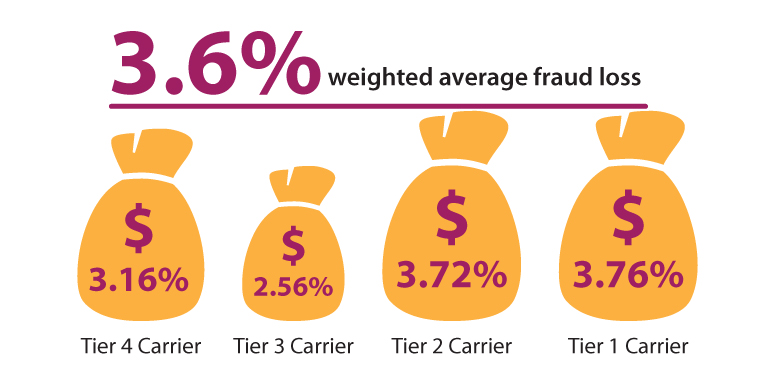
    The survey has revealed that carriers lose around 3.6% of their revenue to fraud, which if the Wholesale Carrier market is estimated to be around $ 170 Billion, translates to monetary figure of $6.12 billion per year!

    fraud-management

    Considering there is a tremendous pressure on wholesale carriers due to increased competition leading to price wars and eroded margins, losses of such high magnitude create a substantial impact on their bottom line.

    fraud

    The problem doesn’t end here. Majority of the participants (82%) have also agreed that the menace of fraud has been on the rise over the recent years and continues to grow!  Clearly, the impacts are going to be higher with time if carriers do not up their ante against fraud now.

    The report also touches and provides interesting findings over the following areas:

    • Size of the problem including prevalent fraud types in the industry currently
    • What factors are fueling the fraud growth
    • Direct and indirect impacts of fraud on carriers
    • Readiness of the carriers in combating and containing frauds
    Being a global provider of Fraud Management solutions & services and leveraging on it’s domain expertise, Subex has also provided its views and opinions over the findings which can help carriers in understand this complex and constantly increasing problem of fraud better and take appropriate measures in order to protect themselves.
    Happy reading!
  • Whats Whys and Analytics

    Whats Whys and Analytics

    For a good part of the last two decades, companies have been building software solutions to solve enterprise problems either as a product or as a service or a blend of both. From getting rid of physical files, removing manual calculations, going online, centralizing operations, automating processes, to recent trends like cloud & analytics, software solutions have been constantly going through major transformations.

    But in most phases till now, software products & solutions to large extent have only looked at the “what”s of customer needs. Do they need a report displaying some data? Do they need a user interface to store information? Do they need automation of some task? Do they need a workflow to track progress?

    A lot of product companies work on basis of the motto ‘What customers want is most important’ & these requirements eventually become the only input to the product roadmap.  But are products just about that? Customers know what they want, no doubt. But do they know what they can get?  The famous quote by Henry Ford, “If I had asked people what they wanted, they would have said faster horses”, is probably the root of all product innovations.

    It’s time the “why”s take the driver’s seat. If a customer wants a feature, it is important to understand why they need it. If they want a report, the first step probably should be about understanding why they need it. For example, a report depicting the margins for products launched in past 6 months is probably being used to decide which products should be discontinued & where the investment should increased or where more marketing focus is needed. So why not tell them that directly instead of throwing out a report & leaving the rest for interpretation?

    A recent conversation that we had with a Communication Service Provider (CSP) is a perfect example. The need as explained to us was to monitor margins for different content services & television packages launched by the CSP. With multiple parties involved in the value chain, it was proving to be difficult to monitor margins taking the retail revenue & the partner costs into consideration. We were asked if we could allow analysis of the cost/revenue/margin data with filters like products, amounts & regions. Of course, we could do that. That is table stakes. What we wanted to know was what they did, with that data. It came out that the aim was to understand low & high performing products, low & high performing regions so that discounts, promotions etc., can be launched to boost sales. We said, ‘Great! So we’ll give you that directly’. We will profile the cost/revenue data and tell you where you should be launching a new promotion campaign. We’ll build the intelligence that you manually apply today so that you can concentrate on bigger things.

    I’m sure you’ve heard of the word ‘analytics’ in hundred different contexts in the industry today. If you are wondering what it’s all about, then this is it: Showing you results in terms of the whys .  At Subex, the basis of product development is the whys of market & customer needs. Our analytics platform ‘Rocware’, our virtual RA analyst ‘Zen’, our integrated analytics module in Wholesale Partner Management are all about the whys of a CSP’s business.

  • Content Settlements: Are the operators in control?

    Content Settlements: Are the operators in control?

    Content and data services are fast growing areas among CSP offerings and are a climbing source of revenues. Profits made by CSPs from content services ranges around 60-70% of the cost of sale. Though there is the occasional threat, mostly around reduction in Revenue shares due to an increase in regulatory charges, this market cannot be neglected.

    Operators are now seeking to deploy sophisticated “User Engagement” based models in order to ensure partners/content owners are paid based on the actual consumption of the service and not just based on subscription, thereby determining the actual value addition that the services in question provide.

    While operators acknowledge the potential in the VAS market, many are struggling to manage the operations when it comes to content billing and settlements. The sheer growth on Content and VAS offerings and increase in number of players in the market, content billing can no longer survive on Microsoft excel and access based manual computations.

    Although the retail billing of content services may be based on their offering structure, like Subscription based billing or event based / on-demand billing. The Interconnect settlements prove to be a greater challenge. Due to a multi-party environment, it is essential to calculate the Revenue share per party keeping in mind the margin which the operators intents to earn. Some of the common models which govern the agreements between CSPs and their Content Owners are the tier based agreement; slab based rating; flat revenue sharing; subscriber based revenue sharing.

    Content market is not a static business environment. New services are launched regularly. The on-boarding (or off boarding) of a new offering should not be a cumbersome. The ever changing contracts between the operator and their partners need the settlement solution to be extremely flexible. One of the vital criteria of the system should be the ease with which it can be con­figured in order to positively impact the go to market time.

    While future of content seems to be bright, Operators need to be mindful that:

    • “OTT players are growing” and here to stay
    • “All you can eat” usage models is coming to an end and “Capped usage” models will prevail
    • “Targeted” content era begins
  • Subex Tweetup Series 1. Internal Fraud

    Subex Tweetup Series 1. Internal Fraud

    Subex Tweetup Series is a initiative for Subexians to share their knowledge and experience in the field emerging telecom trends and practices through Social Media interactions.

    Today, Mr Rohit Maheshwari (Sr Director Business Consulting APAC) shared interesting insides on Internal Frauds. Internal Fraud has been a key area of concern for telecom operators since long. With the advent of new services like IP Services, Mobile Money and others operators will stand more exposed than ever. Below link contains more information on the conversation with Rohit. Please feel free to comment and add more inputs…

    https://storify.com/ravishpatel/subex-tweetup-internalfraud

    Subex provides holistic revenue assurance coverage in a traditional circuit-switched as well as next generation packet-switched landscape, streamlines integration during a merger, and navigates a technology shift such as Internet of Things (IoT). Our solution meets the revenue assurance needs of mobile and fixed line communications service providers (CSPs), analog data networks, digital data service providers and triple / quad play enterprises. It drives revenue growth by extracting unbilled revenue, leveraging automation to identify revenue leakage, and safeguarding revenue streams from potential losses.

  • What kids can teach about Outsourcing??

    What kids can teach about Outsourcing??

    Let’s deal with the difficult one first – Managed Services and outsourcing is here to stay and grow. So, what does this have to do with kids? Well nothing direct, except that kids can help resolve one of the biggest barriers to outsourcing – asking for HELP!
    One thing I often notice, while meeting some of the prospects, is their reluctance to ask for help. The acknowledgement comes blatantly or subtly – there is a need to improve. The pressure of efficiency, productivity, reducing costs (or justifying with equal or exceeding returns) is mounting up on each one of them.  So, why hesitate to ask for help when there is a need? The top 3 inhibiting reasons are:
    a) Asking for help is considered a sign of weakness/failure
    b) Trust deficiency in the person who offers help
    c) Waiting for someone else to do it, so I cannot go wrong
    There have been many management theories propounding kids’ psychology. Without surprise, it holds well when it comes to breaking these barriers too. Let me explain how, with typical kids’ perspective and how business could go about doing it.
    Asking for help is a sign of weakness/failure

    • Kids view: Why? Why? Why? The ubiquitous question that drives every parent crazy is a Childs’ natural way to learn the world around her and develop cognitive skills. The kid sees it as an opportunity to be inquisitive, seek assistance (from someone who knows), learn something new and expand their horizon. The child doesn’t hesitate to ask for help  in its quest to face the world
    • Business way: Today while businesses appreciate hard work and diligence, they expect efficiency. Asking for help is a sure-fire way to achieve it. Seeking assistance is a fun way to solve a problem together and learn something new

      Trust deficiency

    • Kids view: Kids learn whom to trust and who not, either from the parents or slowly over a period of time
    • Business way: If past experience is something to go with and the trusted partner has delivered before, then entrust them with a new challenge. Else, if you are just starting, then start small, build confidence, before entrusting with bigger responsibilities

     Waiting for someone else to do it

    • Kids view: Walk into a classroom and ask for volunteers to try out something new – you will be amazed to see the numbers of tiny hands go up. Kids yearn for new things
    • Business way: Years of conditioning to be extremely risk averse has led to this state of mind. A well-planned and executed engagement will manage & mitigate the risks. Besides, many businesses have seen success the outsourcing way – there is enough precedence available. Go and get one for your benefit

    After all, kids do continue to teach us a vital lesson or two…