Blog

  • No Code AI, No Kidding Aye – Part II

    No Code AI, No Kidding Aye – Part II

    Challenges addressed by No Code AI platforms

    An AI model building is challenging on three fundamental counts:

    1. Availability of relevant data in good quantity and quality: The less I rant about it, the better.
    2. Need for multiple skills: Building an effective and monetizable AI model is not just the realm of a data scientist alone. It needs data engineering skills and domain knowledge also.
    3. The constant evolution of the ecosystem in terms of new techniques, approaches, methodologies, and tools

    There is no easy way out to address the first challenge, at least not so far. So, let us brush that under the carpet for now.

    The need for having multiple resources with complementing skills is an area where a no-code AI platform can add tremendous value. The average data scientist spends half of his/her time preparing and cleaning the data needed to build models and the other half fine-tuning the model for optimum performance. No Code AI platforms (such as Subex HyperSense) can step in with automated data engineering and ML programming accelerators that go a long way in alleviating the requirement of having a multi-skilled team.  What’s more, it empowers even Citizen Data Scientists with the ability to build competent AI models without having the need to know any programming language or having any background in data engineering. Platforms like HyperSense provide advanced automated data exploration, data preparation, and multi-source data integration capabilities using simple drag-and-drop interfaces. It combines this ability with a rich visual representation of the results at every step of the process so that one does not need to wait until the end to realize an error that was done in an early step and have to go back and make changes everywhere.

    As I briefly touched upon a while back, getting the data ready is one-half of the battle won. The plethora of options on the other half is still perplexing – Is it a bird? Is it a plane? Oh no, it is Superman! Well, in our context – it would be more like – Is it DBSCAN? Is it a Gaussian Mixture? Oh no, it is K-Means! Feature engineering and experimenting with different algorithms to get the most optimum results is a specialized skill. It requires an in-depth understanding of the data set, domain knowledge, and principles of how various algorithms work. Here again, No Code AI platforms like HyperSense come to the table with significant value adds. With capabilities like autonomous feature engineering and multi-algorithm trial and benchmarking, I daresay that it makes building models almost child’s play. Please do not get me wrong. I am not for a moment suggesting that these platforms will result in the extinction of the technical data scientist role, on the contrary, it will make them more efficient and give them superpowers to solve greater problems in lesser time while managing and guiding teams of citizen data scientists to solve the more mundane, yet, problem statements of existential importance.

    So far, so good; and having brushed one challenge under the carpet and discussed the other one, there is one more – The constant evolution of AI techniques, methodologies, tools, and technologies. Today, just being able to build a model which performs well on a pre-defined set of metrics does not cut ice anymore. It is just not enough for a model to be simply accurate. As the AI landscape evolves, the chorus for the Explainability and Accountability in models is reaching a fever pitch. Why did K-Means give you a better result than Gaussian Mixture? Will, you then get the same result if a feature was modified or a new one added? Why did the model predict a similar outcome for most customers belonging to a certain ethnicity? Is the model replicating the bias and vagaries present in the historical data set or the person building the model? If there have been policies and practices in a business where any sort of decision bias crept into day-to-day functioning, it is but natural that the data sets you work on will have those biases and the model you build will continue to persuade you to make decisions with the same biases as before. As an organization that is striving to disrupt and transform your industry, it is pertinent that you identify and weed out such biases sooner than later before your AI models hit scale and it becomes a wild animal out of its cage.

    As No Code AI platforms evolve, model explainability is something that is already getting addressed. Platforms like HyperSense give you the option to open up the proverbial ‘black-box’ and peep inside to see why a model behaved the way it did. It provides the analyst or the data scientist with an opportunity to tinker around advanced settings and fine-tune them to meet the objectives. Model accountability and ethics is a whole different ball game altogether. It is not restricted just to technology but also the frailties of human beings as a species. I am sure the evolving AI ecosystem will eventually figure out a way to make the world free of human biases – but hey, where’s the fun then? Human biases do make the world interesting and despicable in equal measure and I believe the holy grail for AI will be to strike a balance between the two.

    Until then, let us empower more and more creative and business stakeholders to explore and unleash the true power of AI using No Code platforms like HyperSense so that the world can be a better place for all life forms.

    Make Better Decisions With Quantifiable Data-Driven Evidence

    Schedule Demo

  • Business Assurance: Decision-driven Versus Data-driven

    Business Assurance: Decision-driven Versus Data-driven

    Having a data-driven Business Assurance (BA) process is an aspirational goal for many Business Assurance teams. This post is not going to be about the technology per se but will talk about what comes before and after technology: humans and our flaws.

    Three Key Aspects of Business Assurance

    Before delving into human-before-and-after-technology, let’s review three aspects of Business Assurance, which form the backstage onto which most of the Business Assurance activities unfold.

    Since its inception, Revenue Assurance (RA) and, later, Business Assurance (which we’ll use interchangeably for the purpose of this article) was a borderline discipline in telco organizations. It has always sat in-between Finance, IT, and Technology, fighting to influence decisions and processes. We have evidence from RA surveys across the years that shows us that RA/BA has consistently resided in different parts of a telco organization.

    Apart from being a borderline activity, RA, done operationally, is dominated by FOMO – fear of missing out. In RA, FOMO works from two perspectives: from the perspective of the process owners that RA is checking and also from the internal RA one. When looked at from other process owners, FOMO is an actual driving force behind RA actions: RA is winning when discovering what others missed out. But FOMO has a play from its own RA perspective such as the fear of missing out on creeping revenue leakages, missing out contributions to impactful projects, missing out on budgets, or missing being relevant within the organization.

    And finally, RA/BA is hard to be conceived without data. Business Assurance delivers rich analytics aimed at enabling action. There is, however, a previous step before action: the decision. Here is where most RA/BA strategies miss out on: the decision is an implied, taken for granted, step. In the same way, being data-driven is often taken for granted.

    The combined effects above make RA/BA a fragile component for any telecom organization, exposed to the political play between major verticals driven mostly by fear, and a weak decision-making process.

    Now, BA leaders cannot change the first two aspects, but they can definitely understand and improve the ‘taken-for-granted’ part of the whole activity: the decisions.

    Decisions impacting Business Assurance

    A telecom organization makes decisions when it launches a new product or implements a new technology. But automated decisions also include the rating and billing ones we take for granted. Each rated amount in the customer usage is a decision – to apply a certain value, according to the customer’s rate plan, for the specific service and usage type.

    There are also internal BA strategic and operational decisions: The extent of risk coverage to implement, the tools to be used, and processes to be implemented are strategic decisions made internally by BA departments, aligned with the larger parts of the organization. BA’s operational decisions are, amongst others, to validate the alarms/findings of the controls, raise them with the process owners, manage the cases, update configurations, etc.

    Business Assurance Decision Space Business Assurance
    Internal External
    Decision Level Strategic
    • Risk coverage
    • RA tools
    • Process
    • Control framework
    • New products
    • New technologies
    • Organizational changes
    Operational
    • Controls results validation
    • Risk assessment
    • Usage rating
    • Product ordering
    • Order fulfilment
    • Billing
    • On-boarding
    • Commissioning

    With this high-level inventory of the decisions BA is called to make, or to protect, we can glance at how aiming to be a data-driven organization can actually hamper decision-making.

    Decision-driven or data-driven?

    We already know that being a data-driven organization is a catchy phrase in business lingo nowadays, which comes with the effect of digitalization.

    But being data-driven has some hidden implications. Making decisions solely based on the available albeit massive, data is the equivalent of looking for keys under a lamp post.

    A policeman sees a drunk man searching for something under a streetlight and asks what the drunk has lost. He says he has lost his keys, and they both look under the streetlight together. After a few minutes the policeman asks if he is sure he lost them here, and the drunk replies, no, and that he lost them in the park. The policeman asks why he is searching here, and the drunk replies, “this is where the light is”

    This is called the “streetlight effect”, a type of observational bias that occurs when we are searching in places where it is easier to look.

    Put in the context of the data-driven organizations, business assurance included, it means that we are exposed to a limitative fallacy, where even though we have plenty of data, we still make poor decisions.

    Such effects have been highlighted in academic literature, where the risk of decisions made, is not based on a purpose, but based on a preference for using a certain set of data because it is available or it validates a preference already made.

    How would such a bias affect the decision outlined above? For BA, it would mean that a sound risk assessment and decisions to cover certain areas will be impaired by the data available: a BA team could start covering the usage because that is the data IT want to give them access to; or because it is better documented, even though the risks would be higher in another area, like subscriptions or dealers, just to give a few examples.

    Operational BA decisions would be impaired as well, if the cases are validated as false purely based on data available while the flawed result may be caused by the out-of-date reference data.

    Another impact of such bias would be that decisions tend to be made only based on available data, without using statistical inferences, hypothesis testing, and judgement.

    The way out

    The way out is simple, even though simple does not necessarily imply easy.

    The purpose should precede the data. This means, as professor Bart de Langhe puts it in the article cited above:

    Find data for a purpose, not a purpose for your data

    In the context of decision-making for Business Assurance, it means that the decisions for covering certain risks, revenue streams or lines of business should guide the use of data, and not the data available to drive such decisions.

    It also means that BA professionals should get acquainted with hypothesis testing and statistical thinking in order to make better decisions in conditions of incomplete information.

    The latter point is a call for modern analytical tools and platforms, which are enhancing the existing capabilities of RA/BA teams with advanced analytics and ML capabilities, able to deliver analytics in an agile manner and to support the rising citizen data scientists.

    [1] Streetlight effect: https://en.wikipedia.org/wiki/Streetlight_effect, retrieved June 30, 2021

    [2] Why decisions should drive your data analytics, https://dobetter.esade.edu/en/decisions-data-analytics, retrieved June 30, 2021

    Tier 1 APAC Operator Leverages Subex to Identify $7m Annual Profit Enhancement Opportunity.

    Download our latest case study

  • No Code AI, No Kidding Aye!

    No Code AI, No Kidding Aye!

    When was the last time you did something meaningful for the first time? For me, that was in the last week of June’21. Just two weeks into my stint at Subex, I made an ML prediction model, my first one! Yes, I know that is nothing earth-shattering, but before you start rolling your eyes at my juvenile glee and start judging, let me tell you that I do not know how to code. I cannot code to save my life and the last time I wrote something that had a semblance of a code was two decades back when I was in graduate college.  So, yes, I am elated; not in the least because I made a very simple ML model, but because of the feeling of freedom and empowerment that I felt when I saw each one of my process steps in the pipeline lighting up in green and running its full course and culminating in successful output. In my mind, it is the kind of emotion one goes through when you have been handicapped for a lifetime, and then, one fine day, you get a bionic limb that liberates you and lets you walk freely once again.

    The future potential of No Code/Low Code platforms

    Gartner’s research points to the emerging trend that digital transformation initiatives have triggered an insatiable demand for custom software development. This, in turn, has ignited the emergence of citizen developers and citizen data scientists who are outside the traditional definitions of an IT developer or an ML developer. This paradigm shift has influenced the rise of no-code and low-code platforms. According to Gartner, on average, 41% of employees outside of IT – or ‘business technologists’ – customize or build data or technology solutions, and they are sticking their neck out confidently to say that that, by the end of 2025, 50% of all new low-code clients will come from business buyers that are outside the IT organization and 65% of all application development will be low code by 2024.

    Enough of numbers for now. I guess we all get the drift – Low code/No code development platforms are the next big thing in software development. So, is this another technological development whose impact will stay limited to large, for-profit corporations and enterprises, or, will this have a greater, more purposeful bearing?

    The profound impact of No Code platforms

    In 2005, the Indian parliament passed a historic and landmark bill – The Right To Information Act, or RTI, as it is popularly known. This Act took the key that was needed to access data related to most of the day-to-day functioning of government bodies, from the hands of limited law enforcement and judiciary entities and passed it into the hands of the common man. Suddenly, everything changed. The fundamental societal framework that government functionaries could do whatever they wanted and get away with it unless someone with a lot of time, money, patience, courage, and determination could force the hands of the law using judicial process, was turned on its head. Anybody who was a citizen of India could pay a paltry sum and demand specific information from almost any government entity and was entitled to get that information. It was a true watershed moment for the democratic fabric of this great nation. It made governance more responsible and accountable, and it paved the way for numerous improvements and transparency at the grassroots level, and that, in the true sense, was a transformation. In case you are wondering how this is related to No Code AI platforms, hold on just a little bit more.

    It was never the case that prior to the RTI Act getting passed, there was no data. Oceans of data existed, but what did not exist was a framework and structure in which that data could be leveraged by every citizen. Until then, data could only be sought and used by limited entities and institutions – legislature, law enforcement, and judiciary and often, they only sought and used data for purposes of utmost legal importance and priority. Compare that to the situation we have at hand in the private and business sector. Humungous amounts of data exist, but how can you leverage the true potential of it if the value extraction power is in the hands of a few limited people who need to have highly advanced, technical skills? Creativity and the power of imagination are not always ensconced inside technical or programming knowledge. There are so many business users who have fantastic ideas which never see the light of the day, either because it is not considered a priority, or simply because there’s just not enough bandwidth of expensive technical resources to spare to chase up every idea that is being tabled. In most cases, the process of innovation in organizations works like the highly competitive entrance examinations to prestigious colleges – it is a process of eliminating as many as possible, rather than retaining everyone who might have potential.

    With RTI, anybody who wanted to check a hypothesis could ask for relevant data and had the right to receive that data within a stipulated timeframe. Suddenly, corruption became one step more arduous as the usage of data became truly democratized. NGOs and committed citizens who wanted to make real fundamental changes started gathering and foraging through data to identify patterns and anomalies and started asking questions, most of which were uncomfortable ones to answer but had the power to alter the basic fabric of the system.

    AI has the power to change the way we eat, sleep, breathe and live. In business, it has the potential to transform fortunes and deliver exceptional customer experiences at scale, but the question we need to ask is – Given a choice, do we want to restrict and throttle this power, due to natural limitations, within the hands of a few people who need to have highly technical and specialized skills to know how to fully leverage it? Imagine the possibilities of this power in the hands of millions of creative and logical people who can dream up out-of-the-world applications for the data assets that we sit on without everybody having to be a software programmer or a technical data scientist. That would be true democratization of data and AI, and No-Code platforms are paving the way for this revolution.

    Note: This blog post is part one of a two-part series on the No-Code AI platform revolution. The next part will cover the challenges of the AI model building that No-Code AI platforms address.

    Till then, stay tuned…

    Make Better Decisions With Quantifiable Data-Driven Evidence

    Schedule demo

  • Business Assurance: Evolution and What It Means to CSPs

    Business Assurance: Evolution and What It Means to CSPs

    Evolution of Revenue Assurance into Business Assurance 

    By now, it is almost common knowledge that the telecom world has moved well beyond the conventional idea of Revenue Assurance (RA). But what were the factors which led to this?

    Conventionally, telecom Revenue Assurance used to be a non-real-time, post-facto, and reactive method of finding revenue leakages amongst the data about events that have already happened.

    To understand this further, conventional Revenue Assurance predominantly revolved around reconciling events between the source of origination to the final culmination point – billing and actioning on the outcomes in the form of mismatches.

    While this methodology was leveraged on a reactive basis for ages, with time and the evolution of sophisticated data transfer technologies, we could derive more capabilities around real-time revenue assurance, thereby mitigating the leakage run-time to the least possible extent.

    However, the effective yield from the RA functionalities mentioned above started to diminish and became increasingly insignificant due to the below factors:

    1. Stiff competition between operators fighting for supremacy on subscriber acquisition meant that the prices of conventional telecom services were constantly reduced.
    2. Consequent to the above, the average revenue per user dropped, which meant that even if the findings from evolved revenue assurance practices were significant, they did not translate to the same level of significance in dollar value.

    Naturally, this set the ball rolling for the evolution of conventional Revenue Assurance into Business assurance.

    What does this really mean?

    Fundamentally, Revenue Assurance (RA) revolves around identifying anomalies across the operator’s business. These anomalies might be systemic, human, process-related, or stemming from a lack of coordination, either technical or intra-departmental, in an operator ecosystem.

    This means that while conventionally, RA revolved around usage, mainly source (switch) to destination (bill) reconciliations, it can be expanded to cover other more expansive business areas. From detecting leakages in usage revenue, it can expand to assure aspects of product margins, customer satisfaction, rating, contract management, etc., to name a few.

    Another aspect to consider in this context is the already available, clean, normalized, ready-to-use and extremely useful data that RA systems have at their disposal, out of which only a sub-set has been tapped into. This has ensured the evolution can be more seamless and natural.

    Collectively, by virtue of the above factors and more, Revenue assurance can and has evolved to what we call it today – Business Assurance.

    The definition of Business Assurance and what it means to CSPs: 

    As clichéd as it is, we all know the Communication Service Providers (CSPs) have transformed dramatically in terms of the services they offer to their customers to being Digital Service Providers (DSPs). This, consequently, means that they have to address new, dynamic, and constantly evolving risks and challenges. As a result, they would have to redefine and rejig their existing resources to equip them with the skills required for a more comprehensive Business Assurance view across the organization.

    Source: Dimensions of BA as per TMF

    Business Assurance amalgamates conventional assurance and risk areas into a data-driven, proactive, all-encompassing framework to protect financial integrity while ensuring seamless customer experience and business value.

    In addition to the above, Business assurance would constitute a wide array of areas – Product & Offer Management, Customer Management, Order Management & Provisioning, Network Management, Rating & Billing Assurance, Finance & Accounting, etc. It would be imperative to say that all these areas need to be supported by sophisticated technologies around data analytics, artificial intelligence, and blockchain.

    While the above BA views are relatively generic, it seldom works in a one-size-fits-all approach. Hence, it is imperative that each organization refines the relevance and extent of the BA scope in their particular environment basis the business needs.

    Webinar on Business Assurance in 5G:
    5 controls you cannot do without

    Watch Now

  • Combat SIP threats with a Proactive Approach

    Combat SIP threats with a Proactive Approach

    With the transition from telecom operators to digital service providers, the communication processes and the necessary protocols have changed over the years. The digital information is packetized, wherein the transmission happens over IP packets instead of the earlier circuit-switched transmission. Today, VoIP technology has overshadowed traditional communication technologies, which are comprehensible due to the edge it provides in terms of accessibility, portability, scalability, voice quality, flexibility & lower costs.

    While several protocols are used in voice-over-IP (VoIP) communications, Session Initiation Protocol (SIP) has become the most popular. There are various benefits that it brings in for a service provider, which include lower costs, immediate ROI, global potential, mobility & network consolidation.

    With the immense benefits that it brings to businesses, there are also certain risks that are associated with it. Security is one such issue that is of paramount importance to the service providers and their customers, as it pertains to direct and indirect attacks by fraudsters and cybercriminals, leading to financial losses and customer churn for the service providers.

    Did you know Session Initiation Protocol (SIP) which acts as a signaling protocol for VoIP, is the world’s most hacked protocol? 

    Let us look at a couple of instances to put this scenario into context.

    With Covid-19, SIP has become even more widespread due to the enterprise customers placing more SIP endpoints outside the confines of a logical network. An interesting statistic shows the importance of VoIP security-roughly 46% of illegally made calls across the world involve VoIP technology [1]. As much as 65% of the global DDoS attacks in 2018 were aimed at communication services providers [2].

    Also, recently there has been a significant rise in cyber-fraud operations targeting VoIP phone systems worldwide. As per a recent news article, a Gaza-based hacking group was responsible for targeting servers used by more than 1,200 organizations based across over 60 countries, with half of those targets being in the UK. What’s even more worrying is that the hackers worldwide create their own social media groups to share tips and know-how relating to VoIP phone system hacking and organize and coordinate future attacks.

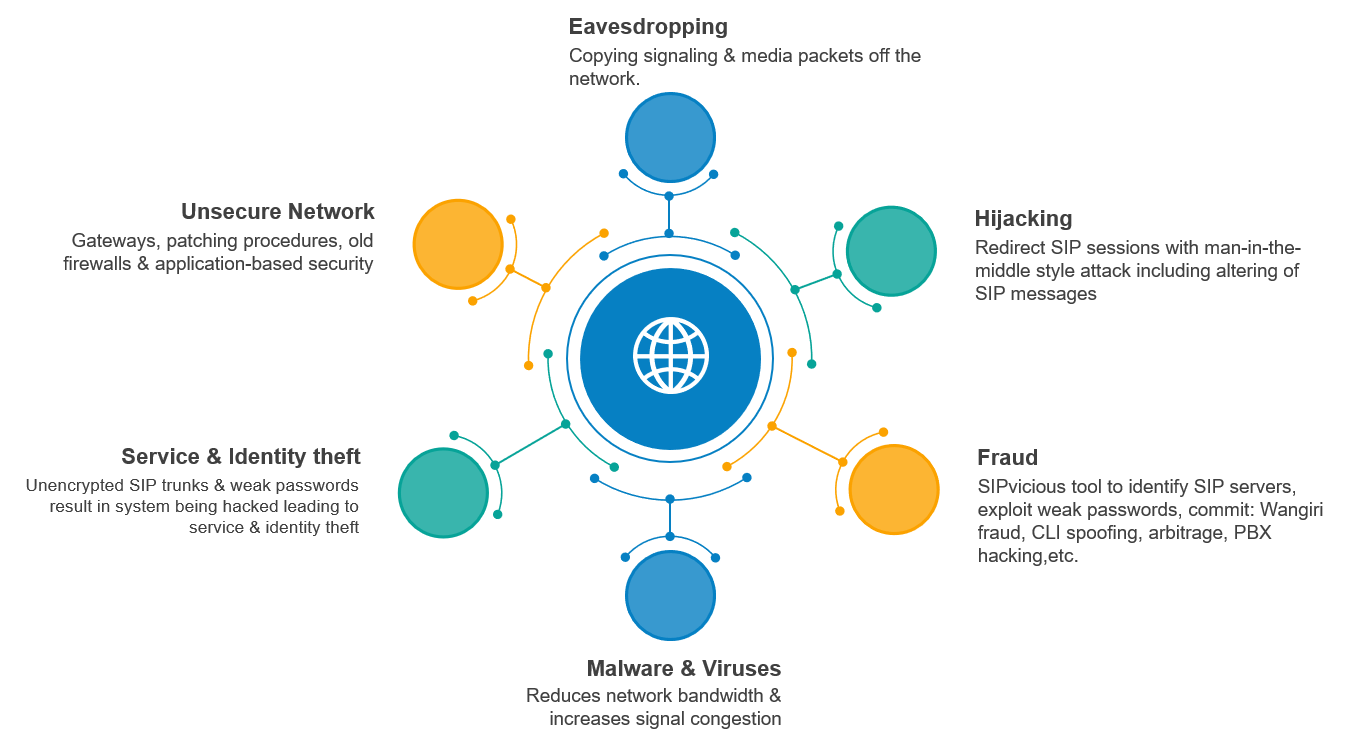
    Although most of the telecom networks are still private, but since they also provide SIP trunks as a service to other smaller carriers or enterprises, they end up exposing some part of their network to a public network and thus become vulnerable to attacks. Interconnect using SIP also exposes telecom networks to attacks as the network laid down for immediate partner and telecom may be private and secure, but if the partner’s network is exposed to a public network, it creates a link to telecom’s network to the public network via other carriers. Also, an international call passes through multiple networks before it’s terminated to the destination. All of the carriers may not have the highest level of security. Hence, such calls are vulnerable to eavesdropping and hi-jacking. SIP is intrinsically vulnerable to a range of attacks, and more importantly, the attackers exploit them to instigate direct or indirect losses to service providers. The below diagram depicts the various threats associated with SIP:

    Combat SIP threats
    Diagram represents the various SIP vulnerabilities

    There are several methodologies of preventing SIP vulnerabilities like network firewalls, cybercriminal simulations, software/hardware patches, etc. But the problem with such arrangements is that fraudsters and cyber criminals still find a way to exploit the inherent loopholes of SIP communication.

    The need of the hour is a proactive approach to detect and nip the vulnerabilities and risks for a service provider in the bud.

    In the traditional approaches, their reactive approach is inadequate and unsatisfactory for the fraud & security strategy of the service providers. This is because of the reliance on xDRs and lack of timely availability of real-time threat intelligence.

    However, we believe the way forward is to have a system in place that uses real-time signaling level analysis, complemented with advanced machine learning techniques and real-time threat intelligence, which will provide new opportunities to drive a prevention-based approach and support operators more effectively to address these types of threats.

    At Subex, we have over 25 years of experience working with telecom operators to proactively mitigate fraud and security risks. To learn more about our approach, reach out to us, and we will bring our expertise in decoding your troubles.

    References:

    1. https://startupanz.com/voip-industry-statistics-2020/

    2. https://www.fiercetelecom.com/telecom/report-two-thirds-ddos-attacks-take-aim-at-communication-service-providers

    Read Our Latest Point of View on SIP Security

    Download Now!

  • Combating Wangiri Fraud: The Need for Collaboration

    Combating Wangiri Fraud: The Need for Collaboration

    What is Wangiri Fraud, and how is it a big problem for CSPs? 

    Wangiri fraud, a call-back scam, is a Japanese word meaning ‘one ring and cut.’ Just as the name suggests, in this form of fraud, fraudsters give a missed call to encourage unsuspecting subscribers to call back to fraudulent premium numbers. CSPs incur both direct and indirect losses due to Wangiri Fraud. It impacts the customers adversely, resulting in customer churn due to high customer dissatisfaction from bill shocks and bad customer experience. It also has a negative impact on the operator’s brand image.

    As per the CFCA 2019 fraud loss survey report, Wangiri is one of the top 5 fraud methods used by fraudsters to carry out fraudulent activities. It is also estimated that telcos are losing close to USD 1.82 billion globally to this fraud. Also, as per the RAG RAFM 2020 Survey, the total global cost for compensation for Wangiri was $1.31 billion.

    The challenges associated with Wangiri Fraud 

    One of the key challenges in detecting Wangiri fraud is the lack of timely availability of threat intelligence. Although telcos frequently update their fraud management systems with the latest hotlist/blacklists, they usually do not have a platform to exchange data in real-time. As a result, telcos always end up being at the receiving end until certain number ranges are tagged as fraud and blacklisted.

    The need for collaboration and community-driven initiatives 

    It is vital to stay one step ahead of the fraudsters in the fraud management space because the fraudsters themselves evolve over time. They change the type of fraud they commit. Therefore, one needs a proactive approach to the problem rather than a reactive one.

    One way to achieve this is to build a collaboration mechanism by which information can flow easily between entities in the telecom ecosystem, making it easier to flag and prevent fraud.

    The industry has looked at ways to share data and have collective databases to identify and share Wangiri fraud numbers. Groups like RAG have actively worked to address some of these problems by bringing industry partners together to innovate and tackle Wangiri fraud effectively.

    The RAG Wangiri Blockchain Consortium is a coming together of telcos and vendors with a common interest in reducing the number of Wangiri fraud calls received by phone users. The consortium does this by using blockchain technology to share intelligence in near to real-time about actual Wangiri calls that have already occurred. This data will help telcos and suppliers improve the algorithms and reference data used for the proactive management of future calls, increasing the likelihood of correctly identifying a Wangiri call before the intended victim suffers harm. The consortium includes more than 100 telcos across Europe, Asia, Africa, and the Americas.

    The Subex-RAG Partnership to leverage RAG Database for fraud detection and prevention 

    Subex, being a pioneer in the Fraud Management space, partnered with the Risk & Assurance Group (RAG) Wangiri Blockchain Consortium to advance innovation in the blockchain space. Subex was one of the first vendors to get into this partnership. This partnership aims to integrate the blockchain database with the Subex Fraud Management system and leverage them as hotlists or reference data to prevent fraud proactively.

    The Benefits 

    Blockchain is a transformative technology, and it is intriguing to see it being used to solve evolving real-world problems such as fraud detection. When it comes to dealing with fraud, the faster the information is exchanged, the better it is to be able to address and prevent fraud. Blockchain enables much faster data exchange. Furthermore, this received data can be actively leveraged for fraud detection in rule-engine and machine learning (ML) techniques. In ML, this can be one of the seed data. Moreover, it can further enhance proactive fraud detection when the data is leveraged from the signaling layer.

    Conclusion 

    Making data intelligence available to the telco community is a crucial aspect of addressing the problem. Strategic partnership and innovations in blockchain mark a new era of sharing data and near-real-time threat intelligence for the telecom industry.

    Learn More on Battling Wangiri Fraud: Need for a Proactive Counter-strategy

    Read this Point of View

  • How to gain efficiency in Radio Optimization through Business Insights

    How to gain efficiency in Radio Optimization through Business Insights

    Today for Communication Service Providers (CSPs), moving to 5G is quickly becoming a necessity. Consequentially, this has led to a need for CSPs to ensure that they are well equipped to cover both expectations and the customer needs that 5G promises.

    5G comes with a host of new services and business models. For CSPs to capitalize on the 5G opportunity and ensure a more significant market share, it would be important to understand how their networks will need to evolve to meet the rise in demand and traffic. At the same time, CSPs continue to amortize their 4G deployments, and this has made it paramount that customer experience on 4G is not affected as CSPs move closer to a 5G deployment.

    The above elements represent a significant challenge for all different departments involved in the 5G deployment. The Radio Optimization team is probably the most impacted one, as they need to address several aspects, such as:

    • Accelerating the learning phase with respect to 5G technology
    • Maintaining QoE and QoS during the new technology integration, while switching off frequency carriers from legacy technologies, or even switching off a specific legacy technology (2G or 3G) in order to make most of the new spectrum scenario that comes with 5G
    • Releasing new services to support new business needs: Fixed Wireless Access, Massive IoT, LTE Advanced, Massive MIMO, Network Slicing, Private Networks, etc.

    Today, most of the optimization processes implemented consider data from PM Counters, Call Traces, Probes, Crowdsourcing solutions, Drive tests, etc. Hence, network KPIs built on data for network performance, CX, and network quality are generally used to provide insights to organize and prioritize actions, such as geolocation data, VIP Subscribers, Roamers, etc. However, these earlier methodologies, which were used to perform radio optimization for legacy technologies, are no longer sufficient to cater to all the needs indicated above and the new use cases that come with 5G.

    To explain why we need to take a step back.

    One of the main advantages 5G offers comes from introducing the possibility to create several tailored use cases that will open doors for newer revenue streams. However, managing the capacity to control the multiple performance indicators inherent to these new services will be significantly complex, as each particular use case will need very specific KPIs and SLAs to be monitored to maintain the high performance; KPIs which are not covered as part of the above-mentioned network KPIs.

    Moreover, 5G will also facilitate network slices for different services or use cases, which will call for adding new analytics techniques and leveraging new data sources to assure a seamless customer experience, enhance profitability, and gain a competitive advantage.

    For these reasons, it will be necessary for CSPs to maximize automation as much as possible to ensure RAN optimization for 5G. Here is where it will be important for CSPs to couple network KPIs with business data to prioritize and enhance the necessary optimization actions to meet the business needs as well as forecast and address the demand for new services built on 5G.

    Generating holistic, actionable insights for improved decision making is only possible by correlating and enriching data from the different areas (Network, Finance, and Customer Experience), applying advanced machine learning techniques, defining the rules engine, and leveraging ML/DL models under the expertise of both data-scientists and domain experts.

    Business data-driven optimization will ensure that radio teams focus their efforts towards maintaining high levels of QoE, QoS and CX for the most relevant revenue streams. Adopting an intelligent approach to RAN optimization can ensure that the ROI from different network elements can be easily tracked, managed and augmented. This can help CSPs ensure that their network Capex is optimized while bringing in a significant reduction in operational costs for RAN Optimization.

    Learn About the 3 Strategic Pillars to Service-based Network Analytics

    Read this Whitepaper

  • Digitization and Revenue Streams for Tower Companies

    Digitization and Revenue Streams for Tower Companies

    Telcos have owned towers as part of their network infrastructure to deliver telecom services to customers. It has been the trend for decades however, stabilizing revenue growths and industry movements have introduced the need to reduce cost and expenses, the efficiency improvement and quicker deployments have pushed telcos to work on the strategy of divestment for their tower infra, which has resulted in the establishment of the Tower Companies.

    Conceptually, the conventional Towerco business model is straightforward. They acquire telecom infra- assets from CSPs and then lease them back to the CSPs with multi-year agreements. These agreements can vary in terms of O&M services, renting the space, and co-locating the tower for multiple operators. Towercos have their monitoring control systems and maintenance tools for managing the tasks. Such a model helps CSPs to move from Capex intensive model to Opex focused and provides a revenue stream to towercos, resulting in a mutually beneficial strategy.

    Different kind of tower companies:

    Different kind of tower companies

    Digitization need:

    In principle, Towercos are managing passive infrastructure however with changing digital environment and to deal with increasing market pressure, 5G rollout, new network technologies, and new business models, towercos also need to undergo a paradigm shift to modify their business strategy. Towercos need to act quickly towards digital transformation for their business to grow and sustain; and it will make them open to new revenue streams too. They will have to be more data-driven, include analytics and the use of the latest technologies to stand out in the competitive landscape.

    Telcos have developed solutions encompassing data-driven business intelligence (BI) and Artificial Intelligence (AI) through machine learning. The towerco industry is still far behind in this area and still leveraging the legacy tools and manual efforts owing to their focus on increasing the tenancy ratio. Towercos need to build a proper data strategy and invest in data collection and data analytics to track detailed and accurate data about their infrastructure and enable decisions based on data intelligence. These are the primary steps for digitizing the foundation of a towerco business.

    The digitization strategy should focus on 4 pillars:

    1. Accurate data collection, with the use of a connected IoT platform that reduces physical site visits and ensures updated information such as location, faults are identified remotely.
    2. Integrated asset’s view, with the help of integrated platform providing the E2E view of assets including financial, project and network data, towercos can focus on critical areas and build cost optimization techniques.
    3. Use of ML models, using data-driven machine learning models for predictive maintenance, fault localization can improve the quality of services from towercos.
    4. Digital Twin: Digital Twins add value to the enterprise by:
      • Predicting “what is likely to happen” from “what has happened”.
      • Serving as a knowledge management framework.
      • Aspiring for strong interrogative (past) and superlative prediction (future) capabilities.

    Digitization:

    Based on Digital twin concept and integrated platform for E2E view of tower assets & deployments.

    site-inspection

    1. All relevant information for the site available in an integrated platform with updated data (Asset 360-degree view).
    2. Scheduled maintenance visits can be optimized using a virtual replica of assets (status, location, GIS data, etc).
    3. Digital view of site avoids multiple visits to the site for rollout, validate drawing with reality, simulate loading for co-location sites, and compare digital twin with the planned site for acceptance.
    4. With digital twins, the physical properties and data from the sensors and operating environment, are being combined with sophisticated prediction algorithms.

    Examples for such prediction/ analysis are:

    • Structural analysis.
    • Vibration analysis.
    • RF band mapping on each site based on info available.

    Simulations are more effective combining digital twin and historical data; it provides effective and more accurate predictions. The drill-down mechanism helps to understand the RCA for any fault that is recurring frequently and unable to be identified. A digital twin is enabled with IoT sensors and enriched data sets.

    Towercos need to incorporate modernization in their approach, moving away from the legacy business model of site leasing.

    New Revenue Streams for Towercos:

    1. ESCO – New business area for Towerco.

    ESCO is defined as an energy services company, that invests capital to acquire energy equipment for telecom cell sites, then sells that energy back to the site owner, whether they are an MNO or a towerco. There are various energy models ranging from pure power-grid-based to a hybrid model of using green energy from solar cells, wind turbines, etc. The ESCOs operate on different models depending on the geography and scale of sites. In most scenarios, they charge a fixed fee per month or even usage-based charges. Recently, some of these have partnered with CSPs to operate in managed services model where they ensure uptime of their active assets and have a percentage of revenue share or even guaranteed savings model.

    2.  Renting the space to surveillance companies for installing cameras for traffic monitoring, video surveillance, etc.

    In today’s connected era, monitoring traffic and other surveillance tasks play a major role. However, in most cases, getting an appropriate spot to install such devices for monitoring becomes a challenge. Using video surveillance for real-time traffic, weather forecast, congestion control, vandalism, etc are few use-cases. The traffic patterns can even be used for future study and observation or issuing challans/ tickets for violations. For the same, installing cameras or such devices should have sufficient visibility and a clear line of sight, along with a larger area to cover. Telecom towers provide such location which can be rented to regulatory bodies, agencies or even security services in some places.

    3. Providing the space for advertisements by camouflaging the infra.

    Do you remember when the Eiffel tower displayed the largest ever advertisement for Citreon in 1925? Telecom towers are huge structures that are visible from far-off and can be easily noticed by a passer-by. They can serve as one of the good sources for advertisement if used in an aesthetic manner. Monopoles, small cells, and even towers can be camouflaged with a nice cover, and they can be used for advertising by media companies. This can provide a very good source of revenue to towercos. Such places attract a lot of views and generate potential customers for the advertiser.

    4. High data speeds will require fiber-based connectivity, and this can be owned by towerco to generated additional revenue by sharing resources.

    With the advancement of 5G, every telco is focusing on having low latency use-cases with URLLC. This can not be achieved with a traditional transmission network and operators are focusing on fibre networks for the same. Towercos can play a vital role here by providing this connectivity layer and laying the fibre cables. Also, with the space they possess, it can act as amplifying spots, routing areas, or hubs for any fiber planning. They can generate revenue by sharing the fibre infra with multiple operators to serve as a common backbone network.

    The best asset management solutions in the market could be found among the leading analytics companies in the telecom sector. They apply their broad experience to digitize telecom sites providing tools like an end-to- end asset management solution, introducing digital twin, creating a virtual site as a service image of the physical site including all the data about the site and its assets. The tower, the site, the small cells become the digital assets of the towerco/ CSPs and provide a layer of analytics to enable accurate decision-making.

    In summary, it is time for towercos to act on their digitization strategy, build innovative use-cases and bring new solutions to the market that implement the latest technologies, artificial intelligence, and digitization enablement shared above. A few of those streams will become the new business models for the digital towerco that will result in building new revenue streams and increasing the value of towercos in the telecom industry.

    Meanwhile, if you’re interested to read about Digital Trust, you’ll find some useful material here.

    Read more

  • Leveraging Blockchain and AI to transform the telecom wholesale business

    Leveraging Blockchain and AI to transform the telecom wholesale business

    Blockchain and AI have been the primary focus area for Telco’s worldwide in recent time. It is astonishing to see how tech companies have open-heartedly embraced AI in their businesses, leveraging big data and boosting their profitability in the era of skewed margins. On the other hand, blockchain has been an active area of research to solve the most critical problem of ‘financial settlement.’ Telecom operators are also exploring the use of blockchain to use cases such as fraud mitigation, digital identity fraud, BCE roaming, and others to improve ROI and offset pressure from traditional businesses.

    While Blockchain and AI are new and most advanced technologies, there has been little focus on these two technologies used together. Although many divisions within a telco are using AI for automation, marketing, sales, and customer experience and are gaining a ton out of it, one department that can also benefit a lot is “wholesale.” This combination can help the wholesale business reduce its decision-making process and significantly improve the margins. Let’s look at some of the critical areas where Telco can leverage blockchain and AI together in the wholesale business.

    Deal creation

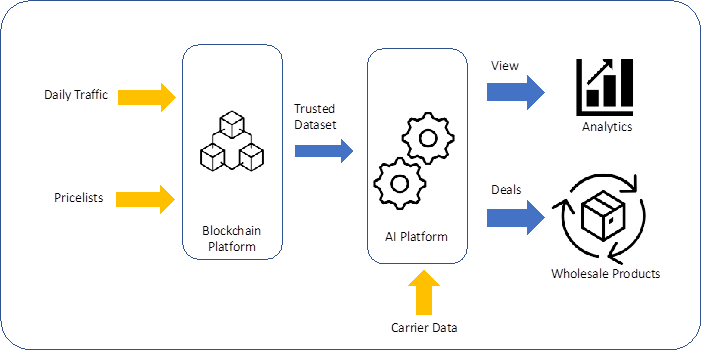
    Telecom operators and wholesale carriers’ margins rely heavily on bilateral and unilateral deals. These deals are for a specific period, where participating carriers are bound to send committed traffic to a certain destination/s per the agreement. In the modern era, having an extended deal period does not ensure profitability because of changing dynamics. What if telecom operators can build wholesale products daily or weekly based on the market trend and scenarios. Blockchain and AI can play an essential role in such a scenario. Blockchain can ensure uniformity and security by building a database of trusted data, which can be relied upon for decision-making. This data can create a data set that can train the various machine learning (ML) models to recommend the most profitable deals. There can be multiple inputs, such as the rate sheets shared by wholesale partners, daily traffic, wholesale partner’s performance, history, and more. Once these models are trained, they can forecast and build wholesale products, which ensures a higher margin with wholesale carriers.

    Figure 1: DEALS WITH BLOCKCHAIN & AI

    Dispute Settlements:

    Disputes are the major roadblocks in a telecom operator’s revenue cycle. While the bills can be settled every month or earlier depending upon the agreed cycle, dispute resolution can take months or sometimes years. Based on a recent survey, operators can take up to 15-45 days for dispute identification and confirmation on average. These disputes mainly arise due to data issues at the mediation level, arbitrations, or recommendations. Again, blockchain and AI can come to the rescue in such cases. CBAN being an agreed data exchange format in the blockchain community ensures that all the data received from the partner operators gets converted into a specified format. Partner operators can share this data daily instead of waiting till the end of the month. A scenario might arise if the operator wants to use new data for settlement, and that has been changed at the source operator side. That is where the AI models can ensure that such changes can be captured in the model itself, with minimal feature engineering, and quickly roll out these changes in production. So once again, blockchain and AI go hand in hand to ensure that such possibilities exist.

    Figure 2: CDR RECON & DISPUTE SETTLEMENTS – BLOCKCHAIN WITH AI

    Finally, innovation in the wholesale market must continue if wholesale voice trading businesses wish to remain profitable. The traditional wholesale way of working has been disrupted, and operators can still reverse or stop declining voice revenues using blockchain and AI/ML. Wholesale business and revenue growth will depend on developing new wholesale products, gaining new wholesale customers or partners, and resolving disputes faster. We’ve seen the sector’s movement into providing things like blockchain-based reconciliation, interconnection and hubbing, BCE-based roaming, fraud prevention, cloud services, machine learning and mobility, and no doubt other such services offerings will coil up as the wholesale demand for traffic change and new digital wholesale services rise up. It is now up to the traditional telecoms industry to keep pace or fall behind the dynamic digital players.

    Learn how our Blockchain-based Settlements solution can help your organization

    Schedule demo

  • Mobile Money is Rewriting the Fraud Landscape in Africa

    Mobile Money is Rewriting the Fraud Landscape in Africa

    Users across the globe are rapidly adopting digital wallets to shop, transact, and pay for utilities using mobile money. Easy, convenient, and real-time, these services are proliferating, particularly in markets where banking access is limited. Take Africa, for example, in just a few years, it has raced ahead as the global leader in the mobile payments landscape, with nearly 161 million active accounts and more than 495 billion dollars in transactions.

    In 2020, this mushrooming industry got new impetus.

    Crippled by COVID-19 in what GSMA calls the ‘Great Lockdown of 2020’ in its recent report State of the Industry on Mobile Money 2021, the world was pushed into a recession, limiting the movement of goods and exchange of cash. But in this crisis, mobile money providers seized their inherent advantages to empower economies by providing financial assistance. Here too, Africa leads the way. The GSMA report states that “In 2020, Sub-Saharan Africa continued to account for the majority of growth with 43% of all new accounts.”

    When we think of mobile money in Africa, M-PESA may be the first name that pops to mind – and rightly so. They were the first player to roll out mobile wallets that doubled up as pseudo-bank accounts. Prolific smartphone access has amplified this trend, extending mobile money beyond banking to something people can use for nearly every service, including booking flights, buying insurance, shopping, foreign remittances, and more. A 2020 report titled Mobile Money and Organized Crime in Africa states that “In September 2019, there were 153 active mobile money operators operating in 45 African countries.” Clearly, this market shows no signs of slowing down.

    Origin of risk

    Every new technology comes with a certain risk, and mobile money is no exception. Running these services means establishing multiple and complex back-end integrations with different players, each of which adds to the risk surface. It has drawn the attention of hackers/fraudsters worldwide as they turn their efforts to exploiting pressure points in the mobile money ecosystem.

    What is worrying is that these loopholes aren’t hard to find.

    Weak ID verification systems, poor customer awareness, insufficient security resources, inadequate training, and limited access to best-in-class fraud detection tools are all challenges that make breaches and financial theft possible.

    Regulations are another challenge. Most regulators are struggling to keep pace with how fast the technology is advancing. Striking a balance between user experience and data safety is a constant wrestle. Moreover, as laws take time to catch up, the criminal justice system lags at apprehending offenders. The African Mobile Money report captures this succinctly, stating, “The lack of resources and training of law enforcement concerning the collection and use of technical evidence in the criminal justice system has resulted in difficulties in prosecuting offenders and tackling established organized crime groups.” Further, the low onboarding barriers for mobile money make it a lucrative channel for terrorist financing and money laundering via cross-border payments and international remittances. Without the right checks and balances and cross-country governing rules, mobile money regulatory frameworks tend to be weak, leading to cracks in implementation, particularly pan-country, making it harder to monitor money laundering activities.

    So, what does mobile money fraud look like?  

    Briefly, these include:

    • Customer Acquisition Frauds – Abuse of identity documents to create fake accounts on the platform.
    • Identity Theft – This involves SIM swaps where fake ID proof is used to procure duplicate SIM cards for online transactions, leading to account takeovers.
    • Transaction Frauds:  The mobile money account holder can perform an increasing number of transactions. The number and variety of operations have grown immensely in the recent past. Some of the types of transactions are as follows:
    Representative mobile money transactions
    Figure 1: Representative mobile money transactions
    Source:https://enactafrica.org/research/interpol-reports/mobile-money-and-organised-crime-in-africa

    However, fraudsters can exploit various loopholes in these processes to commit fraud. In transaction frauds, stolen cards, data, or accounts are used to perform unauthorized transactions like income tax refunds, fake social media accounts, phishing, etc.

    • Money Laundering –Money laundering is the illegal process of making large amounts of money generated by criminal activity, such as drug trafficking or terrorist funding, appear to have come from a legitimate source. Money launderers can exploit mobile money services to transfer the proceeds of crime to co-conspirators located in other countries, or supporters of terrorist organizations can exploit.
    • Internal Frauds – Frauds conducted internally by merchants or employees with access to customer information.

    Uganda’s mobile money network took a significant hit on October 3, 2020, when one of the companies providing services to telecom companies was exploited by fraudsters, leading to 3.2 million stolen dollars. The theft was executed through unsuspecting telecom companies, and money was exchanged through mobile money payment systems using 2000 SIM cards. Many reasons are implicated in the execution of this fraud, including malicious telecom agents, fake KYC, and spurious campaigns.

    Clearly, the challenges of verification and identification are the weakest links. Without being able to clarify whether transactions are authentic, issues like money laundering for terrorist financing emerge. As stated in the Mobile Money and Organized Crime in Africa report, the sheer diversity of national ID documents as well as low national ID coverage in Africa further compound this challenge.

    Need for a Multi-Pronged Strategy 

    With mobile money adoption rates increasing in Africa bearing the promise of even more growth, mobile operators and digital wallet companies need a proactive mindset to stay ahead of fraud. Well-defined training programs, for instance, can educate customers and internal teams on the different types of fraud risk and vectors. Implementing the right fraud management tool, which has the capability to monitor suspicious activity related to internal employees, partners, agents, sanctioned lists, etc., and outfitted with robust AI/ML capabilities that track millions of daily transactions and detect abnormal behavior is extremely important. Further, when coupled with Anti-Money Laundering (AML) capabilities like risk categorization, suspicious activity monitoring, and AML watchlists, such solutions provide a robust defense, helping operators ensure themselves from the evils of mobile money fraud.

    Subex enabled a Tier-1 African Operator to uncover Mobile Money Fraud and help them save USD 3 million

    Download Case Study

    Sukshitha Rao is a Product Marketing Specialist responsible for Fraud management portfolio at Subex. She is a postgraduate in management from Symbiosis Institute of Digital and Telecom Management with Marketing as her major. She has about two years of work experience in the IT industry.