Blog

  • How Artificial Intelligence and Machine Learning is the key to combat Identity Fraud

    How Artificial Intelligence and Machine Learning is the key to combat Identity Fraud

    In an increasingly digitally connected world, identity fraud is a growing problem. According to the Communications Fraud Control Association’s (CFCA) annual fraud survey, identity fraud took the top spot as the number one fraud method present globally and at individual companies. Also featuring as the first among the top ten fraud methods, identity fraud in telecommunication during the subscription process (subscription fraud) resulted in costs of $2.03 billion.1

    Identity theft, where the use of fabricated identities at point of sale, enables the fraudulent use of telecom services and/or perpetuates subsequent fraudulent activities, can result in serious implications in the present age. With highly interconnected 4G and soon to be launched 5G networks enabling not just value-added services but also financial services like mobile payments and banking, it opens up access like never before.  Identity theft can work as an entry point for myriad types of fraud or even terrorism. With access to secondary authorizations (PIN code verification), subscription fraud can be used for any number of illegal activities.

    This has facilitated an urgent need for a proactive and dynamic response to fostering digital identity security.

    Securing against Identity Fraud

    The answer to fighting fraud lies in detecting data anomalies in real time. For example, to tackle telecom fraud, the Technology Research Institute (TRI) has stated that, real-time point-of-sale identity verification services are an invaluable aid to stopping fraudsters from exploiting identity theft.2 Historically, rules have always been in the system. But in the increasingly connected world, effective fraud coverage is only possible with a combination of rules and applied Artificial Intelligence (AI) and Machine Learning (ML) technologies.

    With AI and ML technologies, companies are able to detect data anomalies in real-time and make decisions based on information as it happens, empowering them to anticipate and take proactive action. For instance, AI/ML techniques can use facial recognition technology to identify high risk by making checks against blacklists. ML can augment traditional rule-based systems to develop and train algorithms to determine the characteristics of traffic and identify anomalies that could end up being fraud.

    Furthermore, the immense amounts of unsecured data flowing in from connected devices onto operator networks can be secured only with AI and ML. AI technologies are equipped with the capacity to scale up efforts and enable fraud detection at a massive scale by handling the management of millions of customer or network data points.

    As networks continue to expand and new fraud schemes continue to evolve, a combination of rules and applied AI/ML models will serve as the most effective way in combating identity fraud.

    If you are interested to learn how AI /ML techniques can help you combat Identity Fraud

    DOWNLOAD WEBINAR RECORDING NOW!

    1 . https://v2.itweb.co.za/whitepaper/Amdocs_LINKED_2017_CFCA_Global_Fraud_Loss_Survey.pdf

    2 . https://technology-research.com/products/fraudmgt/telecom_fraud_management_executive_summary.pdf?_sm_au_=iTHSrnwsn4HFwT3q

  • Las 5 razones principales por las que los operadores de telecomunicaciones deberían explorar contratos de socios innovadores – Subex Limited

    Las 5 razones principales por las que los operadores de telecomunicaciones deberían explorar contratos de socios innovadores – Subex Limited

    La industria de las telecomunicaciones ha evolucionado a lo largo de los años en la economía digital a través de innovaciones tecnológicas. El cambio entre la generación de redes está progresando rápidamente, y eso tiene un impacto en los casos de uso de negocios y los sistemas BSS / OSS que son parte de este ecosistema. Si bien hoy hay un gran revuelo sobre 5G, el lanzamiento de 4G todavía está en progreso en ciertas regiones. 5G ha abierto una serie de nuevas oportunidades de negocios con realidad aumentada, autos autónomos, transformación de la atención médica y más. Con este ritmo y agilidad sin precedentes en el negocio, las asociaciones desempeñan un papel muy importante para los proveedores de servicios de comunicación (CSP), y necesitan estar bien equipados para gestionar la complejidad de contratos mayoristas y así lograr el éxito.

    Estos son los 5 impulsores para que los CSP firmen contratos con innovadores modelos de precios económicos:

    • 1. Ecosistema cambiante de la industria de las telecomunicaciones.

    La industria de las telecomunicaciones está experimentando un cambio radical en el escenario actual con múltiples socios en el ecosistema digital. Un CSP ya no está aislado en el mercado, sino que es una parte integral de un ecosistema vital. Están colaborando con diferentes proveedores y socios para proporcionar productos diferenciadores y con contenido innovador para servicios digitales de la nueva era, como la transmisión de audio y video a pedido. Todo esto coloca a los CSP en el meollo de toda la acción. Con una infraestructura robusta y la capacidad de procesar datos en grandes volúmenes, esta es una posición única que se puede aprovechar en este escenario cambiante.

    • 2. Nueva Liga de Clientes y Socios

    La dinámica cambiante en la industria ha dado lugar a una nueva liga de clientes que son agresivos y precisos. Es necesario que haya transparencia en todos los aspectos del negocio. Los plazos de los contratos son cada vez más cortos y exigentes, mientras que los modelos de negocio de los CSP no se han adaptado para satisfacer estas demandas.

    Las asociaciones son muy variadas, ya que la demanda de contenido mejor e innovador sigue creciendo, y esto podría variar desde un canal, una empresa de juegos hasta un creador de contenido individual. Las alianzas estratégicas son clave, y la transparencia también es esencial aquí. Con socios no tradicionales para estos nuevos tipos de contenido, el modelo de negocio debe ser adaptable y receptivo.

    • 3. Abrazando la digitalización

    Atrás quedaron aquellos días en que los CSP se centran simplemente en intercambiar hojas de tarifas entre socios para facturar el uso de los servicios. El precio se ha vuelto cada vez más competitivo. Los márgenes se están reduciendo más rápido de lo que puede crecer la nueva CAGR empresarial. Darse cuenta de las devoluciones lleva más tiempo de lo habitual. Entonces, ¿cómo está reaccionando el mercado? Bueno, la reacción ha sido explorar contratos no convencionales impulsados por volúmenes de datos. La complejidad de la calificación, ha aumentado en los contratos digitales con calificaciones de nivel slab/exclusiones / descuentos y compromisos.

    • 4. El contenido es el rey

    Bill Gates no se equivocó a fines de los años 90 cuando escribió un artículo prediciendo cómo se ganaría dinero real al compartir contenido en línea. La última década ha visto una incursión masiva por parte de los CSP en el espacio de contenido con el pretexto de la diversificación. Hace unos años, NBC Universal (adquirido por Comcast) y Time Warner Cable (adquirido por AT&T) se consideraron más como un cambio para el mercado del video que para las telecomunicaciones. Pero con la nueva tecnología digital para distribuir contenido, y no solo los canales de medios tradicionales, los CSP han ganado importancia allí. Los CSP se están asociando con los jugadores OTT para proporcionar contenido exclusivo y servicios de audiencia especializados en forma de paquetes premium. Las suscripciones OTT dirigidas por operadores se han convertido en el nuevo modelo de negocio que impulsa los ingresos a través de segmentos de clientes específicos.

    • 5. El ascenso del Edge Computing

    Dado que se espera que miles de millones de dispositivos IoT se usen en todo el mundo en los próximos años, la informática Edge jugará un papel fundamental para aprovechar la conectividad de datos de alta velocidad. Las asociaciones se volverán vitales con una mayor colaboración de proveedores en las áreas de dispositivos de borde como sensores, almacenamiento, computación y alimentación, etc. Los CSP se convertirán en la columna vertebral de esta red al proporcionar la conectividad requerida a todos los socios involucrados en el ecosistema.

    Si está interesado en saber más sobre la gestión de contratos mayoristas complejos

    Regístrese para el seminario web

    Debolina Ray

    Debolina is a seasoned professional who specializes in Telecom Partner Settlement, Route Optimization, Interconnect Billing and Order Management/Provisioning. She has over 10 years of experience in the Telecom industry and has a vast exposure to customers from all regions. Debolina currently works as a Technical Product Manager where she manages the product management for the Cost Analytics Portfolio of Subex. She is an active contributor on various forums like Actuate, QlikTech, and is also a voracious reader and an active blogger.

  • What is the role of Machine Learning for an intelligent Network Investment Planning

    What is the role of Machine Learning for an intelligent Network Investment Planning

    “Capacity, not speed is the true 5G revolution”

    Dave Dyson, 3 UK CEO

    This thought-provoking statement has a tremendous resonance for me, not just from a 5G perspective, but for any technology that promises to offer a true broadband experience. It roused my curiosity to think about “Capacity” in detail and find answers to questions like: What does this mean to communication service providers (CSPs)? How is capacity being addressed from a technology perspective – today and in the future? And most importantly, how can capacity (or lack thereof) impact end user experience? Let’s look at these questions in isolation.

    Technology Evolution: CSPs have seen significant evolution of technologies over the past few decades. While the original digital 2G networks were focused on providing improved voice capacity, 3G networks introduced basic mobile data connectivity with a substantial increase in voice and data capacity. Over the last decade, we witnessed LTE networks offering increased data speeds using IP architectures with significant improvement in spectral efficiency, resulting in an exponential increase in data consumption. From the network perspective, this fuelled even more capacity demand.

    The other important aspect of technology evolution comes from the end user experience perspective.

    User Experience: Rapid growth in usage of the network and heightened user expectations led 3GPP to come up with multiple releases (rel 8 to rel 14) for LTE. These helped in accelerating the evolution of LTE technology. Now with 3GPP release 15+, the subsequent move to 5G is mainly driven by the changing demands of consumers and enterprises.  Mobile end users are demanding more network capacity, more data bandwidth and higher mobile data speeds with very low latency. They want to use their mobile devices in more places and have more devices connected to the networks. ITU predicts a huge upsurge in data traffic, mainly video traffic, which will require an immense capacity “blanket” to meet the end user expectations.
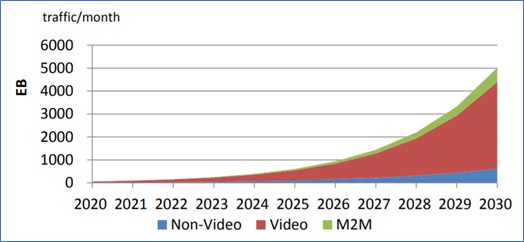
    Figure 1: Estimation of mobile traffic (in Exabyte) by different service types globally by ITU

    Such a tremendous technology evolution and corresponding end user expectations bring in a lot of challenges to CSPs.  However, I see these challenges as an ocean of opportunity, if addressed in an efficient way. Let’s explore some key related questions that need to be asked:


    2-Part Webinar Series on Intelligent Network Investment Planning

    DOWNLOAD WEBINAR RECORDING NOW!


    1. What are the primary challenges and the associated opportunities that CSPs need to address?

    Strategically, CSPs leverage capacity-driven investments to gain competitive advantage and enhance end user experience. Most of the time, such investments are highly cost intensive, both in terms of Capex and Opex. Any inaccuracies in the overall network investment planning can lead to unintended impacts on company financials and can create significant network inefficiencies. Such inaccuracies eventually impact end user experience and erode competitive advantage.

    Conventionally, capacity investment plans require substantial amounts of historical data and consumes plenty of time in stitching the data for forecasting. Most of the time, it takes multiple iterations to test different scenarios. Moreover, inputs across multiple domains often tend to be overlooked, which could lead to further increase in iterations. Collectively it makes the overall process cumbersome and brings further inefficiencies as well.

    So, the next obvious question is, how can we come up with a network investment plan which is accurate, has optimal cost, meets current & future requirements of users and gives competitive advantage over a long term?

    1. Is there a better approach to capacity management and planning?

    In my view, cross domain analytics is quintessential for an accurate and effective investment plans. Establishing seamless alignment and strong correlation between data from different domains like network, user, business, marketing and operations will give CSPs a better understanding of how consumers and enterprises are using their mobile network. It also helps them to understand how capacity can be optimized and how the user base can be segmented based on behaviour (not simply demographics).

    A strong data driven correlation between domains will help CSPs unlock hidden revenues from their networks, as well as understand which services are being used and valued (and those that are not). And most importantly, it can yield deep analytical insights for smart decision making towards future network investments.

    Figure 2: Cross domain network view

    1. What are the key enablers to achieve an efficient network investment plan?

    I believe there are 3 key pillars that can help CSPs overcome challenges in achieving an efficient network investment plan.

    Cross domain data: Cross domain historical data (in years) is one of the basic requirements to achieve an efficient plan. With perhaps billions of records flowing, the plan will need seamless big data handling capabilities which could efficiently extract relevant and meaningful attributes for analysis. An intelligent handling of abnormal values can be leveraged to get desired aggregated data as per the requirement. I call it the most basic and important step, this will lay a strong foundation for later steps in the process.

    Machine Learning: A good set of processed and aggregated data, taken as an input to train machine learning algorithms, will help in establishing the right forecasting model(s) for specific scenario(s). Such a fine-tuned model(s) can then be fed as a critical input for smart network investment plans, yielding optimized business decisions. Machine learning is a must to handle cross domain data efficiently.

    Visualization: Complex analytical outcomes can be simplified with interactive visualization. It can enable and empower decision makers to identify relevant and meaningful patterns for decision making. A strong visualization capability can further help CSPs focus on areas most likely to influence their key business objectives.

    I truly believe these enablers can bring significant efficiency in overall network investment plan process. It can help CSPs fulfil the demanding end user expectations proactively, while giving them a huge long-term competitive advantage.

    To understand more on network investment planning, join our 2-part webinar series on “Intelligent Network Investment Planning”.

    DOWNLOAD WEBINAR RECORDING NOW!

  • The 6 worst pitfalls of not having an Analytics Maturity Assessment in place

    The 6 worst pitfalls of not having an Analytics Maturity Assessment in place

    Most organizations use analytics to improve their operations to enhance business performance and growth. However, through our experience of working with telecom organisations across various geographies, we have witnessed that analytics in many cases is done in an ad-hoc manner rather than in a planned phase. This results in organisations not witnessing the kind of return they were expecting from their analytics investments. An Analytics Maturity Assessment (AMA henceforth) helps in identifying such pitfalls and avoiding them. Few of the pitfalls that AMA helps in identifying are:

    1. Data Issues & trust: The root of any analytics project is the Data element. It is important that the end user does not have any form of data trust issues when it comes to their data. Proper data capturing, storing, infrastructure design, validation etc. are important dimensions which AMA investigates with proper checks and balances based on industry standards.
    1. Lack of Clarity: The first step to having clean data comes from having a good understanding of the data. There are basic graphs, queries, questions that every data analysis requires at the start of any project. For companies to be truly data driven, a Data Analysis pack consisting of the above elements and beyond is necessary. AMA checks these points to help figure out whether the first cut is robust enough. This understanding, the results of such a pack, is essential not only for the analytics team but helps business users as well gather lots of useful insights.
    1. Lack of Business Understanding: Analytics is a means to an end and not an end in itself. The intention is to help the organization improve on its top line, bottom line and operational efficiency. This is not possible unless the analytics team has a good understanding of the business as well the business team clearly understands what analytics can bring to the table. Synergy between the two is needed for implementable outcomes. The analytics solution should answer the questions that the end user wants to know. AMA helps in avoiding this pitfall or checks the status quo by having multiple checklists such as SMEs, trainings, meetings, presentations on this dimension.
    1. Improper Implementation: After what is to be done is clear, how it is done is essential for effective implementation. Ad hoc project work and repetition of same mistakes are cost centers for organizations. There must be standard practices for project implementation.
    1. Information Asymmetry: Having to constantly reinvent the wheel is another cost factor which takes the essential time of resources. This issue is usual the result of teams working in silos and not functioning as a larger team. Often similar analytics projects are undertaken in different verticals such as say finance and operations. This is another grey area which AMA helps in identifying and avoiding.
    1. Missing dollar accountability: Many organizations do not have long term vision in place. In these cases, analytics becomes good to have but it remains just a cost center. The vision and purpose of analytics needs to should come from the top and be clearly identified and communicated. Each project’s expected outcomes should be predefined and once implemented, its ROI calculated. This is essential for the integration of analytics into the DNA of the organization for it to be able to make a string contribution to the growth story.

    Conclusion:

    It is essential for every organizations to take stock of the situation after certain intervals. It is even more important when trying to inculcate something very different and new within the organisation to bring about a mindset/cultural change. Most of organizations are investing in analytics but find using it effectively difficult. AMA helps in streamlining this change. It helps in asking pertinent questions and figuring out the change methodology. As noted above, there are quite a few pitfalls of not having an AMA for an organization, and not having an AMA in place can be expensive considering the associated risks.

    To understand more on how you can adopt an AMA within your organisation, view a recent webinar we had conducted on the topic.

    Click here to view the webinar

  • What are the 5 keys that telecom operators should explore innovative partner contracts

    What are the 5 keys that telecom operators should explore innovative partner contracts

    The telecommunications industry has been evolving over the years in this digital economy through technological innovations. The shift between the generation of networks is progressing swiftly, and that sees an impact in business use cases and the BSS/OSS systems that are part of this ecosystem. While there is a huge buzz about 5G today, the 4G rollout is still in progress in certain regions. 5G has opened a host of new business opportunities with augmented reality, self-driven cars, transforming healthcare and more. With this unprecedented pace and agility in the business, partnerships play a very significant role for Communication Service Providers (CSPs), and they need to be well equipped to manage complex wholesale contracts to succeed.

    Here are the 5 drivers for CSPs to sign contracts with innovative economic pricing models:

    • 1. Changing Ecosystem of the Telecommunications Industry

    The telecommunications industry is experiencing a radical shift in the current scenario with multiple partners in the digital ecosystem. A CSP is no longer isolated in the market, but an integral part of a vital ecosystem. They are collaborating with different vendors and partners to provide differential products, innovative content for new age digital services like on-demand audio and video streaming. All of this puts the CSPs at the crux of all the action. With robust infrastructure and ability to process data in huge volumes, this is a unique position that can be leveraged in this changing scenario.

    • 2. New League of Customers and Partners

    The changing dynamics in the industry has given rise to a new league of customers who are aggressive and precision-driven. There needs to be transparency in every aspect of the business. Contract timelines are getting shorter and demanding, while CSPs’ business models have not adapted to meet these demands.

    Partnerships are very varied, as the demand for better and more innovative content keeps growing, and this could range from a channel, a gaming company to an individual content creator. Strategic partnerships are key, and transparency is essential here as well. With non-traditional partners for these newer types on content, the business model needs to be adaptive and responsive.

    • 3. Embracing Digitalization

    Gone are those days when CSPs focus on merely exchanging rate cards among partners to bill the usage of services. Pricing has become increasingly competitive. Margins are shrinking faster than new business CAGR can grow. Realizing returns is taking a longer time than usual. So, how is the market reacting? Well, the reaction has been to explore unconventional contracts that are driven by data volumes. The complexity of rating has increased in digital contracts with tier/ slab ratings, exclusions/discounts, and commitments.

    • 4. Content is the King

    Bill Gates wasn’t wrong in the late 90s when he wrote a paper predicting how real money will be made by sharing content online. Last decade has seen massive foray by CSPs into the content space under the pretext of diversification. Few years back, NBC Universal (acquired by Comcast) and Time Warner Cable (acquired by AT&T) were seen more as a change for the video market than for telecommunication. But with new digital technology to distribute content, and not just traditional media channels, CSPs have gained prominence there. CSPs are partnering with the OTT players to provide exclusive content and niche audience services in the form of premium bundles. Operator-led OTT subscriptions have become the new business model driving the revenues through targeted customer segments.

    • 5. Rise of Edge Computing

    With billions of IoT devices expected to be in use globally in the coming years, Edge computing will play a critical role in taking the advantage of high-speed data connectivity. Partnerships will become vital with increased collaboration of vendors in the areas of edge devices like sensors, storage, compute & power, etc. CSPs will become the backbone of this network by providing the required connectivity to all partners involved in the ecosystem.

    The last 5 years have been crucial for CSPs in transforming into digital service providers, and this has opened a whole lot of new business opportunities and challenges. Digital transformation had been the buzz word in the industry for almost a decade. In hindsight, it is just an enabler and real transition happens only when organizations embrace & evolve with it.

    If you are interested in knowing more about managing complex wholesale contracts

    DOWNLOAD THE WEBINAR RECORDING NOW!

    Debolina Ray

    Debolina is a seasoned professional who specializes in Telecom Partner Settlement, Route Optimization, Interconnect Billing and Order Management/Provisioning. She has over 10 years of experience in the Telecom industry and has a vast exposure to customers from all regions. Debolina currently works as a Technical Product Manager where she manages the product management for the Cost Analytics Portfolio of Subex. She is an active contributor on various forums like Actuate, QlikTech, and is also a voracious reader and an active blogger.

  • Managing Complex Partner Agreements in the Digital Era

    Managing Complex Partner Agreements in the Digital Era

    Digitalization has opened a plethora of opportunities for Communication Service Providers (CSP) across the globe to transform their traditional service offerings, moving from telephony into content-driven businesses and reaching the status of Digital Service Providers (DSP). There is a paradigm shift in the telecommunications ecosystem with the entry of technological disruptors (like OTT players) resulting in a portfolio of services with competitive pricing models. The depletion of voice revenues and the rise of data services has changed the dynamics of business partnerships.

    The traditional telecom service provider is no longer isolated in the market and has multiple collaborations for audio, video, content, analytics, cloud, etc. Furthermore, due to shrinking margins, operators are looking forward to having contracts/agreements with their vendors and partners, which will create a win-win situation for the parties involved. According to a recent survey by TM Forum, DSPs have a revenue opportunity of around $142 billion from digital services. Whether it is AT&T acquiring Time Warner for $85.4 billion or Reliance Jio integrating with Saavn to create JioSaavn app, telcos are looking to roll out exclusive content to their end customers. Considering that there is much to gain, a DSP without a strong content offering in today’s scenario is almost unimaginable.

    A DSP often has hundreds of content provider contracts (mostly with aggregators) to manage, and there is a huge diversity of partners ranging from a garage developer to the likes of Google.

    Building success factors:

    The phenomenal surge in data consumption by subscribers and free content is driving the majority of telcos’ core businesses today. In addition to this, few telcos are partnering with OTT players to provide exclusive content and niche services in the form of premium bundles. Operator-led OTT subscriptions have become the new business model driving revenues and customer segments.
    Building Success Factors
    Source: IHS Markit

    Driving new business models – The increasing level of complexity

    Initially, rate cards were exchanged between partners for billing the usage of services. Later they entered into bilateral agreements to settle the revenues between them. Now, telcos are moving to digital contracts by partnering with content providers and other OTT players. These digital contracts involve tier/slab ratings, along with exclusions/discounts. Commitments and rating based on specific parameters have increased the level of complexity with respect to rating and charging their partners.

    Let us go through 3 types of agreements that are executed between partners these days:

    There are several agreement scenarios (deals) between the operator and content partner based on different business models. Furthermore, revenue sharing models have been evolving from fixed % based to a tier/slab-based approach across product scenarios.

    1. An agreement based on new subscriptions

    No of New Subscriptions    Revenue Share

    0 – 500                                           P %

    501 – 2000                                     Q %

    2001 and above                              Q % and additional T % for no of subs >2000

    As per the partner agreement, if new subscriptions are negative for a particular month, no pay-out will be made to the partner for that month.

    2. An agreement based on promotions

    Revenue sharing between the parties will be on a monthly basis. The promotion period can be for a few months or it can be ongoing. If the user subscribes to the content for

    Months                  Revenue Share

    1 month                         P %

    2 months                       Q %

    3 months and above      R %

    3. An agreement based on market penetration

    In this scenario, the operator is liable to share the revenue based on the penetration of subscribers in an area. The complexity involved here is that the penetration level of each market is different from the other. In addition to this, there are certain areas where the radius is defined with respect to a landmark. Subscribers within the radius will be charged a premium and accordingly the revenue share.

    In today’s competitive market scenario, partnerships have become the need of the hour for telecom operators and they are moving ahead by signing innovative and complex contracts. The above mentioned examples of digital contracts/agreements are a few models that we have recently dealt with. In the future, we will see many such models with increased complexity and innovative digital contract definitions.

    If you are interested in knowing more about managing complex wholesale contracts

    DOWNLOAD THE WEBINAR RECORDING NOW!

    Have you negotiated or signed any complex contract recently? Let us know in the comments section below. Looking for partner who can help you handle complex contact? Talk to us.
  • The growing interest in big data technologies for Fraud Management & Revenue Assurance

    The growing interest in big data technologies for Fraud Management & Revenue Assurance

    The telecommunications sector is no stranger to big data. As a premier vendor for Revenue Assurance and Fraud Management solutions, Subex is no stranger to big data too. Traditionally, our RA & FM applications process billions of transactions every single day. The past few years have been particularly demanding – with the proliferation of 4G, LTE and the upcoming 5G, data has exploded and continues to. Change seems to be the only constant.

    The bid management team, I’m part of, is a witness to the change. We are at the helm of affairs in serving our customers needs that come via an RFP.  Over the past year, we are witnessing a key ask in the RFP —

    “Does your tool comply with big data technologies like Hadoop”?

    The Trend

    Request for proposals (RFXs), are one of the modes, through which Subex periodically receives the customer requirements. A key component in Subex RA & FM solution is the database. For many years, RDBMS like Oracle, MYSQL, Vertica, have been the preferred choice for telcos. There is a new trend now – Hadoop.

    Telcos are now considering big data technologies like Hadoop. Looking into the trend of RFPs over the past years, gives an understanding of the future. The requirement for big data technologies have gone up two times in the past 2 years.

    GROWTING TREND IN BIG DATA ASK

    GROWTING TREND

    A further drill-down of the requirements is also a testimony to the changing face of RA & FM functions. Few of the key requirements taking shape are:

    • Data lake: Data lake is becoming de-facto ask. With the explosion of data volumes and data types (structured and un-structured), telcos are increasingly preferring to set-up a common data lake to feed multiple downstream systems
    • Data quality: Given the importance telcos are now placing for the quality of data, expectation is to procure systems that provide high level of data integrity and sanctity of the underlying data
    • Analytics & Machine Learning: Clearly, RA & FM functions are now including analytics, insights and pattern recognitions to their repertoire of tools at disposal to combat fraud and leakages. The RFPs are now focusing beyond transaction monitoring and entering the realm of business intelligence and machine learning

    Subex Big Data Solution

    Recognising the importance of big data and its’ relevance to the RA & FM teams, Subex started offering Hadoop as a platform of choice a few years back. Today, we are hosts to many live implementations around the world, processing billions of transactions every single day.

    Subex RA & FM solutions with Hadoop as a technology, delivers value on the 4-fronts:

    • Volume: Capability to handle large volumes of data loads and deliver at scale
    • Velocity: Forget the days of “T+n” monitoring. Real-time assurance is becoming the norm
    • Variety: Gleam insights from the good old structured to semi-structured and un-structured data, using traditional rule engines and new age ML & AI capabilities
    • Veracity: Highest quality of output with high integrity

    Big data is empowering RA & FM teams with big possibilities. To learn how you can benefit, talk to us.

  • The Road to Being Data-Driven Starts with Knowing Where You Are

    The Road to Being Data-Driven Starts with Knowing Where You Are

    The telecom world is changing, and organisations are challenged to not only grow, but to merely stay relevant.  To cope up with the fast-changing environment, organizations need to be at a certain level of maturity where the decision-making process needs to move from gut feelings to number & reasoning-based practices. The mandate here is clear: Organisations need to become data-driven or risk being left behind. However, the reality is bleak considering that nearly 100% of enterprises want to become more data-driven, but only less than a third have accomplished that goal. The starting point to being data-driven starts with being able to assess where one stands, and which is the best way to move ahead to a certain objective, a notion which continues to remain challenging for organisations.

    Almost all organisations have ventured into the woods of data analytics with a purpose to make a sense and get the best out of the huge volumes of data they have. Sometimes they ask what others (either in the same industry or across industries and academia) are doing and how they can replicate it, while at times they ask what new can be done that no one else has. To analogize the entire data analytics practice to the workings of an engine, an engine can be only as good as the sum of its parts. The parts must fit in well, the oiling mechanisms should help in friction reduction, the oil supply has to be timely and of course, the sparks need to be perfect. As many say, data is indeed the new oil and data analytics is fast becoming the engine (in this case, of growth).

    Fine tuning this engine is the need of the hour. Assessing where we stand, which directions we can move towards and where would that lead us to, what would be the best enabler to move in each direction, and how to go about doing it, is mission critical. This, in itself, is an optimization problem where maximizing returns and minimizing costs given the multiple constraints is challenging.

    Transformation is important, but to ensure true competitive advantage, organizations must transform themselves in a planned phase. The approach to analytics cannot be stochastic as it would result in more troubles than benefits. Organizations must traverse one stage at a time. Not only defining those stages is the need of the hour but also is knowing what steps one needs to take at a point of time to move from one stage to another. In this scenario, an Analytics Maturity Assessment becomes imperative.

    We have been working with customers across the globe in helping them assess their Analytics Maturity, to define the business objectives and carve out an Analytics roadmap towards said objectives, through our Subex Analytics Maturity Models. Subex Analytics Maturity Models defines those stages and the steps between those stages, through an assessment across People, Process, Technology and most importantly Data.

    To know more about why an Analytics Maturity Assessment is important, and how it can help your organisation, Schedule a Demo with us and our Subject Matter Experts will get in touch with you.

  • 5G and the dawn of “age of inventions” – Key Takeaways from MWC19! – Subex Limited

    5G and the dawn of “age of inventions” – Key Takeaways from MWC19! – Subex Limited

    I am just back from MWC 2019 and am really excited to share my thoughts. The mood at this year’s MWC was of general enthusiasm and exuberance, particularly with respect to 5G and the possibilities it opens up for telcos.

    When 3G and 4G happened telcos were slow to evolve and transform their business models. Global internet giants such as Google, Apple, Facebook made most of the mobile internet revolution in the last decade, whereas telcos saw continued pressure on margins, revenue and customer experience.

    5G is yet another chance for telcos to #makeithappen if they can get their acts together. I firmly believe telcos have learnt from their previous experiences and are much better prepared for the next wave.

    Here are my top three takeaways from MWC 2019

    1. The dawn of “age of inventions”: 5G has finally broken through the hype and we saw some groundbreaking innovations being displayed around at MWC 2019. This is after the last few years where there was, in my view, a higher degree of tentativeness. We saw low latency, reliable connectivity-based use cases such as:

    a)  Remotely operated medical surgery/ emergency medical treatment

    b)  Ushering of “second great inflection point” # in transportation with autonomous cars, cars with natural language interface, cars with cognitive interface

    We also saw several announcements in the area of IoT and Industry 4.0 with SAP, AT&T, Vodafone, Ericsson, Telstra etc. launching new solutions.

    From Subex’s point of view, these are exciting times as our IoT Security solution is well positioned to help operators, smart cities and autonomous cars by providing much needed security cover.

    2. 5G means intense Capex: While developing economies will continue to focus on monetizing 4G networks, developed economies will start rolling out 5G networks starting 2019. 5G rollouts will be Capex heavy needing massive investments in Radio Access Network with network densification, mmWave network rollouts etc. and in core network to support high speed, high capacity, low latency use-cases which 5G promises.

    Subex showcased its Network Analytics portfolio driving smart spend, smart asset management and AI/ML driven network capacity planning use cases and these were very well received by both customers and prospects alike.

    3. Digital Trust key to success in 5G: According Vittorio Colao, Ex CEO Vodafone one of the main challenges facing telcos is “the lack of a genuine customer orientation, which, if you have it, makes customers truly love your services and thereby drives value” (McKinsey Quarterly).

     As the 5G juggernaut rolls out, telcos will need to do aggressive network build outs, forge new partnerships, and offer far more critical services. Customers will expect ubiquitous connectivity of very high quality, investors will expect better management and ROI.

    All this means telcos will need to really focus on building digital trust – a mechanism that creates trust in their offerings, processes and information systems. Failure would mean yet again handing over advantage to the internet giants who already benefit from global scales, not having to invest in expensive networks, and who have shown to be far more nimble in responding to customer needs. Subex with its focus on enabling digital trust through privacy, security, risk mitigation, predictability and confidence in data, is yet again well positioned to work closely with operators in building this much needed digital trust.

    What do you think of dawn of age of invention powered by 5G? Let me know in the comments section below.

    # Mckinsey Quaterly 

    PS: Oh! Here is a bonus takeaway for those among you planning to be at MWC 2020. Wear comfortable shoes. One easily clocks 20,000 steps each day.

  • Are you 5G Assured? 4 Game-changing Business Assurance trends to evolve with 5G

    Are you 5G Assured? 4 Game-changing Business Assurance trends to evolve with 5G

    Even before we could be content with 4G and its value offerings, the 5th wave of telecom evolution is already here. Telecom giants from Middle East Asia, the Americas and the European geographies have already built their first publicly available prototypes in the 5G environment and are aggressively working towards building newer service models to drive unparalleled customer experiences. All said and done it is still in silos since the very process of conceiving the 5G ecosystem is underway. OEMs and integrators like Nokia and Qualcomm have also created enablement environments for the CSPs to progress with their 5G on-going projects.

    Release 16, one of the much-hyped releases by 3GPP aims to complete the IMT 2020 vision of building a fully functional 5G working environment is in progress. This, in turn, is going to change the entire scenario of business assurance.

    Here are four forecasts which are going to change the perception of looking at Business Assurance.

    1. Business Assurance practices will be services driven and customer focused.

    5G is a service driven architecture. The basic objective of 5G is to develop an integrated communications environment for driving scalability of services and Man-to-Machine interactions a reality. The evolution of 5G offerings, services and niches will be around 3 major value propositions as described in the IMT Vision 2020:

    • Enhanced Mobile Broadband
    • Ultra-Reliable Low Latency Communications
    • Massive Machine Type Communications

    More such use-cases can be seen in the diagram proposed by ITU-T for enabling IMT 2020 vision.


    The “switch to bill” outlook towards revenue assurance will soon be replaced by revenue enhancement and monetization of these freemium models of service delivery. With the first line of controls already being built and integrated into the BSS systems, the focus of business assurance will shift towards customer experience while maintaining the required financial bandwidth for sustenance and monetization of services offered.

    1. Managed services will converge for the OSS and BSS spaces.

    Managed services have evolved separately for OSS and BSS parts of the telecom ecosystem and have required special resources (manpower & machinery) for execution. However, that will no longer be the case. 5Gs service-oriented architecture with network slicing capabilities would cause business assurance functions to be staffed with professionals who have a sound understanding of networks and the business aspect of services associated with it. Strong data interpretation and the ability to co-relate, interpret and present a business outcome with a network performance measure would be in demand. Also, new areas such as Network Asset Assurance, Spectrum and Capacity Assurance, (which were previously on the edge) would now be an integral part of the overall business model.

    1. Use of Advanced Statistical Methods and Analytics for Assurance Practices

    5G, with its ability to support multiple service environments, will offer a great platform for the proliferation of Machine learning (ML) practices, both in the networks as well as the business domains. For example, ML may find use in enhancing self-organization feasibility through cognitive network management while in the business domain ML’s role would be to support QoS management in highly automated slicing environments.

    1. Integrated Security Practices will drive a whole new outlook for combating fraud

    Cyber-security and traditional fraud management practices, until now have had different paths of evolution. Since 5G will be an end to end IP based delivery platform, this will cause cyber security and fraud management practices in telecom to converge to counter new fraud scenarios that threaten the confidentiality, availability and security of the business.

    Bottomline Question: How do I ensure business readiness for venturing into 5G?    

    The readiness matrix for venturing into the 5G space can be broken into three major pillars:

    • Technology and Risk Readiness:

    While venturing into the new generation of technology, it must be ensured the current network and systems are not cannibalized. One good way to start with is to ensure backward technology integration. This, in-turn, will ensure seamless onboarding. It is also required to premeditate necessary risk controls (business, operational, compliance and financial) involved in the different stages of migration to quantify the overall risk appetite to arrive at basic business decision of “to be or not to be”!

    • Business Model Readiness:

    As stated earlier, the IMT – 2020 vision is to create business models best suited for the targeted customers. Depending on the existing value chain arrangements, the CSP can start identifying what kind of revenue stream partnerships can it afford to get into to roll-out services best suited to the proposed customer segment. It is suggested that in an economy that is cost-sensitive, sharing of capabilities (technology, manpower and resources) is the best way to start with.

    • Customer Readiness:
      Knowing the present capabilities, limitations, interests and desires of the customer is important and correlating these with the business model deliveries is imperative to the sustainability of the business. This not only helps the business earn more from the customer but also helps understand the changing patterns in their behavior much sooner and with visible effect.

    What to look in a 5G transformation assurance partner?

    To sum it up, it’s important to have an assurance partner that can support you in driving a technology transformation course that is so complex. The partner should be able to provide support at any leg of the transformation – from choosing the right model of delivery to helping realize monies out of it. The partner should be capable enough to drive decisions on risk treatment and help the business attain long term sustainability with an optimal amount of investment.

    Read the PoV to know about the journey of 5G and how CSPS can navigate through the hurdles.

    Download Now