Blog

  • Preserving Capex and Improving Network Efficiency – Can both go hand-in-hand?

    Preserving Capex and Improving Network Efficiency – Can both go hand-in-hand?

    As one of the largest capital line items in every telecom operator’s budget, Network Capex continues to drive large numbers every year since network augments and migrations to newer technologies are unavoidable budget items. Today operators are spending huge sums of money on new network infrastructure for advanced telecom services like LTE / 4G, IPX, etc. without adequate visibility on revenue growth. A recent survey points out 20% of the assets fail to return cost of capital and 5-15% of these network assets are ‘stranded’.

    Hence, effective capital expenditure and network asset lifecycle management are rapidly becoming a big boardroom issue for telecoms operators. This is only possible when all functions work together to maximize the returns from their investments. Both the CFO’s and the CTO’s teams in a telecoms operator should have a holistic and collaborative view on the network asset investment.

    The urgent need is to have a strategic approach to asset assurance program which manages and reduces network capex substantially. ROC Asset Assurance is different from ERP services because of its workflow and analytics elements. It can initiate workflow to ensure that all the applicable assets are procured and deployed when needed. ROC Asset Assurance helps the CFO & CTO function within the operator company to tackle the following pain-points:

    • Planning of capital spend vs budget
    • Tracking deployed assets and ROI on those assets
    • What to buy, when to buy, where to buy, and for what reason?
    • Information related to assets
    • Ensuring usage of all available assets at the utmost efficiency
    • Network resource capacity and the need to respond

    To learn how an effective asset assurance program will provide complete confidence to operators that their network will grow to meet market demands while also guaranteeing optimal value for every dollar of capital budget spent, download our newsletter: Asset Assurance –  Preserving Capex While Improving Network Efficiency featuring research from leading Analyst firm Gartner.


  • Subex User Conference 2013

    Subex User Conference 2013

    Subex User Conference 23rd and 24th Crowne Plaza, Blanchardstown, Dublin

    It is that time of year again when we look forward to our annual User Conference. It has rapidly become one of the most sought after events in the BSS calendar. Not just for the range of speakers but also for the focus on our roadmap and plans. And, of course, for a little relaxation.

    Last year we were in Vienna, a truly beautiful city. The sessions were excellent, with keynote speaker Daniel Rui Felicio, CEO, Siemens Communications, Media and Technology kicking off the proceedings. Alex Leslie, Publisher of industry blog BillingViews followed him with his ‘More Interesting Things’ in which he explored some of the more interesting trends and statistics in our industry, such as DNA that you can email and paper that is interactive. Speakers included Paul Fedarb from BT, Dan Baker from TRI in North America and our own John Brooks, who has just been named as the project leader for the TM Forum’s Asset Assurance program. To relax we were treated to a guided tour of some of the most famous buildings in Europe, followed by a traditional dinner under the city walls.

    This year we turn to Dublin, a great city. Not only will be exploring the city (and a Guinness or two) we have a great line up of speakers and topics. Our keynote speaker is Dr. Peter Cochrane, former CTO at BT and acknowledged industry visionary. We have also asked Alex Leslie back, for some ‘Even More Interesting Things’ and have added a couple of extra industry experts in the shape of Tony Poulos, Market Strategist with the TM Forum and Eric Priezkalns, Editor of revenue assurance blog, TalkRA.

    With such a line up, we can look forward to some lively debate between these often controversial figures, some excellent insights into where our industry is going and an in-depth look at what we have been busy with in the last year.

    And, as you have possibly heard, we have been very busy.

    We have, for instance, launched our Asset Assurance platform, which has been getting some attention in the media, “Take the Stranded Assets Tests! How to Maximize Time to Revenue?”. With financial control and agility being the critical requirements for CTOs and CFOs our solution gives them the tools they need (and their priorities tend to be different) to better manage their OSS assets, reducing time to revenue and allowing them to make better decisions about when to retire others.

    We have not been neglecting our other core strengths, and our ROC platform is stronger than ever. It needs to be to help our customers fight ever greater threats from fraud, whether it be at the Point of Sale or on the Wholesale front. Both are threats that stretch into the billions of dollars and need a partner that can remain up to date and as agile as ever to combat these threats.

    Our outlook is robust too. With some significant changes since we saw you in Vienna, our revenues are up, our customers and partners are happy and we have been winning some industry awards, such as the Pipeline Innovation Award for our Asset Assurance solution.

    All in all, it is has been an interesting, exciting and challenging year. We are all looking forward to seeing you in Dublin to bring you up to date, share some stories and a glass or two of wine – or Guinness – and to provide some insights which will help your teams stay ahead of the game. Our team is working hard behind the scenes to make sure it goes ahead smoothly and provides great value and benefit. We look forward to seeing you there.

    If you need more information, then please contact us.

  • How to save millions in Network Capex?

    How to save millions in Network Capex?

    Effective capital expenditure and network asset management is rapidly becoming a big boardroom issue for telecoms operators in recent times. With decreasing EBIDTA and ever increasing pressure on margins, operators can no longer afford to keep on spending heavily on capital assets and network projects with no questions asked. Yet telcos are not managing their assets adeptly, and this is something that senior management needs to address with some urgency in order to control their capital expenditure more effectively and efficiently.

    At the crux of the problem is the unfortunate reality that operators don’t have an accurate picture of what assets and network inventory they already own, let alone how these assets are being used. These problems have prompted Subex to launch ROC Asset Assurance, a service that combines inventory management with workflow and analytics so that operators can gain visibility into the complete asset lifecycle through dashboards, KPIs and reports. The solution is different from asset management services because of its workflow and analytics elements. It can initiate workflow to ensure that all the applicable assets are procured and deployed when needed. All of which means that operators should be able to and reduce their capital expenditure and manage the capacity needs of their networks with greater precision

    Here is an interesting and exciting short video on ROC Asset Assurance which provides you better understanding of the Asset Assurance space, the problems and challenges faced by global operators and how ROC Asset Assurance can help them manage and reduce network capex.

  • Network Discovery and Analytics – The Evolution (Part 2)

    Network Discovery and Analytics – The Evolution (Part 2)

    In continuation to my previous blog on Network Discovery and Analytics, which mostly revolved around  some of the core but basic functionality that a Discovery system needs to possess. In this post lets discuss some of the key challenges that discovery systems have to face when they first get deployed.

    1)      Resistance from network operations teams.

    • Network operations for example would like for the network not to be disturbed during peak traffic hours or during maintenance windows. Towards that intent, the Network operations teams would like to be confident that a discovery system can be set up such that the system will at no cost touch the network for a configured duration. The network operations team would expect to have confidence in the discovery system that irrespective of the stage at which a network polling activity is in, the activity needs to be suspended on the event of hitting a black out window.
    • Non – intrusive discovery is what a network operations team would be confident about. By non-intrusive discovery, I mean that a device which is already overloaded with respect to its resource consumption should not be further affected by querying for information to perform a discovery

    2)      Resistance from IT teams managing N/EMS systems.

    • In the event of discovery from NBI of N/EMS or from gateways that maintain stateful sessions, in a lot of situations it would be required of the discovery system to not consume more than a configured number of sessions. This may be required to make sure that other northbound OSS systems a not denied a session request from the N/EMS or gateways. It may also be because only a few NBI sessions have been purchased from the equipment vendor and using more number of sessions than purchased may lead to a contract violation or error in discovery.

    The OSS Network discovery applications have to evolve and stand up against the above challenges by introducing functionality like blackout support and network hit throttling capability.

    Moving forward to the next stage of the evolution. Tier-1 or Tier-2 operators have discovery systems deployed and use this information to keep inventories in sych with the real world. But inventories typically store services or end-to-end circuits. And what is discovered are individual components of a service or circuit which have been provisioned within a network element. It is important from the perspective of the service provider to view the current state of a circuit in the Network, compare it with the inventory to fix misalignment. This brings in the responsibility within the Discovery system to be able to assimilate service components discovered within each network element along with the network element interconnectivity information and be able to plot end to end circuits for various technologies.

    As of today,  a few tier 1 operators who are pretty mature in their process are looking towards evolving the discovery system’s capabilities to be in near real time synch with the state of the network. A system which is able to listen to traps/events from the network and refresh its database with the latest state of the network. And use the near real time discovery system to evolve the inventories to be near real time up-to-date with the reality in the network.

    It’s another thing that a lot of inventories even today are far from accurate despite a whole lot of tools out there in the market specifically designed to solve data integrity issues of Inventories. And the reason for that is the lack of a sound practice around the usage of these tools or a lack of commitment to adhere to a data integrity program or a failed OSS inventory transformation project etc

    In the interim, while operators are trying to get their inventories cleaned up we believe that the Discovery system along with intelligent and actionable analytics has a lot more to offer to the planning and service assurance teams which has been mentioned below.

    1) The discovered physical fabric can be compared and/or enriched with OSS inventories and ERP systems to build a 3600 view the asset. The 3600 view when recoded for a period of time becomes a very power source to a bunch of analytical function which would provide actionable intelligence to planning and network operation teams in helping with Capex avoidance.

    2) The discovered logical/service component information when captured for a period of time can again be a source to bunch of other analytical functions (Time series trending and forecasting, What-If modeling and optimization) to help network operations and planning teams to perform network capacity management on accurate and as discovered information.

    3) The discovered information when assimilated with topological analytics to calculate end-to-end circuits/services can be a powerful source of information to Service assurance teams to overlay alarms and generate a service impact view in their NOC.

  • Network Discovery and Analytics – The Evolution (Part 1)

    Network Discovery and Analytics – The Evolution (Part 1)

    Let us look at why OSS Network discovery systems came into existence, how they evolved over years and in our opinion the areas in which it would play a critical role going forward.

    Most Tier-1 and Tier-2 service providers have at some point in time invested in building one or more inventory system which would work as a central repository for functions like Planning, Design, Fulfillment and Assurance. For these functions to have a reliable and up-to-date view of the network, it is important that depth and breadth of information is captured by the inventory. By breadth, I mean the ability to store information from multiple device types from multiple device vendors. And by depth I mean the ability to store physical inventory and also logical inventory for multiple technologies like PDH, SDH/Sonet, DWDM, Ethernet, ATM, FR, IP, MPLS, xDSL, FTTx, 2G, 3G, LTE etc. These Inventories have largely been maintained/updated by manual data entry and in the event of weak process or lack of discipline in following processes; these systems would very quickly go out of synch with the network. And hence OSS Network discovery systems first came into existence in order to help keep inventories up-to-date with the real world. Towards this intent, OSS Discovery systems needed to take care of the following requirements.

    1) Data that needs to be acquired from the network

    • Ability to perform shallow discovery i.e. discovery of physical fabric (Physical inventory like Racks, Shelves, Cards, Ports) from most leading-class networking equipment vendors based on standards like SNMP Entity Mib-2, TMF 814 etc.
    • Ability to discover deep logical information like vlans, ip interfaces, ip subnets etc again using standard mibs (like RFC 2233, RFC 2674), MTNM etc.
    • Ability to discover inter-connectivity (PTOPO) between devices wherever possible

    2) How data needs to be acquired from the network

    • A lot of device vendors equipment cannot be discovered using standard SNMP interfaces and hence the need to be able to discover using other network management protocols like TL1, MML, CMIP, Corba, WebServices.
    • Many a times Network operations teams are not comfortable with multiple IT systems (N/EMS, Discovery, Fulfillment, Assurance etc) connecting directly to the devices for multiple reasons like worried about resource consumption on devices which may affect revenue generating traffic and access control list and login configurations on all devices need to be modified for discovery servers to access the device. This may seem like a trivial one time activity, but a few large Tier 1 operators which have strong process in place; this activity can run into a few months.

    And hence discovery systems were forced to interface with north bound interfaces of N/EMS systems or gateways in order to perform discovery. These NBI APIs on a lot of occasions end up being propriety or customizations done on standard specifications.

    For reasons mentioned above, discovery systems with ability in capturing breadth and depth in discovery have had to build a lot of device vendor specific adaptors instead of standards based adaptors.

  • Asset Assurance: Leveraging our Experience, Maximizing the Network

    Asset Assurance: Leveraging our Experience, Maximizing the Network

    Over the years we have gained a deep understanding of the culture within telcos. We are best known, through the ROC, as specialists in Revenue Assurance and Fraud Management. As such, we know how to deliver different views of the same data.

    Having successfully done this in the BSS world, we have turned our attention to the networking side of the business. Controlling costs and optimizing network capital investment are priorities for the business and managed by the CFO’s office. Optimal usage of the network assets and manage traffic effectively are under the control of the CTO’s office.

    Both offices need access to the same information but in different ways. With different priorities, sharing the same information without interpretation or tailored analytical choices would make communications between the two entities very difficult.

    A CFO needs to know how many assets are stranded and therefore not producing revenue. Right now, the status and whereabouts of only 75 percent of a telco’s assets are known. Knowing where assets are, knowing how long an asset is in place before it is revenue producing and knowing that delaying an investment for a month makes financial sense is of huge importance to a CFO.

    Understanding which assets can be re-used in other parts of the network, or which need to be retired can help the CTO with his priorities. Some assets can be effectively re-sold, so what is a retirement to the CTO becomes a possible source of revenue for the CFO.

    We believe that creating a view into network assets will benefit both offices and create a better collaboration between them. Revenue Assurance can provide a financial view of IT assets, which adds a new and effective dimension to that craft. So, too, Asset Assurance adds the tools to the network capex side of the business to actively manage it. We not only believe it, we know it. Working with one of our customers we found $17 million of stranded assets in a single week. Better yet, Asset Assurance also benefits the customer.

    Talk to a Telecoms Manager about what he would like from his telecoms provider and he will not say more accurate bills as a priority. He accepts that billing is complex and accepts that his comms bill will never be 100 percent accurate. What he would like more than anything is to know what inventory is in place in his organization, where it is, whether it is still live and whether he is paying for it. This can be discovered with Revenue Assurance tools, but now the communication providers can actively manage the whole inventory issue with the new Asset Assurance solution.

    By leveraging our experience in Revenue Assurance and Fraud Management in the OSS world, we are now proud to be able to offer solutions and expertise to operators in all of the vital parts of their business, including network. And we are already proving that this concept of asset assurance is important in managing assets more effectively and efficiently.  We also believe, like many such solutions, that we will discover uses for Asset Assurance that we cannot quite see yet. We will keep you up to date with the story as it unfolds.

  • BSS/OSS Transformation – An Assailable Phase for Telcos

    BSS/OSS Transformation – An Assailable Phase for Telcos

    “Rapid” is an understatement to describe the pace at which the telecommunications industry is evolving. A vicious circle formed between the advancement of hardware capabilities and services offered to utilize these capabilities is probably what is causing this constant evolution. With such augmentation in the services offered, migrating to next-generation operations and billing systems is inevitable to operators. While the change is definitely a thumbs-up for telcos, the flip side is the challenges inherent to the transition phase itself.
    Consider an expert chef in a successful restaurant offering a variety of dishes to customers. Quite obviously, his menu changes periodically to ensure that he caters to the constantly changing customers’ taste. While a changing menu keeps the restaurant and the chef in good business, it also brings in a big risk of cooking something unsavory in the process of creating something new. Though the chef is dexterous at what he does, it would always be a possibility that he would add that extra pinch of salt or sugar while trying out a new dish. Does this mean that the chef is not competent enough? Or should it stop the chef and the restaurant from offering newer dishes? The answer is “No”. It only goes to indicate that the transformation phase is highly vulnerable and needs to be dealt with extra caution to ensure continued success in the business.
    Equating the above analogy to the telecom sector, one would understand that the chef is the telco and the new dishes are the variety of services offered to customers. The extra pinch of salt/sugar that we spoke about is the possible leakage or frauds that can hit telcos during the phase of BSS/OSS transformation.
    A recent survey by KPMG indicates that 49% of the teclos undergoing transformation projects saw a significant increase in revenue leakage and threat of fraud while another 45% indicated a partial increase in revenue leakage and threat of fraud. Put together, a whopping 94% of operators have encountered some kind of increase in revenue leakages during the transformation phase.
    Reasons for this vulnerability are quite straight forward. The controls that existed with a set process get disrupted and start to diminish once the transformation begins, thus leaving the operators in a bit of a handicap. Another main reason would be the significant loss of data that is an innate characteristic of transformation projects. This causes blind spots in the revenue chain and keeps telcos in the dark about the leakages occurring. To add to the telcos’ woes, transformation projects are not completed in a day’s work. They may stretch to anywhere between 2-10 years depending upon the size and type of operations.
    All this points to one thing – with the breathtaking speed of change in the telecom sector, telcos have to adapt quickly and decisively or else risk even greater leakage. Revenue Assurance processes need “greater than ever” emphasis during the transformation phase. After all, no one likes extra salt in their dishes; not even a pinch of it.

  • Asset Assurance – Translating Visibility into Capital Savings

    Asset Assurance – Translating Visibility into Capital Savings

    As one of the largest capital line items in every operator’s budget, Network Capital Expense continues to drive large numbers every year.  Re-purposing fixed line and backhaul assets, moving to complete IP backbones, migrations to newer technologies (e.g., LTE), and demanding more throughput from the same asset footprint have all contributed to consistent pressure on capital, regardless of previous years’ growths and efforts.

    Each year, network capital planning and budgeting have repeatedly been baselined on factors that include:

    1. Growth planning and projections
    2. Network maintenance and replacements
    3. Decommissioning and retirement
    4. Previous year expenditures

    Each of these factors contributes valuable intelligence that help planning activities determine and set budget levels, but critical gaps are also created in the process that strand capital indefinitely.  Gaining visibility into the available capital assets, and acting on that knowledge are the primary keys to actually preserving capital, creating peak utilization efficiency, and generating the highest level of free cash flow in the business.  But what aren’t operators doing today?

    The ability to understand what capital is stranded in your network is based on visibility.  ERP systems consistently lack views into deployed assets; similarly, inventory platforms have a good (yet almost always incomplete) view into what is deployed.  What isn’t known are factors around capacity and utilization rates, lost or vacant assets, or status of all “tagged” assets.  This, coupled with a clearly orchestrated and managed retirement and resale process, positions the operator to not only “connect” data from ERP and Network sources, but to also act on that data in a way that is poised to saved the average operator tens of millions of dollars in capital expense and increase free cash, all in the first year of such a program.

    Without the ability to act, no realization of optimization and savings should be expected from any program – this is the difference between mere reporting visibility, and a program to drive the data through a lifecycle that culminates in tremendous operators gains.  This is a unique set of capabilities for any operator, and it forms a program Subex calls ROC Asset Assurance.

  • Introducing ROC Asset Assurance

    Introducing ROC Asset Assurance

    Your network has a story to tell you about wasteful Capex practices which are likely reducing your Return on Capital.   If you are like most Operators, you may not be listening.

    Much of the Telecom Industry’s recent focus has been placed on CEM and related analytics.  Certainly, customer acquisition and retention programs are critical as these drive revenue.   Network augments and migrations to new technologies are an unavoidable “price to pay” and the lion’s share of management’s attention is placed on squeezing as much revenue traffic onto pipes and spectrum as possible.

    Trouble is, EBITDA margins are being squeezed for reasons that I’m sure you are all too familiar with.  Amongst many Operators with whom Subex has spoken recently, there is a growing recognition that network costs must be better managed, but also a frustration that lack of visibility and insights undermine the ability to do so.

    As I said, your network has a story to tell you—in fact, many stories.  What’s more, it will give you critical information that your ERP or Asset Tracking system simply can’t.  Without this information, your ability to optimize Capex throughout the asset lifecycle can be significantly eroded.

    Can you answer:

    Where are my assets?

    ERPs are important for managing vendor relationships, driving supply chain process and tracking warehouse inventory. Once an asset leaves the warehouse, responsibility for tracking and managing the asset typically shifts to technical OSS’s (e.g. Network Inventory).  Data quality within technical OSS’s is notoriously poor.  As a result, assets can become stranded, under-utilized and/or lost.   Consequently, Operators spend Capex that could otherwise be avoided if existing assets were effectively harvested and redeployed.


    The Asset Lifecycle and Relative Positioning of ERPs vs. Technical OSS

    When are my assets generating returns?

    A critical capital management objective is minimizing the cash-cash cycle.  This is the interval between paying cash to a vendor, and receiving cash from a customer once an asset becomes productive (i.e. carries revenue traffic).   Each extra day in the cycle increases your cost of capital.  Reducing the cycle requires that you know the answer to:

    • How much time elapsed from the purchase of an asset until deployment in the network?
    • How much time elapsed from deployment of the asset until it became productive?

    Equipped with such time-to-value analytics, finance can better hold Network Operations accountable for any excessively long intervals.  Network Operations also has the actionable information it needs to identify and correct inefficient deployment and service delivery processes.

    Where did my assets go?

    A very common dysfunction is mismanagement of assets once they are decommissioned or retired.  Some assets remain powered but unproductive, contributing to excessive energy costs.  Others simply disappear (whether moved, shelved or pilfered) and are no longer available for re-provisioning or salvage.  A recent PwC survey found that “one half of wireline operators and over one-third of wireless operators indicated that less than 50% of their assets are currently catalogued and managed.”  Network Intelligence enables Operators to track movement of assets in the network and provides an early alert when an asset has been removed and does not reappear elsewhere.

    What assets do I need?

    A critical component of avoiding unnecessary Capex is having accurate and timely Network Intelligence to guide the budgeting, forecasting and planning process.  This is especially important for portions of the network which are most sensitive to traffic growth.  It is essential to monitor resource utilization and equip planners with metrics and trending to ensure assets are purchased when needed, where needed and for the right purpose.

    Introducing ROC Asset Assurance

    Drawing on our industry leadership in Data Integrity Management, Capacity Management, Network Discovery and Analytics, Subex is launching ROC Asset Assurance to harness Network Intelligence throughout the asset lifecycle and do for Asset Assurance what Subex has famously done for Revenue Assurance and other business optimization areas.   Look for more exciting details on ROC Asset Assurance in the days and weeks to come.

  • Wholesale carriers lost 6.12 billion dollars last year due to fraud!

    Wholesale carriers lost 6.12 billion dollars last year due to fraud!

    Subex, in collaboration with Capacity magazine, had conducted a survey on Wholesale Fraud Management which was responded by 195 diverse participants from the wholesale industry including senior executives, fraud practitioners and experts from some of the world’s largest carriers.

    Survey participants’ regional distribution can be seen in the map below:

    Fraud

    Participants’ profile in terms of revenue can be seen in the chart below:

    Fraud

    The results which were published on 13-Mar-2013 turned out to be quite staggering and an eye opener!

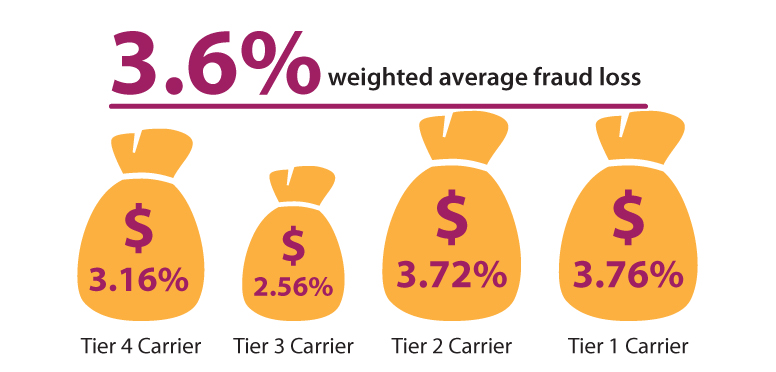
    The survey has revealed that carriers lose around 3.6% of their revenue to fraud, which if the Wholesale Carrier market is estimated to be around $ 170 Billion, translates to monetary figure of $6.12 billion per year!

    fraud-management

    Considering there is a tremendous pressure on wholesale carriers due to increased competition leading to price wars and eroded margins, losses of such high magnitude create a substantial impact on their bottom line.

    fraud

    The problem doesn’t end here. Majority of the participants (82%) have also agreed that the menace of fraud has been on the rise over the recent years and continues to grow!  Clearly, the impacts are going to be higher with time if carriers do not up their ante against fraud now.

    The report also touches and provides interesting findings over the following areas:

    • Size of the problem including prevalent fraud types in the industry currently
    • What factors are fueling the fraud growth
    • Direct and indirect impacts of fraud on carriers
    • Readiness of the carriers in combating and containing frauds
    Being a global provider of Fraud Management solutions & services and leveraging on it’s domain expertise, Subex has also provided its views and opinions over the findings which can help carriers in understand this complex and constantly increasing problem of fraud better and take appropriate measures in order to protect themselves.
    Happy reading!